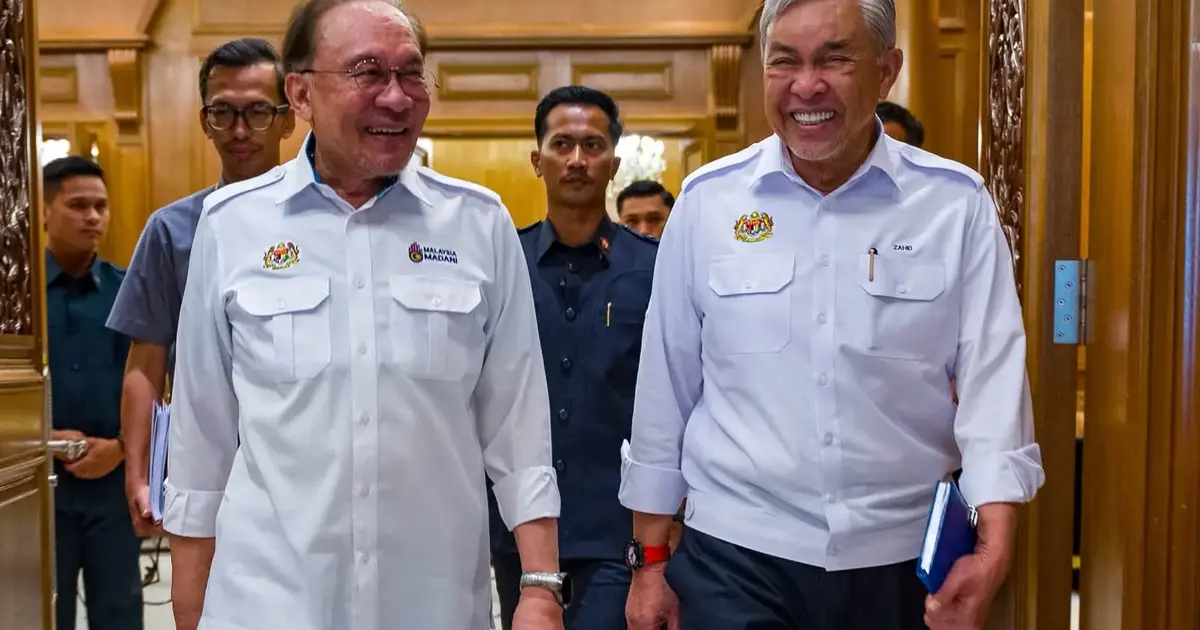
Prime Minister Anwar Ibrahim and Barisan Nasional chairman Ahmad Zahid Hamidi appeared together in convivial spirits, seemingly putting to rest the friction that had erupted between their two political camps just hours earlier over the future of BN representation in the federal cabinet.
The cordial display came in the immediate aftermath of Zahid's combative remarks the previous day, when he pointedly suggested that Anwar could remove the eight BN-affiliated ministers currently serving in government if their presence displeased him. The statement was widely interpreted as a provocative challenge to the prime minister's authority within the governing coalition, and raised questions about the stability of the PH-BN power-sharing arrangement that has held since the 2022 general election.
Zahid's aggressive posturing reflected underlying tensions within the ruling coalition. The Umno president, who leads the largest component party in Barisan Nasional, has long been regarded as a potential rival power center to Anwar's government. His willingness to publicly float the possibility of BN ministers being dismissed suggested he was willing to escalate pressure on the prime minister over matters of coalition management and resource allocation. Such declarations, even when framed rhetorically, carry significant weight in Malaysia's factional political culture, where loyalty and institutional confidence are perpetually under examination.
Anwar's decision to appear alongside Zahid with evident warmth signalled a deliberate effort to neutralize the confrontational tone that had briefly threatened to destabilize the coalition. Such public demonstrations of unity serve important symbolic functions in Malaysian politics, reassuring both the electorate and potential dissidents within the respective parties that their leaders remain committed to the governing arrangement. The prime minister's willingness to move past the inflammatory rhetoric without public recrimination suggested either confidence in his position or a pragmatic calculation that confrontation would be more damaging to government stability than accommodation.
The episode illuminates the delicate equilibrium that underpins Malaysia's current political structure. The governing coalition relies on maintaining cooperation between Pakatan Harapan and Barisan Nasional, two historically adversarial blocs whose leaders are still navigating the unwritten conventions of shared power. Each side possesses potential leverage over the other—BN through its parliamentary numbers and control of substantial party machinery, and PH through Anwar's position as prime minister and his ability to allocate ministerial portfolios and government resources. This inherent tension periodically surfaces in displays of chest-thumping and veiled threats, but typically resolves through face-saving gestures designed to preserve the coalition's functionality.
The presence of eight BN ministers in cabinet represents a crucial accommodation that keeps the coalition operational. These positions carry not only symbolic importance for BN and its constituent parties, but also provide tangible benefits in terms of government contracts, patronage opportunities, and policy influence. Any threat to these positions represents a genuine threat to BN's interests and its ability to deliver benefits to its members and supporters. Zahid's comments, therefore, should be understood as a defense of his party's institutional interests rather than merely a rhetorical flourish.
For observers monitoring coalition stability, the rapid de-escalation offers some reassurance that Malaysia's political leadership retains the capacity to manage internal disputes without allowing them to spiral into constitutional crises. However, the frequency with which such tensions surface—and the relative ease with which they can be triggered by statements about ministerial tenure—suggests that the coalition remains fundamentally fragile. The absence of a comprehensive power-sharing agreement with clearly defined terms for ministerial representation means that these matters remain perpetually negotiable and subject to reinterpretation.
The incident also reflects the broader challenge facing Anwar's administration as it attempts to govern with a slim and unwieldy parliamentary majority. The dependence on BN support means the prime minister cannot simply exercise unilateral authority over cabinet composition without risking the collapse of his government. This structural constraint severely limits his maneuverability on any issue affecting Barisan Nasional's core interests. Understanding this dynamic is essential for grasping why even pointed exchanges between Anwar and Zahid are typically resolved through rapid reconciliation rather than sustained confrontation.
Looking forward, the coalition's stability will likely continue to depend on the willingness of all parties to exercise restraint and maintain the appearance of unity, even when genuine disagreements emerge over resource distribution and policy priorities. The public performance of solidarity between Anwar and Zahid, despite their underlying differences, demonstrates that both leaders recognize the costs of coalition collapse and remain committed to the continuity of the present government. Whether this commitment will endure as Malaysia faces economic pressures and approaches the next general election remains an open question that observers across Southeast Asia are watching closely.
The episode serves as a reminder that Malaysian politics operates within a framework where symbolic gestures and public displays of harmony carry substantial weight. The capacity of senior political leaders to move from confrontation to cooperation within hours reflects both the sophistication of Malaysian political actors and the fragile nature of consensus-based governance.

