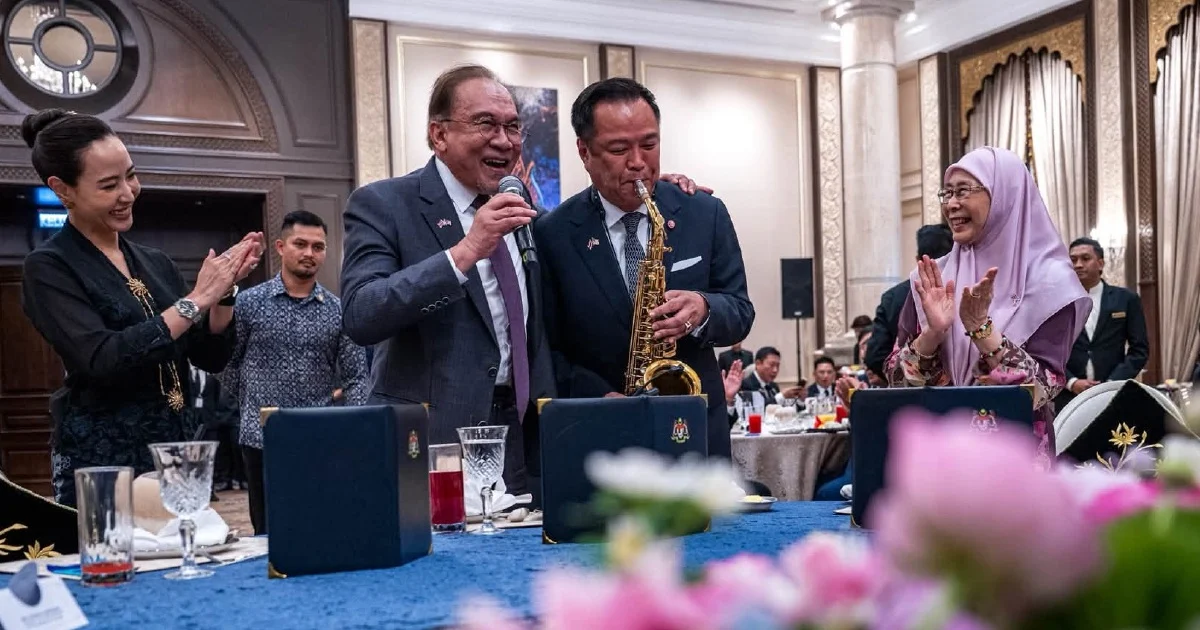
Prime Minister Datuk Seri Anwar Ibrahim and Thai Prime Minister Anutin Charnvirakul set aside diplomatic formality on Monday to deliver an unexpected cultural moment, performing Frank Sinatra's timeless classic My Way during an official luncheon in Putrajaya. The impromptu musical collaboration came shortly after the two leaders concluded their bilateral discussions, demonstrating the warming personal rapport between neighbouring Southeast Asian nations at the highest level of government.
The performance, which saw Anwar take the lead vocals while Anutin provided accompaniment on the saxophone, reflected a deliberate effort by both premiers to inject levity and human connection into their official engagement. Such informal moments during state-level visits are increasingly recognised by diplomats and observers as valuable opportunities to build trust and goodwill beyond the confines of formal negotiating tables. The choice of My Way, a song about forging one's own path with determination and integrity, carried symbolic resonance given the various bilateral and regional challenges both nations navigate simultaneously.
Thailand and Malaysia maintain complex relations shaped by deep historical, cultural, and economic ties, but also occasional friction over maritime boundaries, irregular migration patterns, and cross-border security concerns. High-level visits such as Anutin's trip to Malaysia provide crucial platforms for addressing these multifaceted issues while strengthening institutional cooperation. The luncheon setting and musical interlude suggested both leaders were intent on emphasising the collaborative spirit underlying their engagement, moving beyond transactional dealings to foster genuine partnership.
Anutin's visit to Malaysia and his willingness to participate in such a relaxed, creative moment underscores Thailand's commitment to deepening engagement within the ASEAN framework. As Thailand continues to navigate its own domestic political complexities and regional positioning, maintaining strong bilateral relationships with fellow ASEAN members remains strategically important. Malaysia, similarly invested in regional stability and intra-ASEAN cohesion, has prioritised elevating its relationship with Bangkok across multiple sectors including trade, tourism, security cooperation, and people-to-people exchanges.
The saxophone performance by Anutin added an interesting dimension to the encounter, revealing a personal interest that humanises leaders often perceived solely through the lens of political decision-making. Music and the arts serve as universal languages that transcend the formality of state protocol, and moments such as this resonate strongly in our increasingly connected world where diplomatic interactions are documented and shared instantaneously across digital platforms. The spontaneous nature of the performance, rather than a carefully orchestrated spectacle, enhanced its authenticity and appeal to observers in both nations.
For Malaysian audiences, the scene captured an intriguing facet of Prime Minister Anwar's diplomatic style—one that balances rigorous engagement with neighbouring governments on substantive matters while remaining accessible and personable. Such public displays of camaraderie with foreign counterparts carry domestic significance as well, signalling to the Malaysian public that their leaders maintain productive, amicable relationships with regional peers. This can positively influence public perception of bilateral relations and support for cross-border initiatives that require popular endorsement.
The bilateral talks preceding the luncheon almost certainly covered pressing regional matters, from trade and investment frameworks to security cooperation and the management of shared maritime resources. Thailand and Malaysia both face pressures related to climate change impacts, irregular migration, drug trafficking, and ensuring sustainable economic growth. The capacity to address these challenges hinges significantly on the quality of bilateral relations and the willingness of leaders to invest in dialogue and institutional cooperation. The casual musical moment, therefore, functioned as a capstone to substantive discussions, leaving both delegations in an atmosphere of mutual respect and shared commitment.
In the contemporary Southeast Asian diplomatic landscape, where geopolitical tensions occasionally threaten regional cohesion, moments of genuine human connection between leaders take on added importance. The My Way performance reflected a broader trend among ASEAN nations to strengthen the association's unity and relevance on the world stage. Both Malaysia and Thailand recognise that ASEAN's collective strength depends on deepened bilateral relationships amongst its members, and visits such as this serve that fundamental objective.
The incident also highlighted how cultural diplomacy continues to play a meaningful role in international relations, even in an era dominated by digital communication and formal state machinery. The shared enjoyment of music—a Frank Sinatra classic no less, a figure whose career transcended cultural boundaries—demonstrated that despite different national interests and occasional policy disagreements, regional leaders maintain a capacity for understanding and human warmth. This foundation proves invaluable when both nations must navigate complex negotiations or respond jointly to regional challenges.
For observers monitoring ASEAN dynamics and Malaysia-Thailand relations specifically, the luncheon performance offered a reassuring signal that bilateral engagement remains cordial and forward-looking. Whether the two leaders discussed specific outcomes during their formal talks remains to be seen through subsequent official statements and policy developments. However, the obvious comfort and cooperation demonstrated during their musical interlude suggests that both governments view their relationship as sufficiently robust to weather disagreements and collaborate on mutually beneficial initiatives. As regional cooperation frameworks evolve and new challenges emerge across Southeast Asia, such moments of genuine connection between leaders may prove as important as the formal agreements they sign.

