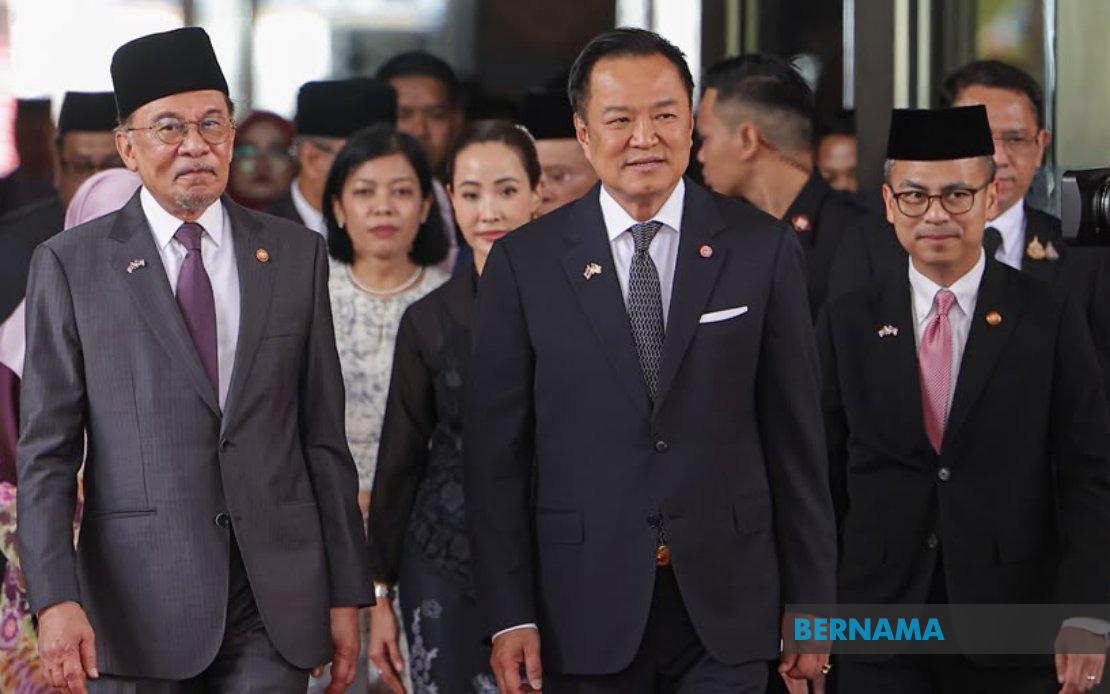
Prime Minister Datuk Seri Anwar Ibrahim and his Thai counterpart Anutin Charnvirakul commenced a significant diplomatic engagement on July 9 at the Perdana Putra Complex in Putrajaya, underscoring both nations' commitment to deepening ties across economic, security and social dimensions. The bilateral meeting, following Anutin's arrival at Kuala Lumpur International Airport at 11.11 am, brought together high-level delegations from both governments to examine the trajectory of Malaysia-Thailand relations and identify fresh avenues for collaborative advancement.
The scope of discussions reflected the breadth of the two-day official visit, extending well beyond ceremonial courtesies to encompass substantive policy matters. Trade and investment emerged as a cornerstone agenda item, given that Malaysia and Thailand maintain one of Southeast Asia's most developed commercial relationships, with each nation serving as a critical trading partner and investment source for the other. Cross-border connectivity initiatives likewise featured prominently, particularly given the strategic importance of the Malaysia-Thailand boundary spanning nearly 650 kilometres and touching multiple Malaysian states. Both leaders recognised that enhancing physical and digital infrastructure linking their economies could unlock significant economic potential for border communities and broader regional trade flows.
Security cooperation represented another weighty dimension of the bilateral framework. Thailand's significance as a gateway between mainland Southeast Asia and Malaysia makes security coordination essential for both nations, encompassing everything from counterterrorism operations to maritime surveillance and intelligence sharing. The presence of Thailand's Defence Minister Lt. General Adul Boonthumjaroen in the delegation underscored the gravity attached to this dimension, reflecting mutual concerns about transnational security threats ranging from trafficking networks to maritime piracy in the Strait of Malacca region.
Agricultural collaboration earned particular prominence during the engagement, culminating in a planned signing of a Memorandum of Understanding dedicated to advancing agricultural cooperation. This initiative holds particular resonance for Malaysia, where rural development and food security remain pressing policy priorities, especially as both nations navigate shifting global commodity markets and climate-related agricultural challenges. Thailand's expertise in rice cultivation and agricultural innovation could offer valuable lessons for Malaysian farming communities, whilst Malaysia's advances in palm agriculture and value-added food processing represent potential areas for knowledge transfer in the opposite direction.
Tourism and people-to-people exchanges formed an equally vital component of the bilateral agenda. The Malaysian delegation included Human Resources Minister Datuk Seri Ramanan Ramakrishnan, signalling emphasis on educational partnerships and workforce development programmes linking universities and vocational institutions across both nations. Thailand's inclusion of Minister of Tourism and Sports Surasak Phancharoenworakul highlighted mutual recognition that cultural tourism and experiential travel could strengthen social bonds whilst generating substantial economic returns for both economies. Cross-border student mobility, academic partnerships and cultural festivals represent tangible mechanisms through which such exchanges can deepen popular understanding and goodwill.
The composition of Malaysian attendees reflected the whole-of-government approach to the dialogue. Deputy Prime Minister and Minister of Energy Transition and Water Transformation Datuk Seri Fadillah Yusof joined Foreign Minister Datuk Seri Mohamad Hasan, Transport Minister Anthony Loke, Minister of Agriculture and Food Security Datuk Seri Mohamad Sabu, and Home Minister Datuk Seri Saifuddin Nasution Ismail. Additionally present were Minister of Investment, Trade and Industry Datuk Seri Johari Abdul Ghani and Economy Minister Akmal Nasrullah Mohd Nasir, collectively representing the strategic pillars of Malaysia's national development agenda and illustrating how bilateral relations intersect with domestic priorities.
Thailand's delegation equally demonstrated high-level commitment, with Deputy Prime Ministers shouldering portfolios in foreign affairs, transport and finance. The inclusion of Sihasak Phuangketkeow as Deputy Prime Minister and Foreign Minister signalled Thailand's intent to elevate the diplomatic relationship, whilst the presence of Finance Minister Ekniti Nitithanprapas suggested substantive discussions around investment frameworks and financial cooperation mechanisms. Thailand's Minister of Agriculture and Cooperatives Suriya Juangroongruangkit and Minister of Labour Julapun Amornvivat further reinforced the sectoral breadth of engagement, touching on domains critical to both nations' socioeconomic trajectories.
Regional architecture, particularly ASEAN-centric frameworks and mechanisms, constituted an important dimension of the broader strategic conversation. Both Malaysia and Thailand hold significant influence within Southeast Asia's premier regional organisation, and their bilateral relationship inevitably shapes collaborative approaches to regional challenges ranging from economic integration to maritime security and climate adaptation. The bilateral meeting provided an opportunity to align positions on pressing ASEAN agenda items and coordinate approaches to international developments affecting regional stability and prosperity.
The planned signing of the agricultural Memorandum of Understanding represented more than symbolic gesture; it embodied commitment to concrete collaborative projects addressing shared development challenges. Malaysian policymakers have increasingly recognised that agricultural modernisation, value chain integration and sustainable farming practices require regional cooperation, whilst Thailand's position as one of the world's premier rice exporters and agricultural innovators makes partnership mutually beneficial. Such agreements typically establish working groups, facilitate technology transfer, enable joint research initiatives, and create frameworks for trade facilitation in agricultural products.
The subsequent official luncheon hosted by Anwar for Anutin and his delegation provided opportunity for more informal discussion beyond the structured bilateral format, often where candid exchanges occur and personal relationships deepen. Such occasions frequently prove diplomatically valuable, allowing leaders to discuss sensitive matters, explore creative solutions to contentious issues, and build the interpersonal rapport that facilitates smoother bilateral relations across subsequent administrations and policy cycles.
For Malaysia and Southeast Asia more broadly, strengthening Malaysia-Thailand bilateral relations carries strategic implications extending beyond the immediate bilateral dyad. A robust Malaysia-Thailand partnership strengthens ASEAN cohesion, enhances regional capacity to address transnational challenges, and demonstrates the tangible benefits of deepened integration within Southeast Asia. As both nations navigate evolving global geopolitical dynamics and economic transitions, their bilateral relationship serves as an anchor for regional stability and a model for how neighbouring developing economies can harness cooperation for mutual prosperity and shared security.

