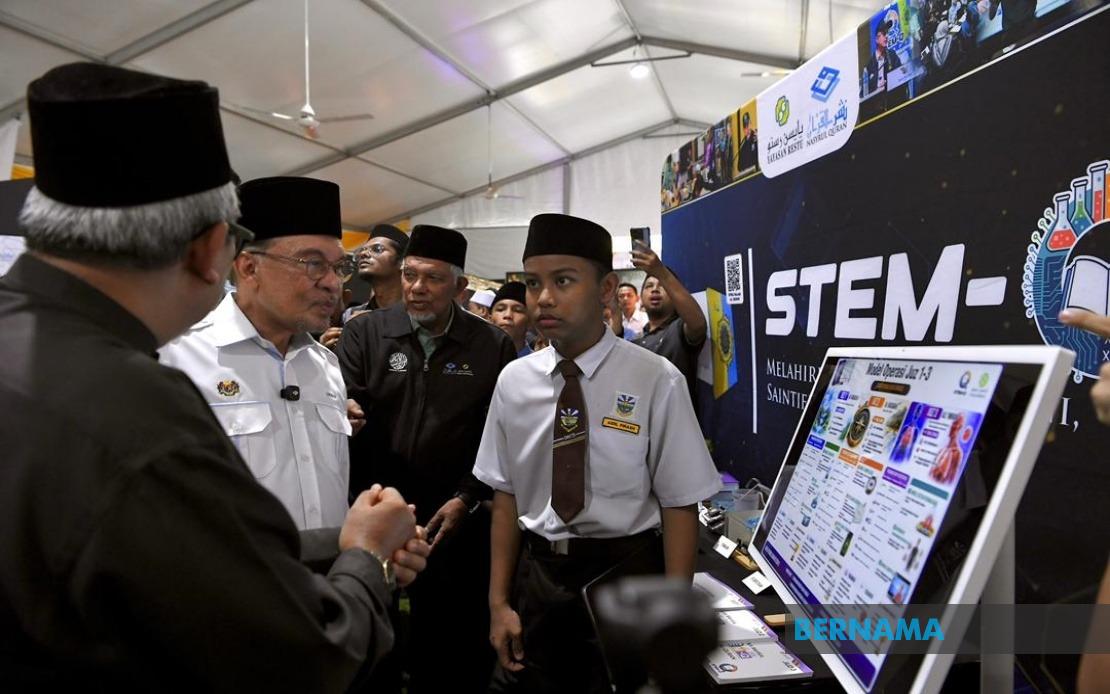
Prime Minister Datuk Seri Anwar Ibrahim announced on Friday that the government has sanctioned an additional RM4.6 million this financial year to boost infrastructure improvements across 27 Islamic educational institutions in Penang. The decision reflects a substantially expanded commitment to religious education in the state, with the funding envelope nearly tripling from RM2.11 million allocated in the previous year for upgrading work at just 11 institutions.
Anwar, who simultaneously holds the Finance Ministry portfolio, detailed the scope of the investment during remarks delivered at the National Tadabbur Perdana and Maidah Wanita MADANI Permatang Pauh programmes at Masjid Muhajirin in Butterworth. The projects funded by this allocation encompass a diverse range of physical and structural enhancements deemed critical to creating better learning environments for students and teachers at these institutions.
The breadth of the upgrading works demonstrates the government's multifaceted approach to strengthening Islamic education infrastructure. Resources will be directed towards fortifying and constructing perimeter barriers, refurbishing madrasah facilities, enhancing primary and secondary school campuses, constructing dedicated kindergarten structures, and establishing new tahfiz academies dedicated to Quranic memorisation programmes. Such investments underscore recognition that adequate physical infrastructure serves as a foundation upon which quality religious education can be built.
Beyond brick-and-mortar improvements, Anwar signalled the government's intention to maintain sustained focus on the evolving needs of community-based religious schools and formally established Islamic educational institutions nationwide. This commitment aims to strengthen the overall ecosystem of religious education delivery, recognising that institutional capacity requires ongoing investment and refinement across multiple dimensions.
In remarks that extended beyond immediate funding announcements, the Prime Minister addressed the integration of modern technology into Islamic studies curricula. He acknowledged that artificial intelligence and digital tools present opportunities for advancing Quranic scholarship and deepening engagement with Islamic knowledge domains. However, Anwar tempered this enthusiasm with a crucial caveat about values-based implementation. He stressed emphatically that technological deployment in religious education must remain anchored to robust ethical frameworks and sound moral reasoning.
Anwar articulated a concern resonating throughout contemporary policy discussions about technology governance: the risk that artificial intelligence systems, if developed and applied without principled constraints, might facilitate knowledge transmission devoid of moral grounding. His position reflects a distinctly Malaysian perspective on balancing modernisation with cultural and religious values—a tension particularly acute within societies navigating rapid digitalisation while maintaining strong faith-based institutional structures.
The Prime Minister's emphasis on values-driven technology adoption carries particular significance for Malaysian Islamic educational institutions facing pressure to modernise pedagogical approaches. Rather than uncritical embrace of artificial intelligence tools, Anwar's framework suggests selectivity informed by Islamic principles and educational philosophy, ensuring technological change reinforces rather than undermines the moral formation objectives central to Islamic education.
Beyond infrastructure and technology considerations, Anwar encouraged broader community participation in strengthening Islamic understanding through grassroots programming. He advocated for expanded public initiatives centred on Quranic interpretation circles, contemplative learning sessions focused on reflecting upon revealed texts, and community lectures featuring religious scholars and educators. Such programmes, he argued, serve essential functions in deepening societal comprehension of Islam's authentic teachings and countering misconceptions or distortions that might otherwise take root.
The initiative reflects governmental recognition that Islamic education extends beyond formal classroom settings into community spaces where laypeople and scholars engage in collective learning. Supporting infrastructure for madrasahs and tahfiz academies alone cannot suffice if complementary civilian engagement remains underdeveloped. Anwar's vision encompasses a more holistic ecosystem where institutional capacity and community initiative reinforce one another.
For Malaysian policymakers and stakeholders tracking governmental priorities regarding religious education, the announcement signals sustained commitment despite competing budgetary pressures and development priorities across other sectors. The near-tripling of Penang's allocation year-on-year suggests this commitment may extend to other states, though specific expansion timelines remain unclear. Regional Southeast Asian observers noting Malaysia's approach to reconciling religious education development with technological modernisation may find instructive lessons in the government's emphasis on ethics-grounded innovation implementation.
The funding allocation also reflects political importance placed on Penang as a significant economic and demographic centre within Malaysia. Enhanced Islamic educational infrastructure across the state may serve broader objectives of strengthening social cohesion and community resilience in an increasingly diverse urban environment. Religious institutions functioning as educational anchors require adequate facilities to serve their constituencies effectively, a principle transcending partisan political considerations.

