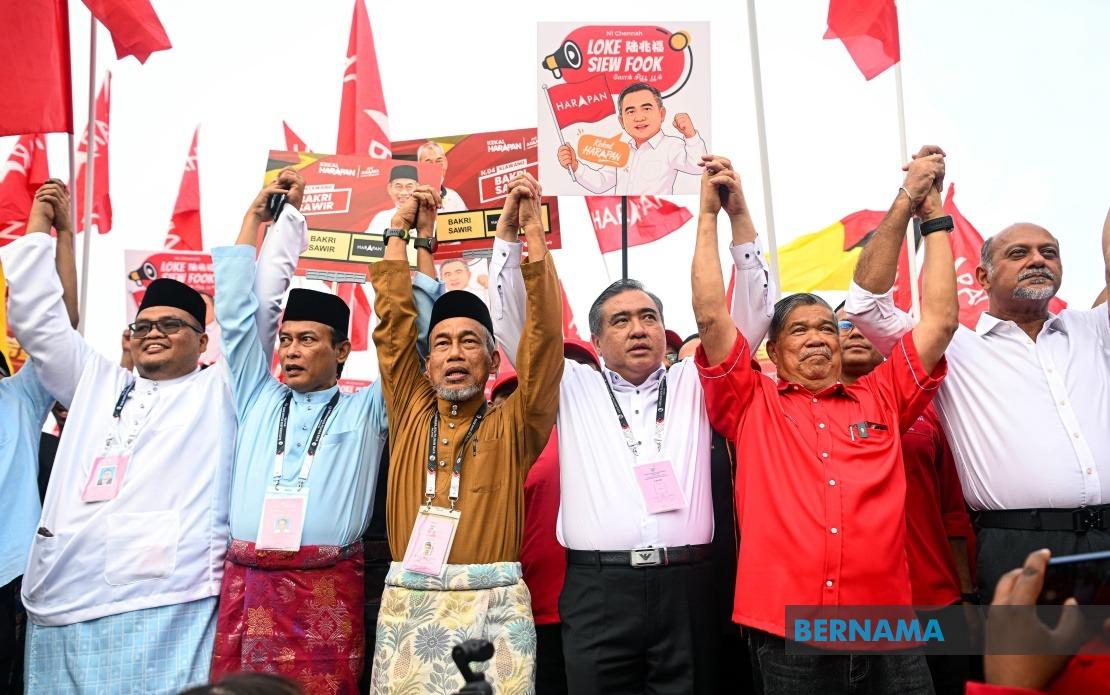
Transport Minister Anthony Loke, the DAP secretary-general who has represented Chennah since 2013, is bracing for a competitive defensive battle in the 16th Negeri Sembilan state election after registering his candidacy on nomination day. The returning officer for Jelebu Parliamentary constituency, Abdul Rahim A Aziz, confirmed a straight contest between Loke and Siow Kong Choon, the state MCA Youth chief standing as the Barisan Nasional standard-bearer, following the close of nominations at the Dewan Besar Kuala Klawang in Jelebu.
Loke, who simultaneously serves as Member of Parliament for Seremban, submitted his nomination papers at 9.05 am, with his BN challenger following nine minutes later at 9.09 am. The stage is thus set for a direct matchup in what promises to be one of the more closely watched contests in the state election campaign. This development reflects the intensifying political rivalry in Negeri Sembilan as both coalitions mobilise their resources ahead of voting day.
The outcome of the Chennah seat carries symbolic importance beyond its immediate constituency boundaries. Loke's position within the DAP hierarchy, combined with his ministerial responsibilities in the federal government, means that any change in representation would signal broader shifts in political momentum within the state. His previous electoral performance established a formidable baseline against which his challenger must now mount a competitive campaign.
In the previous 2023 Negeri Sembilan state election, Loke dominated the Chennah contest with a commanding performance. He accumulated 5,888 votes, establishing a cushion of 2,200 votes over his nearest rival, Perikatan Nasional candidate Rosmadi Arif. That decisive margin reflected strong grassroots support within his constituency, though the political landscape has shifted considerably in the intervening period as the state navigates new coalition alignments and shifting voter preferences.
The choice of Siow Kong Choon as BN's challenger represents a deliberate strategic selection by the coalition. As state MCA Youth chief, he brings organisational experience and party machine support, yet he enters the race as a relative newcomer to state-level electoral competition. This contest thus features an incumbent with demonstrated electoral prowess against a candidate representative of MCA's effort to reclaim ground in Negeri Sembilan after years of fluctuating fortunes.
Malaysia's political geography has been redrawn in recent years through a combination of coalition realignments and voter realignments. The 2023 state election marked a particular inflection point, and the 16th state election must be understood within this context of continuing political flux. For DAP, holding Chennah becomes part of a larger equation involving the party's overall performance in Negeri Sembilan and its ability to sustain the Pakatan Harapan-led state government.
The Election Commission has structured the state election timeline with early voting scheduled for July 28, providing a two-week window for the main campaign period. Polling day is set for August 1, giving candidates limited but concentrated time to mobilise supporters and articulate their platforms. This compressed timeframe typically favours incumbents with established party machinery and voter recognition, though energised opposition campaigns can still generate decisive momentum.
The broader context of Negeri Sembilan state politics involves multiple constituencies and a complex arithmetic of seats that will determine the overall composition of the state assembly. While individual contests like Chennah capture media attention and reflect national-level political struggles, the state election outcome ultimately depends on aggregated performance across numerous contests. This particular rematch between Loke and Siow therefore assumes importance as a bellwether race indicating whether existing political alignments are holding or shifting.
For Malaysian observers monitoring DAP's electoral trajectory, the Chennah contest provides early evidence of whether the party can consolidate support following the challenges and adjustments of its 2023 performance. Similarly, BN's choice to mount a serious challenge here suggests confidence in its competitive position, even as the coalition navigates its own internal dynamics between component parties and the ongoing evolution of Malaysian political competition more broadly.
The voter demographics and socioeconomic composition of Chennah will significantly influence the campaign tenor and likely determine the decisive factors in voters' minds. Urban-rural divisions, economic concerns, and local development issues typically intersect with national political narratives to shape electoral choices at the state level. Both campaigns will necessarily calibrate their messaging to resonate with Chennah residents while also reflecting their respective parties' broader strategic positioning.

