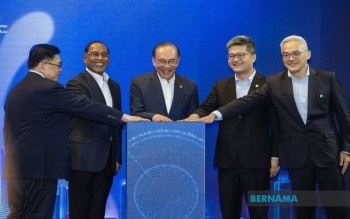
Prime Minister Datuk Seri Anwar Ibrahim has welcomed Ant International's decision to establish its Global Operations Centre in Kuala Lumpur, framing the move as a strategic advancement of Malaysia's ambitions to position itself as a leading digital and artificial intelligence destination in Southeast Asia. Speaking at the inauguration of the payments and fintech provider's regional hub, Anwar underscored that the investment transcends a mere corporate milestone, instead representing a meaningful contribution toward building local technological capacity and employment opportunities across the nation.
Anwar articulated a vision of progress rooted in inclusive economic principles, arguing that innovation initiatives must prioritize broad-based benefits rather than serve narrow commercial interests. He emphasized that sustained growth depends upon ensuring communities across all socioeconomic strata participate meaningfully in technological advancement, positioning the Ant International investment as emblematic of people-centric development rather than corporate enrichment alone. This framing reflects Malaysia's broader strategic pivot toward harnessing fintech and AI capabilities as engines of inclusive prosperity.
The Prime Minister directed critical attention toward systemic imbalances within the global financial architecture, observing that traditional banking institutions, while instrumental in capital mobilization, have historically perpetuated inequities that disadvantage smaller economies and entrepreneurs in the Global South. He highlighted how this disparity becomes particularly pronounced in emerging markets, where financial systems remain heavily oriented toward supporting multinational corporations whilst offering limited access to capital for small and medium enterprises. Ant International's operations in Malaysia represent a counterweight to this structural inequality.
Anwar emphasized an emerging shift in Malaysia-China bilateral relations centered on reducing reliance upon the US dollar in trade transactions. The proportion of Malaysia-China commerce conducted through local currencies—the yuan and ringgit—has expanded substantially from five percent to eighteen percent of total trade volume, a development Anwar characterized as mutually beneficial. This monetary realignment, though the US dollar maintains dominance in financial transactions, reflects broader geopolitical and economic reorientation reshaping regional commerce and offering greater autonomy to participating nations.
The Prime Minister articulated cautious optimism regarding artificial intelligence adoption whilst simultaneously advocating for institutional safeguards protecting against concentrated technological power. He warned that large language models and other advanced AI systems must remain subordinate to human oversight, ensuring that decision-making authority never devolves entirely to machine processes. This balanced perspective acknowledges AI's transformative potential whilst prioritizing preservation of human agency and accountability within critical institutional frameworks.
Ant Group chief executive officer Cyril Han positioned Malaysia as an ascendant regional center for digital innovation and AI research, emphasizing the imminent transformation expected from agentic AI systems within six to twelve months. Han articulated that Malaysia must prepare infrastructure and workforce capacity to harness this technological revolution productively, linking commercial growth with broader social development objectives. He affirmed Ant's commitment to supporting Malaysia's AI Nation 2030 initiative and the broader national digitalization agenda, signaling long-term institutional presence and investment.
The Global Operations Centre has already generated approximately 1,500 employment positions within Malaysia's fintech sector, with more than half concentrated in technology-focused roles underpinning artificial intelligence, digital payments, small-medium enterprise digitalization, and fintech innovation. This employment profile demonstrates that Ant International's Malaysian operations concentrate on advanced technical functions rather than back-office administrative work, creating higher-value positions aligned with skills development priorities. The distribution reflects strategic decisions to position Malaysia as a center for sophisticated technological work rather than routine processing functions.
Remarkably, approximately fifty percent of Ant International's technology workforce comprises fresh university graduates recruited from over thirty Malaysian institutions, establishing the company as a significant employer of early-career professionals. This recruitment pattern, enabled through formal collaboration with the Malaysia Digital Economy Corporation, systematically channels emerging talent from tertiary education into fintech roles whilst simultaneously developing Malaysia's digital talent pipeline. Such arrangements create symbiotic relationships between private sector technology companies and the higher education ecosystem, addressing longstanding concerns regarding skills mismatches between university curricula and industry requirements.
The Ant International hub thus represents a multidimensional strategic asset for Malaysia's economic future. Beyond immediate employment generation, it anchors regional AI and fintech expertise within Malaysian jurisdiction, strengthens partnerships with technological leaders in Asia, and demonstrates tangible progress toward the government's AI Nation 2030 vision. For regional readers, the development signals that Malaysia is transitioning from peripheral positions within global technology value chains toward genuine innovation leadership, whilst maintaining commitment to inclusive economic principles and human-centered technological governance.

