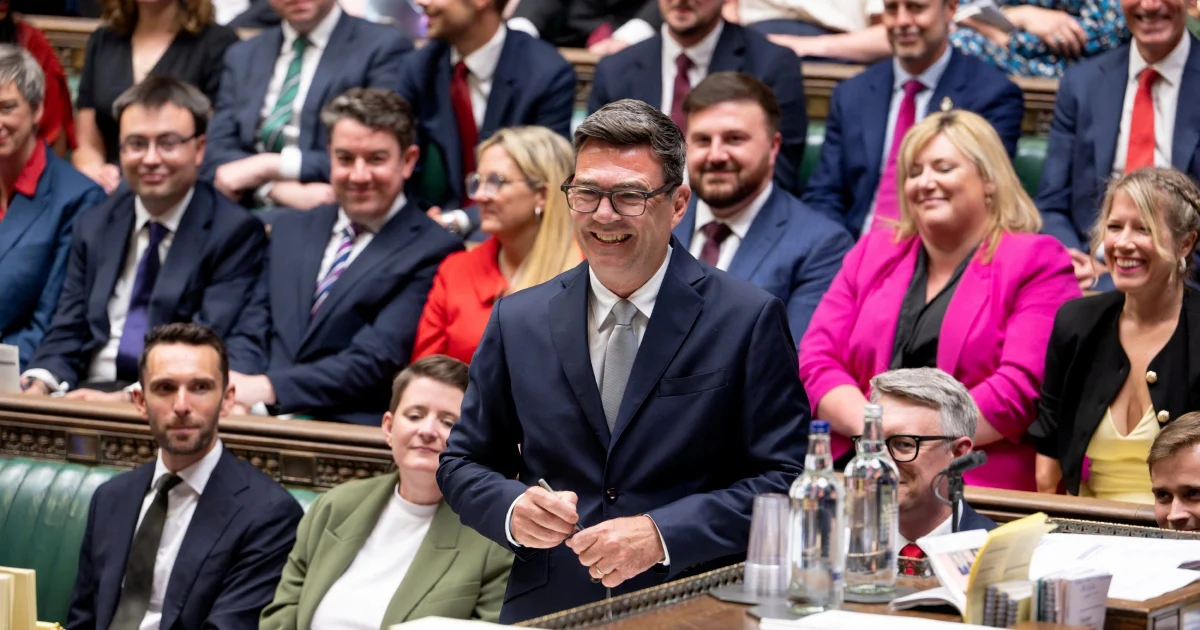
Andy Burnham emerged as the strongest contender to become Britain's next Labour prime minister after Keir Starmer announced his resignation, receiving a roaring reception in parliament on Monday. The Greater Manchester mayor, who has cultivated a reputation as an advocate for the nation's economically disadvantaged regions, is now positioned at the forefront of a succession battle that will reshape the country's political landscape. His ascension signals a potential shift in Labour's direction, with implications for how the party addresses regional inequality and devolved governance across the United Kingdom.
Burnham's path to national prominence has been distinctly unconventional. Rather than remaining in Westminster, he deliberately stepped back from the House of Commons to lead Greater Manchester, a strategic move that allowed him to build a compelling political brand based on tangible achievements outside the capital. Over the past decade, he has positioned himself as the champion of the North, mobilizing communities around issues of health inequality, transportation infrastructure, and economic development that London-based politicians frequently overlook. This geographic pivot has paradoxically strengthened his credentials for higher office by demonstrating his commitment to practical governance and regional concerns.
The timing of Starmer's departure creates an unprecedented opportunity for Burnham to consolidate support among Labour MPs and party members. Unlike previous leadership contests dominated by factional divisions, this succession race occurs at a moment when the party is searching for fresh direction and renewed credibility after recent electoral difficulties. Burnham's northeastern credentials and track record of working collaboratively with local authorities give him distinct advantages over other potential candidates, particularly among the party's grassroots membership and MPs representing economically struggling constituencies.
Burnham's political profile reflects a careful balancing act between traditional Labour values and pragmatic regionalism. His consistent advocacy for devolution and metro-level governance autonomy resonates strongly with voters in post-industrial communities who feel neglected by Westminster-centric policymaking. By championing local control over budgets, health services, and transport networks, he has demonstrated an understanding of how economic opportunity clusters develop at regional rather than purely national levels. This approach addresses a genuine weakness in British politics: the persistent imbalance between London's prosperity and the stagnation affecting much of the Midlands, North, and Wales.
For Malaysian and Southeast Asian observers, Burnham's emergence illuminates broader challenges facing Westminster democracies. The concentration of political and economic power in single metropolitan centres—whether London, Kuala Lumpur, or Bangkok—creates persistent regional resentment and governance inefficiency. Burnham's emphasis on devolving decision-making authority offers an alternative model, though implementing such changes requires fundamentally restructuring how central governments allocate resources and authority. His rise suggests that electorates increasingly demand politicians who understand local contexts rather than delivering one-size-fits-all policies from capital cities.
The parliamentary reception Burnham received underscores his considerable backing among Labour MPs, many of whom represent constituencies facing similar economic challenges as Greater Manchester. This groundswell of support reflects recognition that the party must reconnect with working-class and middle-income voters who have drifted towards other parties in recent elections. Burnham's leadership would signal a deliberate refocusing on industrial regions and manufacturing communities, reversing years of perceived Westminster indifference to North-South inequality. Such repositioning could realign British politics around geographic and class divisions rather than ideological factional disputes.
However, Burnham's leadership ambitions face substantial obstacles. Competing candidates may emerge from other wings of the Labour party, potentially fracturing the succession. Additionally, his record managing Greater Manchester during the COVID-19 pandemic and subsequent devolution negotiations will receive intense scrutiny, with opponents highlighting any perceived failures or broken promises. The media will closely examine his previous ministerial tenures, searching for ammunition against him. International observers should note that even frontrunners in British leadership contests frequently encounter unexpected complications as campaigns develop.
The broader significance of Burnham's candidacy extends beyond Labour's immediate fortunes. His potential elevation to prime minister would represent vindication of the devolution experiment that has characterized British governance since the late 1990s. Rather than viewing devolved authorities as subordinate to Westminster, a Burnham administration would likely treat metropolitan mayors and regional governments as genuine partners in national policymaking. This transformation could accelerate the decentralization of power that Scotland, Wales, and Northern Ireland have demanded, forcing England to finally develop genuinely autonomous regional structures.
For regional economies across Southeast Asia, Burnham's potential success offers instructive lessons about political representation and economic development. Cities and regions that can articulate distinct policy agendas and secure genuine fiscal autonomy tend to outperform those entirely dependent on capital-city approval. Whether in Malaysia, Thailand, Indonesia, or the Philippines, mayors and regional leaders who accumulate political capital and demonstrate effective governance create leverage for negotiating with central governments. Burnham's trajectory from Westminster MP to regional powerbroker illustrates how geographic repositioning can paradoxically increase national political influence.
The Labour succession contest will unfold over coming weeks, with formal candidate nominations, hustings, and membership ballots shaping the outcome. Burnham's early dominance suggests he remains the likeliest victor, but British politics has repeatedly surprised observers with unexpected turns. Regardless of the final result, his emergence as frontrunner has already influenced the discussion about Labour's future direction, ensuring that regional inequality, devolution, and geographical balance will feature prominently in the party's platform and policy commitments going forward. The contest will reveal whether Britain's electorate genuinely demands greater representation for its economically disadvantaged regions or whether London's political and cultural dominance will persist despite persistent voter discontent.