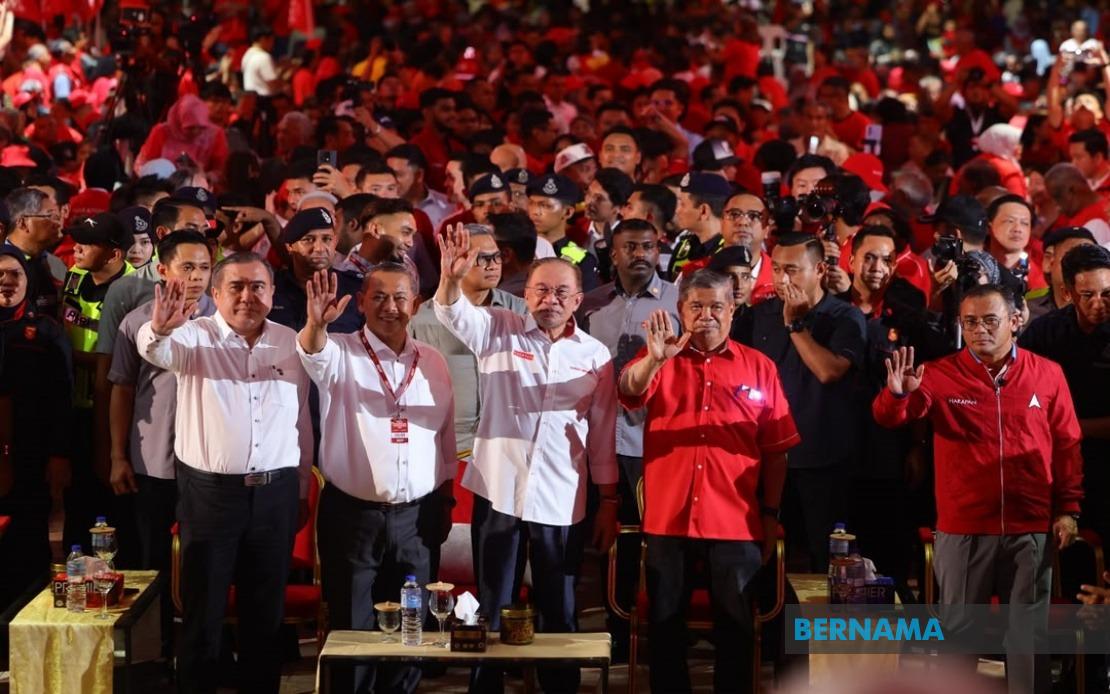
Datuk Seri Aminuddin Harun, heading Pakatan Harapan in Negeri Sembilan, has made an urgent appeal to the electorate to grant the coalition a fresh mandate in the forthcoming 16th state election, arguing that continuity of government is essential for safeguarding the state's trajectory. The Negeri Sembilan PH chairman outlined his case during a candidate announcement ceremony in Kuala Pilah on July 14, contending that political predictability remains vital for maintaining the confidence of investment communities while preserving the flow of programmes and support measures benefiting ordinary Negeri Sembilan residents.
At the heart of Aminuddin's pitch lies a governance argument that echoes across Malaysian politics: a stable state administration provides the bedrock upon which economic growth and public welfare improvements can be constructed. He emphasized that since the 2018 transition, his administration has honoured numerous election promises, sustained various incentive initiatives, and witnessed measurable improvements in state performance precisely because the government has avoided the disruptions inherent in frequent changes of administration. This framing attempts to persuade voters that the risks of electoral uncertainty outweigh potential gains from an alternative administration.
The coalition's welfare agenda featured prominently in Aminuddin's remarks, with specific attention directed toward educational assistance programmes and the distribution of complimentary tablets to students. These initiatives reflect a deliberate strategy to demonstrate tangible delivery on commitments affecting households directly. Beyond education, the state government has maintained a range of welfare schemes, and Aminuddin positioned continued re-election as the mechanism through which these programmes could persist without interruption or dilution under a different political arrangement.
Economic data served as a cornerstone of the coalition's campaign messaging. Aminuddin cited Negeri Sembilan's success in attracting RM19.1 billion in investments as evidence of investor confidence in the current administration's stewardship. This figure carries particular weight in a state where foreign and domestic capital remain crucial for employment creation and fiscal health. The implication embedded in this claim is that changing government might risk sending negative signals to potential investors who have come to regard the current political environment as predictable and conducive to business.
Another significant metric highlighted was the dramatic expansion of zakat collections within the state, which has grown from approximately RM80 million to nearly RM200 million during Aminuddin's tenure. This more than doubling of Islamic almsgiving revenue demonstrates increased economic activity and rising household incomes, while also enabling greater charitable disbursements to vulnerable populations. The expansion underscores how economic dynamism and religious obligations intersect in Malaysia's social fabric, with strong zakat collection functioning as both a social safety net indicator and a proxy for broad-based prosperity.
Critically, Aminuddin stressed the necessity of harmonious cooperation between state and federal authorities to realize development schemes effectively. This emphasis reflects the complex reality of Malaysian federalism, where state governments depend substantially on federal transfers, infrastructure coordination, and policy alignment to deliver results. The message implicitly warns that electing an opposition state government opposed to the federal administration could create gridlock and delay crucial projects, a concern particularly acute given Malaysia's experience with divided governance producing inefficiencies.
DAP secretary-general Anthony Loke, also present at the ceremony, reframed the Negeri Sembilan contest as the coalition's opportunity for redemption following its disappointing performance in the recent Johor state election. Loke's language—describing Negeri Sembilan as PH's "second round" and explicitly acknowledging that the Johor outcome "was not in our favour"—reveals a coalition conscious of momentum loss and determined to arrest declining fortunes. His call to rebuild coalition momentum suggests internal anxiety about the broader trajectory of Pakatan Harapan's electoral appeal across the nation.
Loke's exhortation that Negeri Sembilan remains PH's "home ground" carries geographic and political significance. The state has been a traditional stronghold for the coalition, making any loss here particularly damaging symbolically and electorally. Should Pakatan Harapan fail to retain Negeri Sembilan, it would signal a troubling erosion of its support base beyond isolated state contests, potentially hastening a broader realignment in Malaysian politics toward rival coalitions. Conversely, victory would provide a narrative of recovery and renewed viability.
The coalition's emphasis on unified campaign machinery across component parties—with Aminuddin remaining the designated Menteri Besar candidate and "commander" of the Negeri Sembilan operation—underscores efforts to project cohesion and coordination. Loke's repeated invocation of party discipline and respectful conduct, including specific references to honouring royal institutions and state customs, responds to sensitivities around DAP's secular positioning within a coalition operating in Malaysia's Muslim-majority context. These warnings about proper decorum reflect awareness that campaign missteps or perceived disrespect toward constitutional monarchy or Islamic institutions could provide ammunition to rivals seeking to mobilize opposition voters on communal lines.
The Negeri Sembilan election thus emerges as more than a routine state contest. For Pakatan Harapan, it represents a crucial test of whether the coalition possesses sufficient organizational capacity and voter support to prevent further erosion of state governments following Johor's setback. For Malaysian voters, it offers an opportunity to evaluate whether the administration's investment figures and welfare expansions translate into lived improvements in quality of life. The outcome will likely shape perceptions about which coalition possesses momentum heading toward future federal elections, making Aminuddin's call for a fresh mandate fundamentally about national politics articulated through the lens of state governance.

