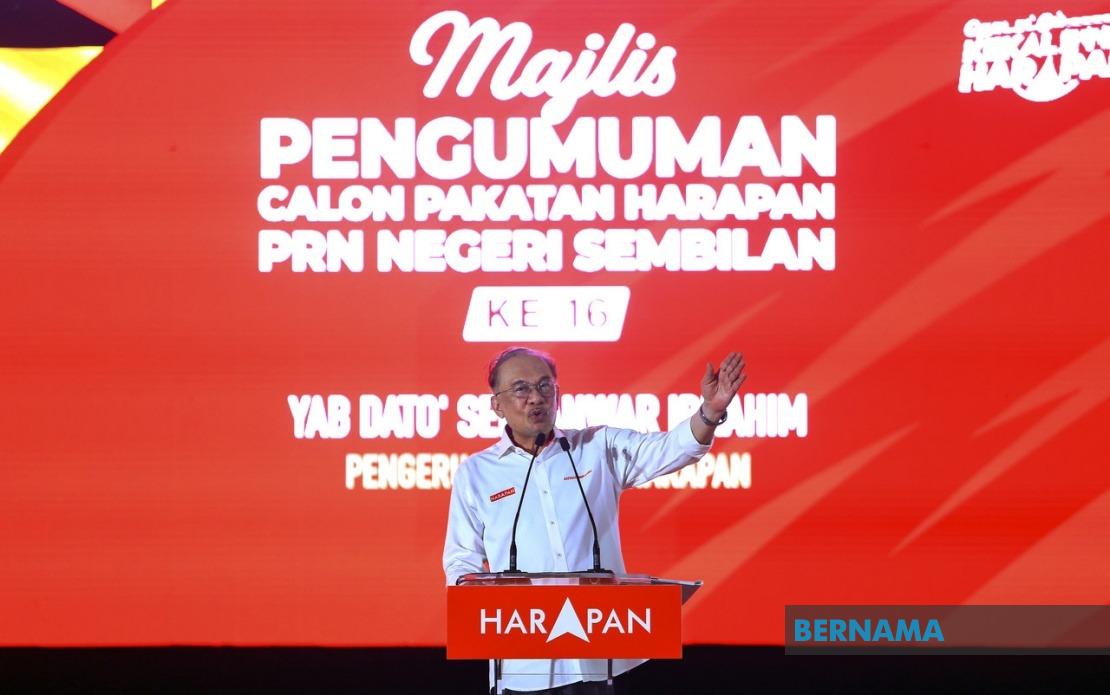
Prime Minister Datuk Seri Anwar Ibrahim has formally announced Pakatan Harapan's candidacy strategy for the 16th Negeri Sembilan State Election, positioning two heavyweight political figures in contrasting battlegrounds. Negeri Sembilan Menteri Besar Datuk Seri Aminuddin Harun will represent the coalition in the Linggi state seat, marking a strategic shift in his electoral base after more than a decade of representing a different constituency. The announcement came during a major coalition rally in Kuala Pilah, drawing thousands of party supporters and senior leadership figures.
Aminuddin's candidacy represents continuity in executive leadership within Negeri Sembilan's PH-led government, even as the party strategically repositions him across district lines. Since 2008, the Menteri Besar has successfully retained the Sikamat state seat through four consecutive electoral cycles, building a formidable political machinery and constituency presence. His move to contest Linggi signals either demographic shifts in voting patterns that favour PH in that area, or a deliberate effort to strengthen the coalition's hold beyond traditional strongholds. As PH's state chairman alongside his Menteri Besar role, Aminuddin carries the party's institutional weight into this contest, making the Linggi seat a potential bellwether for PH's overall performance in the state election.
Equally significant is the reconfirmation of DAP secretary-general Anthony Loke's candidacy in Chennah, where the veteran politician has maintained an unbroken electoral streak since 2013. Loke's longevity in this seat underscores both his personal political appeal and DAP's consolidated strength in this particular constituency. His continued presence in Chennah provides continuity for the PH coalition in a state where DAP traditionally performs well, particularly among urban and suburban voters. The decision to retain Loke rather than seeking higher office or repositioning him elsewhere demonstrates the coalition's confidence in his grassroots infrastructure and electoral viability.
The candidate announcement ceremony itself projected significant organisational capacity, with Malaysia's ruling coalition marshalling not only its top-tier leadership but also mobilising substantial community participation. The presence of Amanah president Datuk Seri Mohamad Sabu reflected the tripartite nature of PH's structure in Negeri Sembilan, where PKR, DAP, and Amanah share responsibility for governance. Communications chief Datuk Seri Fahmi Fadzil and election director Datuk Seri Amirudin Shari's attendance underscored the campaign's professional coordination and the coalition's intention to fight comprehensively across all battlegrounds.
For Malaysian political observers, the timing and composition of this announcement carries implications beyond Negeri Sembilan's boundaries. The state election occurs within a broader national political context where PH continues navigating internal coalition dynamics while defending its record in state governments. Aminuddin's repositioning and Loke's retention both serve to signal internal cohesion—that the coalition has settled its candidate selection process through consensus rather than fractious negotiation. This matters because Negeri Sembilan, with a population of roughly 1.1 million people, represents a micro-scale test of how the PH coalition functions under electoral pressure.
The Linggi seat historically carries political significance in Negeri Sembilan's electoral geography. By fielding the sitting Menteri Besar there, PH has effectively declared this constituency a priority battleground. This strategic choice suggests the coalition either faces unexpected vulnerability in a seat it previously held comfortably, or is making a calculated offensive move to expand its geographic reach. Either reading carries weight for understanding the coalition's confidence levels heading into the state election.
Aminuddin's electoral history prior to the 2008 election and his performance across four consecutive state elections provides him with exceptional experience in navigating Malaysian electoral dynamics. His ability to retain Sikamat despite various political upheavals—including the 2020 political realignment, internal coalition tensions, and changing demographic patterns—demonstrates resilience and effective constituency management. Whether these qualities transfer to the Linggi context remains an open question, particularly if the seat harbours distinct demographic profiles or established incumbent opposition.
The announcement also reflects broader strategic thinking within PH regarding state-level governance versus electoral representation. By maintaining Aminuddin in his Menteri Besar role while shifting his constituency base, the coalition ensures executive continuity while attempting to strengthen its assembly representation. This dual focus—preserving institutional capacity while competing vigorously for additional seats—shapes how PH intends to contest the election across multiple fronts.
Anthony Loke's position as DAP secretary-general and his Chennah candidacy further illustrate the interconnection between party organisation and electoral competition. As the party's second-highest official position, Loke's continued electoral success in Chennah serves symbolic purposes beyond his individual constituency—it provides visible proof of DAP's ability to retain voter confidence while the party grapples with national-level responsibilities. For DAP members and supporters, particularly in Peninsular Malaysia, Loke's re-election would signify sustained grassroots viability amid changing political winds.
The coalition's evident organisational readiness, demonstrated through the large-scale candidate announcement event, signals that PH has moved beyond the selection phase into active campaign mode. The deployment of multiple senior figures and the mobilisation of thousands of supporters represents significant resource commitment, suggesting that internal agreement on candidates has been resolved and the coalition is pivoting toward the electoral campaign proper. This matters for Negeri Sembilan voters who will now witness a presumably well-coordinated, two-front PH campaign across multiple constituencies and demographic groups.

