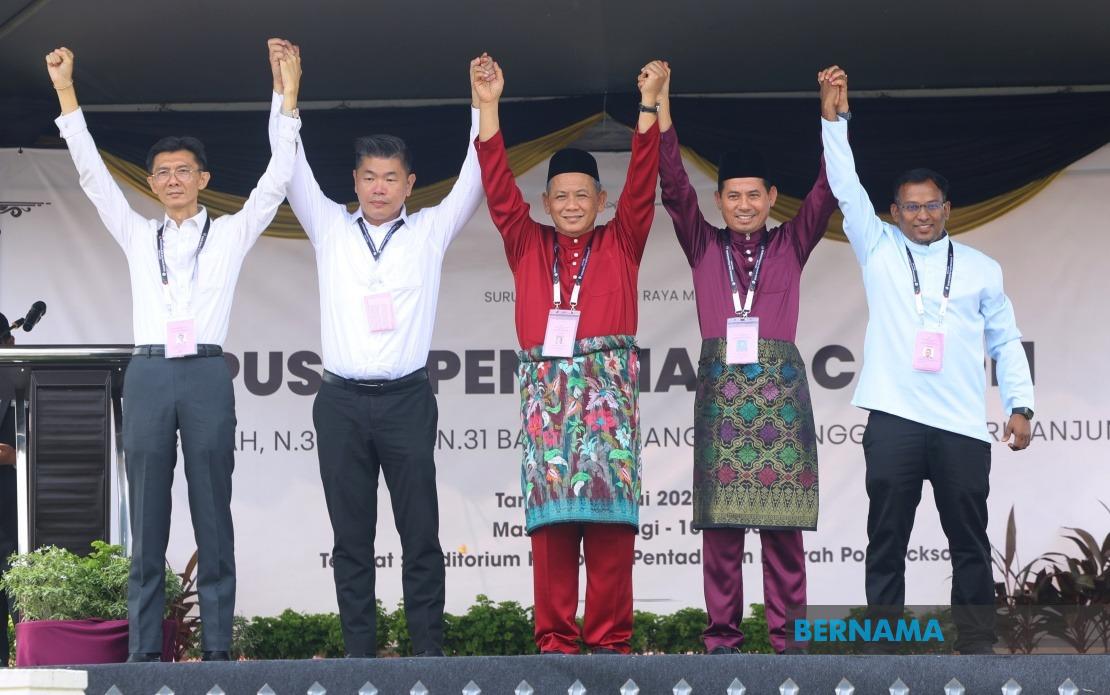
Datuk Seri Aminuddin Harun, Menteri Besar of Negeri Sembilan, has declared ambitious infrastructure ambitions for the Linggi state constituency, promising the construction of a commercial port and industrial estate should Pakatan Harapan secure victory in the forthcoming 16th state election. Speaking at the nomination process held at the District Administration Complex Auditorium in Port Dickson on July 18, Aminuddin positioned these major development projects as central to a comprehensive economic transformation strategy designed to elevate living standards and unlock fresh opportunities for residents across the constituency.
The proposed port and industrial complex would represent a significant departure from current economic patterns in Linggi, traditionally dependent on agricultural and service sectors. Industrial zones of this scale typically attract manufacturing operations, logistics hubs, and export-oriented enterprises, potentially generating substantial employment opportunities for the local workforce. For a constituency in Negeri Sembilan, a state historically focused on palm oil, cocoa, and rubber production, such diversification could broaden revenue streams and reduce vulnerability to commodity price fluctuations that periodically disrupt rural economies across Malaysia.
Amiuddin, who leads the Negeri Sembilan chapter of Pakatan Harapan, indicated that this development blueprint originated from his personal initiative, subsequently endorsed by party leadership. His characterization of the undertaking as contingent on divine favour—"God willing, there will be a port and an industrial area"—reflects the political custom of attributing electoral outcomes to celestial providence while simultaneously underscoring the gravity of the contest ahead. The rhetorical framing suggests both confidence in the proposal's popular appeal and acknowledgment of the formidable challenge mounted by an entrenched rival.
Contesting in Linggi places Aminuddin directly against two opponents: Datuk Mohd Faizal Ramli, the incumbent Barisan Nasional assemblyman, and Datuk Zamri Md Said, fielded by Bersatu as a splinter candidate. This three-way contest complicates Barisan's traditional dominance in the constituency, potentially fracturing the coalition's voter base. For opposition strategists across Southeast Asia watching Malaysian state elections, such triangular contests often signal weakening incumbent grip, particularly when credible alternatives emerge from coalition defectors. Aminuddin's confidence in the PH machinery rests partly on this fragmentation, though he acknowledges that unseating an entrenched BN bastion demands sustained organisational effort and persuasive messaging beyond infrastructure promises alone.
The Menteri Besar's public acknowledgment that Linggi represents hostile terrain for Pakatan Harapan—widely regarded as unassailable BN territory—demonstrates political candour rarely seen in Malaysian campaign discourse. Rather than dismissing the difficulty, he explicitly confronts it, framing his candidacy as an act of personal bravery necessary to advance the opposition coalition's regional standing. This rhetorical strategy transforms what might otherwise appear as a futile gesture into a principled stand, potentially resonating with voters fatigued by establishment politics or sympathetic to multi-party competition.
Mohd Faizal's measured public response, calling for a campaign devoid of "excessive provocation, slander or baseless allegations," indicates that Barisan remains alert to the possibility of losing what it has long regarded as a safe seat. His caution suggests internal concern about voter sentiment in the constituency, possibly triggered by dissatisfaction with incumbent performance, infrastructure neglect, or broader swing against the coalition evident in recent Malaysian electoral cycles. The incumbent's appeal for civility, while couched in democratic language, effectively signals Barisan's recognition that it cannot assume automatic victory.
The timing of this contest within the broader 16th Negeri Sembilan state election, scheduled for August 1, places Linggi within a larger narrative of Malaysia's political realignment. State elections offer voters opportunity to experiment with opposition governance without affecting federal structures, creating space for protest voting or desire for political competition. Negeri Sembilan, as a relatively compact and economically significant state located in the Klang Valley's orbit, commands particular attention from national political movements seeking to demonstrate momentum and capability at sub-federal levels.
From a Southeast Asian perspective, the emphasis on port and industrial development reflects broader regional trends toward infrastructure-driven electoral competition. Throughout the region, voters increasingly evaluate leaders based on tangible development delivery rather than purely ideological distinctions. Aminuddin's platform directly targets this expectation, presenting specific, investment-oriented projects as electoral reward for supporting Pakatan Harapan. Whether such promises prove implementable or merely aspirational remains to be determined; however, their articulation demonstrates how contemporary Malaysian opposition messaging has evolved from protest-focused critiques toward constructive alternative visions of governance.
The geographic significance of Linggi merits consideration for Malaysian business and development circles. Located in Port Dickson, a port town with existing maritime infrastructure and proximity to Kuala Lumpur, the constituency possesses inherent advantages for port expansion and industrial clustering. A viable port facility could potentially serve as competitor or complement to Port Klang and Port of Tanjung Pelepas, affecting regional logistics patterns. Such infrastructure, if realised, would reshape Negeri Sembilan's economic positioning and potentially influence cross-strait investment and trade flows within the peninsula.
For Malaysian voters monitoring the election, Aminuddin's detailed promise regarding specific projects distinguishes his campaign from typical broad pledges of development or governance improvement. Such precision invites scrutiny—critics may demand feasibility studies, financial projections, and implementation timelines. Conversely, specificity enhances credibility compared to vague assurances, potentially appealing to pragmatic constituents seeking demonstrable commitment rather than rhetorical flourish. The challenge for Pakatan Harapan involves converting infrastructure enthusiasm into sufficient electoral margin to overcome Barisan's traditional structural advantages in rural and semi-rural constituencies.
The August 1 polling date approaches rapidly, compressing the campaign window into an intensive two-week period during which all three candidates must mobilise supporters, conduct grassroots outreach, and persuade persuadable voters. For Aminuddin, the task involves overcoming decades of Barisan dominance while simultaneously differentiating Pakatan Harapan from Bersatu's competing claims. The outcome in Linggi will offer insight into whether development-focused opposition messaging, combined with incumbent vulnerability and coalition fragmentation, proves sufficient to alter electoral patterns in constituencies long considered impregnable bastions of the ruling coalition.

