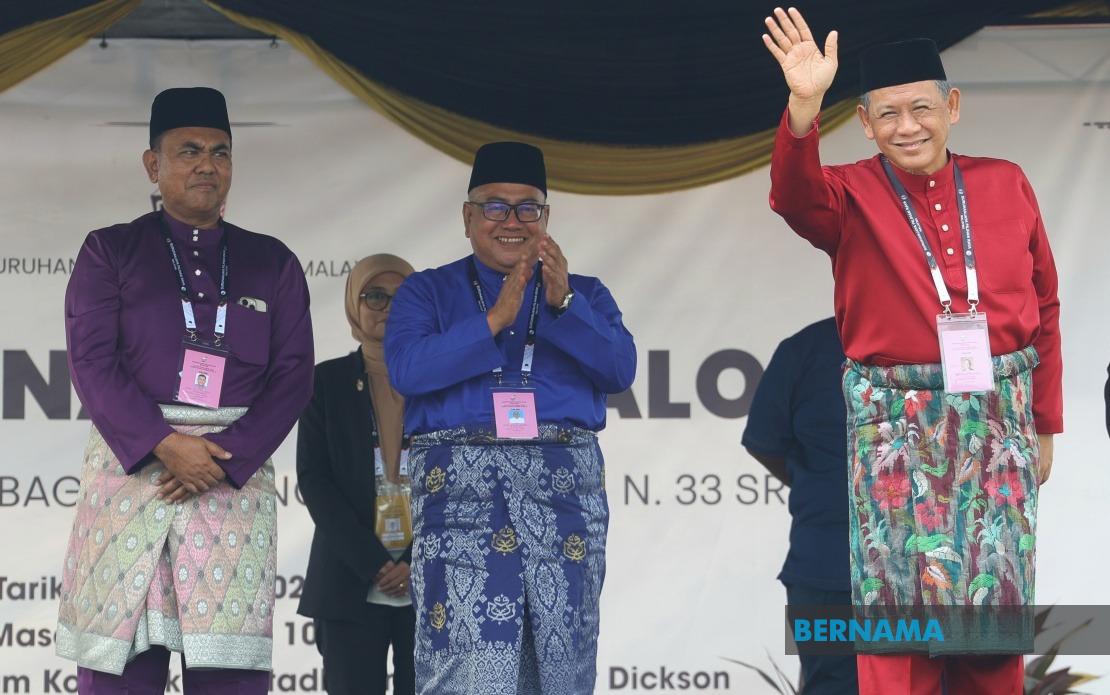
The political landscape in Negeri Sembilan is set for a fierce contest on August 1, with Menteri Besar Datuk Seri Aminuddin Harun of Pakatan Harapan preparing to defend his position in a complicated three-way race for the crucial Linggi state seat. The nomination process concluded on July 18 with returning officer Nurhazelin Makli confirming that Aminuddin's main challengers will be Barisan Nasional's Datuk Mohd Faizal Ramli, the current seat holder, and Datuk Zamri Md Said representing Bersatu, setting the stage for what promises to be one of the most closely watched battles in the 16th state election.
The tri-partite showdown in Linggi carries significant implications for Negeri Sembilan's political direction. As the incumbent Menteri Besar seeking re-election in his home constituency, Aminuddin faces the difficult task of consolidating his Pakatan Harapan support while managing the disruption posed by Bersatu's candidacy—a challenge that reflects broader fragmentation within Malaysia's political landscape since the 2020 general election. The involvement of a former ruling coalition partner in a three-way contest suggests lingering tensions over resource allocation and representation within the state's voting blocs.
Beyond Linggi, the state election will determine the composition of the Negeri Sembilan assembly across multiple constituencies with similarly complex contests. In Sri Tanjung, incumbent Pakatan representative Dr G. Rajassekaran must contend not only with Barisan Nasional's A. Achutan but also with Bersatu newcomer Leevineshwaraan Murugan, indicating that the party-switching dynamics affecting national politics have thoroughly penetrated state-level races. The three-way configuration appearing across multiple seats suggests that voters will face more fragmented choices than in previous electoral cycles.
The Lukut constituency presents a different configuration, where Pakatan Harapan incumbent Choo Ken Hwa squares off against Perikatan Nasional's Sathes Kumar Nilameham and independent candidate Teo Seng Lee. The emergence of independent candidates in several contests reflects growing voter dissatisfaction with established party structures, or alternatively, the willingness of local personalities to challenge party political machinery. This independent element could prove decisive in close races where traditional party loyalties have weakened.
In Bagan Pinang, PAS retains control through incumbent Abd Fatah Zakaria, who now faces competition from Pakatan's Nasir Raman and Bersatu's Sheikh Junaidy Jamaludin. This particular contest highlights the complex realignment within Islamist politics, as PAS maintains the seat while competing rivals seek to capture dissatisfied voters. The three-way battle reflects broader uncertainty about which coalition can convincingly appeal to the constituency's electorate in the current political environment.
The Chuah seat represents a simpler contest, featuring only Pakatan incumbent Yew Boon Lye and Barisan Nasional's Pau Jeou Ching in a straight fight. Such two-way races, while less common across this election, provide voters with clearer choices and may produce more decisive outcomes. The relative absence of a third major challenger in Chuah suggests different political dynamics or stronger incumbent entrenchment compared to constituencies experiencing three-way contests.
The Election Commission has scheduled polling for August 1, with early voting permitted on July 28 to accommodate military and police personnel and their families. The commission has confirmed that 889,490 voters are registered to participate, comprising 867,151 ordinary voters alongside 16,884 military voters and 5,455 police voters. This substantial electorate—accounting for every registered voter in Negeri Sembilan—means that turnout and campaign effectiveness will significantly influence final outcomes, particularly in constituencies where margins are expected to be tight.
The incorporation of military and police voters into the electoral process underscores a distinctive feature of Malaysian state elections, as uniformed personnel and their families constitute a meaningful proportion of eligible voters in several constituencies. This demographic factor has historically influenced campaign strategy and messaging, as political parties calibrate their positions on security, governance, and public service delivery to resonate with this particular segment. The relatively high proportion of service-related voters in Negeri Sembilan may amplify their collective impact on results.
From a broader Southeast Asian perspective, Negeri Sembilan's state election reflects the wider democratization challenges confronting Malaysia's federal system. The proliferation of three-cornered contests across multiple constituencies suggests that Malaysian voters increasingly face fragmented political choices, with traditional two-coalition battles giving way to more complex multi-party scenarios. This fragmentation mirrors developments in other regional democracies grappling with the decline of stable party systems and rising voter volatility.
The Menteri Besar's contest in Linggi assumes added weight because it simultaneously functions as a referendum on Pakatan Harapan's governance record in the state and on Aminuddin's personal political standing. Should the incumbent be pushed to third place or face a narrow margin, it would signal potential problems for the coalition's ability to hold the state in the absence of substantial improvements in public satisfaction. Conversely, a comfortable victory would bolster Pakatan's narrative of maintaining support despite competing political pressures.
The election campaign period leading to August 1 will test each coalition's ground organization and message effectiveness in an increasingly crowded political marketplace. Pakatan Harapan must mobilize its core support while defending against the dual challenge from Barisan Nasional's establishment infrastructure and Bersatu's opportunistic positioning. For BN, the campaign represents a chance to reclaim ground lost in 2018 while managing perceptions of the coalition's renewal. Bersatu, meanwhile, seeks to capitalize on voter frustration and position itself as an alternative force capable of attracting crossover support from existing coalition voters.
As nomination day concluded and formal campaign activities commence, Negeri Sembilan voters face a significantly more complex electoral landscape than in previous state contests. The emergence of multiple challengers in key seats, combined with the participation of independent candidates, reflects genuine political uncertainty about the state's future direction. The August 1 election will ultimately reveal whether Malaysian voters embrace this fragmentation as offering greater choice or view it as creating undesirable instability in state governance.

