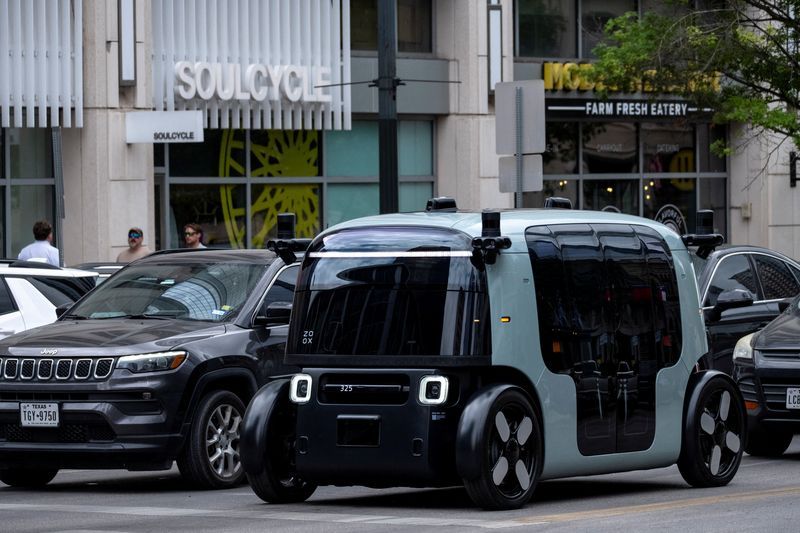
Amazon's autonomous vehicle subsidiary Zoox took a major step forward this week by launching its first paid robotaxi service in Las Vegas, marking the real-world commercialisation of a fully driverless ride-hailing platform. The announcement comes just days after the United States' National Highway Traffic Safety Administration granted Zoox formal approval to deploy its autonomous vehicles without human safety drivers, a regulatory milestone that validates the technological maturity of the company's self-driving system and opens the door for commercial expansion across multiple American cities.
Zoox's entry into the paid ride-hailing market intensifies an already crowded competitive landscape where technology giants are racing to establish dominance in autonomous mobility. Alphabet's Waymo has already secured a substantial head start, operating paid driverless services across several major metropolitan areas, while Tesla has begun rolling out its autonomous taxi service. The competition now extends beyond mere technological achievement to encompass real-world service delivery, customer acquisition, and the race to achieve profitability in this capital-intensive sector. For Southeast Asian observers, this American competition foreshadows the inevitable arrival of autonomous ride-hailing technology in the region, with Singapore and Malaysia likely to become key testing grounds given their sophisticated regulatory environments and developed urban infrastructure.
The Las Vegas launch will see Zoox pricing its service at rates comparable to the premium "comfort" tier offered by conventional ride-hailing platforms such as Uber and Grab, typically commanding fares approximately 20 to 40 percent higher than standard services. The company has structured its pricing model around a transparent base fare combined with time and distance calculations, with any additional fees such as airport surcharges disclosed upfront to passengers. This approach attempts to address consumer concerns about hidden costs and unpredictable routing, a persistent pain point in traditional ride-hailing. Notably, Zoox has committed that passengers will not incur additional charges if the robotaxi selects a route longer than originally anticipated, removing a friction point that has plagued human-driven services and representing a competitive advantage in customer perception.
Zoox's distinctive vehicle design sets it apart from competitors attempting to adapt conventional automobiles for autonomous operation. The company's purpose-built electric carriage features two rows of inward-facing seats, creating a social travelling experience quite different from traditional taxi configurations. This design choice reflects intentional thinking about passenger comfort and the user experience of autonomous travel, suggesting that manufacturers increasingly view robotaxis not merely as transportation conveyances but as premium mobility experiences. The vehicle's clean-sheet engineering also represents a philosophical departure from competitors who have begun with existing platforms, potentially offering advantages in efficiency, safety integration, and long-term scalability.
The NHTSA approval represents a watershed moment for the autonomous vehicle industry, as Zoox became the first ride-hailing company to receive an exemption from federal regulations mandating human controls in commercial vehicles. However, this approval carries meaningful constraints and conditions. The regulatory clearance permits deployment of up to 2,500 vehicles during each of the next two years, effectively staging the company's growth within a controlled framework that allows federal authorities to monitor performance and safety outcomes in real-world conditions. Furthermore, NHTSA imposed additional reporting obligations on Zoox, requiring detailed disclosure of incidents including crashes and instances where vehicles stop inappropriately on roadways, creating an unprecedented transparency requirement that will generate valuable data for ongoing regulatory assessment.
Despite receiving regulatory approval, Zoox continues facing scrutiny over its safety performance in complex traffic environments. The company has issued multiple software recalls during the past two years, most significantly a July 2024 update necessitated after one of its robotaxis failed to properly detect dense smoke at an emergency scene. This incident highlights a persistent challenge in autonomous vehicle development: the ability to interpret unusual environmental conditions and respond appropriately to safety-critical scenarios that fall outside typical driving patterns. Such occurrences underscore why regulators maintain cautious approaches to autonomous vehicle deployment, and they suggest that perfecting self-driving technology remains substantially incomplete despite remarkable progress.
The competitive dynamics triggered by Zoox's commercial launch extend beyond immediate market share considerations to encompass broader strategic positioning. Waymo's existing paid operations across multiple cities provide a first-mover advantage and accumulated data on real-world service delivery, regulatory interactions, and customer behaviour. Tesla's emerging service leverages its massive installed base of vehicles equipped with advanced driver assistance systems, creating potential synergies between consumer sales and autonomous fleet operations. Zoox, by contrast, must construct its entire market presence from scratch, though Amazon's deep pockets and logistics expertise provide substantial resources for this undertaking. The competitive intensity suggests that only well-capitalised entities will survive the long journey to profitability in this sector.
For Malaysian and Southeast Asian stakeholders, Zoox's commercial launch offers important lessons regarding the trajectory and timeline of autonomous vehicle adoption in the region. Regulatory approval frameworks will prove critical to deployment timelines, and the American experience demonstrates that such approvals require demonstrable safety records, transparent reporting mechanisms, and iterative refinement of autonomous systems. The premium pricing strategy adopted by Zoox suggests that initial autonomous ride-hailing services will target affluent consumers seeking cutting-edge mobility experiences rather than mass-market transportation. This positioning implies that autonomous vehicles will initially complement rather than replace conventional ride-hailing services like Grab, which dominates the Southeast Asian market, and will serve high-value customer segments in major cities.
The infrastructure requirements for Zoox's operations, including centralised monitoring facilities, high-definition mapping systems, and maintenance depots, represent substantial capital investments that concentrate autonomous vehicle services initially in affluent, well-mapped metropolitan areas. Singapore's highly regulated environment and mature technology sector make it an obvious candidate for early autonomous ride-hailing deployment, while Malaysian cities including Kuala Lumpur and potentially Iskandar Puteri could follow within five to seven years as regulatory frameworks mature and local partnerships develop. The Las Vegas launch should therefore be viewed not as isolated American news but as a preview of technological change that will eventually reshape regional mobility markets.
Zoox's decision to withhold information about paid service launches in San Francisco, Austin, and Miami suggests a measured expansion strategy rather than aggressive nationwide rollout. This phased approach reflects lessons learned about the complexity of managing autonomous fleets across diverse regulatory jurisdictions, traffic patterns, and customer demographics. Each new market presents unique challenges including local regulations, infrastructure requirements, and customer acquisition costs. By sequencing expansion deliberately, Zoox can refine its operational model, address technical issues, and build organisational capacity for larger-scale deployment. This measured strategy may ultimately prove more sustainable than rapid expansion but also gives competitors opportunities to establish market presence and regulatory relationships in key cities.
The fundamental question facing Zoox and its competitors concerns whether autonomous ride-hailing represents a sustainable business model at meaningful scale. Profitability depends on achieving high vehicle utilisation rates, minimising maintenance costs, and reducing operational overhead significantly below human-driven alternatives. While autonomous vehicles eliminate driver wages, they introduce substantial technology costs, monitoring requirements, and regulatory compliance expenses. The next two years will prove crucial as Zoox and Waymo accumulate operational data that will clarify whether autonomous robotaxis can achieve unit economics supportive of profitable scaling. Malaysian investors and policymakers should monitor this unfolding American experiment closely, as the outcomes will directly inform decisions about autonomous vehicle regulation and investment in the region.

