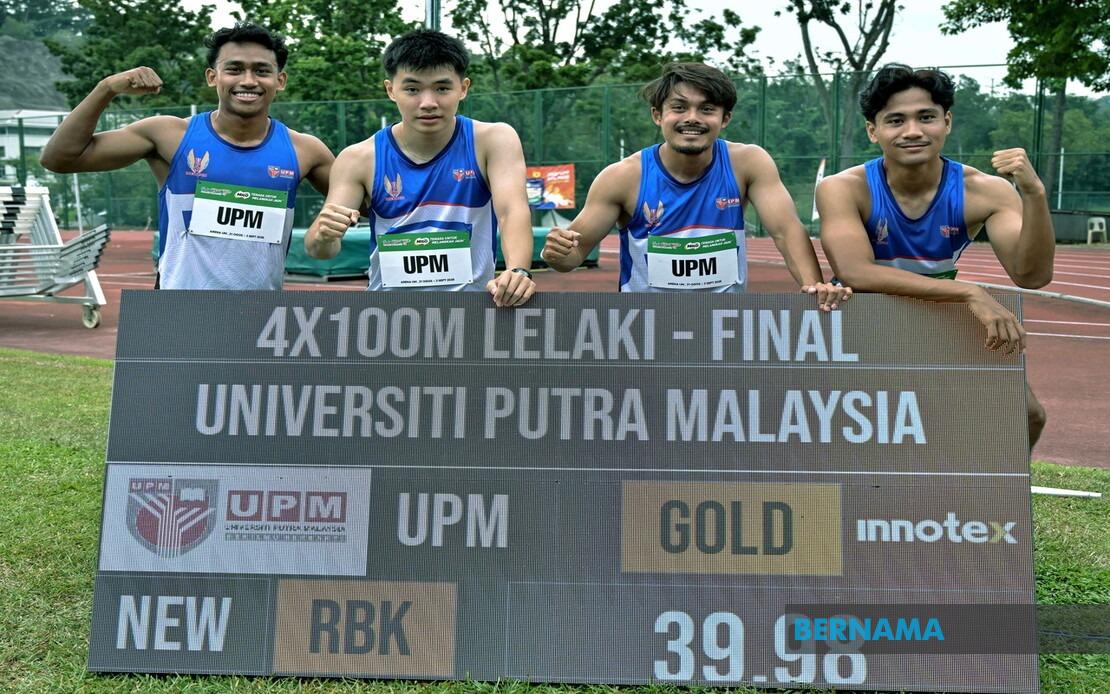
Universiti Putra Malaysia's men's 4x100-meter relay squad etched their names into Malaysian university athletics history on Saturday, clocking an impressive 39.98 seconds to capture gold at the 2026 Higher Education Institutions Sports Games (SUKIPT) in Kuala Lumpur. The blistering time obliterated the previous games benchmark of 40.98 seconds, signalling a watershed moment for the institution's track and field programme as it navigates a generational shift in elite sprinting talent.
The achievement carries deeper significance than the numbers alone suggest. Universiti Putra Malaysia has long been a powerhouse in Malaysian university athletics, but maintaining that dominance requires careful succession planning and the grooming of fresh talent capable of sustaining excellence. Aliff Iman Mohd Fahimi, a seasoned performer making his final SUKIPT appearance, orchestrated the triumph by anchoring a squad comprising primarily junior runners experiencing the championship environment for the first time. Their collective performance demonstrates that the university has successfully identified and developed young sprinters with the capacity to uphold institutional standards.
For Aliff Iman personally, the gold medal represents a poignant capstone to his university athletics career. After spending six months on the sidelines recovering from injury, his return to competitive action yielded tangible rewards. He wore wristbands inscribed with 'Papa' and 'Mama' throughout his final competition, a personal tribute that underscored the emotional weight of the occasion. More importantly, his role as the experienced elder statesman of a predominantly first-time SUKIPT team speaks to his leadership qualities and the respect his younger teammates place in his guidance.
The transition of power at Universiti Putra Malaysia gains added resonance when contextualized against the broader Malaysian athletics landscape. The university has previously produced elite runners such as Jonathan Nyepa and Zulfiqar Ismail, whose legacies loom large within the institution's competitive culture. Aliff Iman acknowledged this responsibility explicitly, recognizing that he bore the weight of ensuring continuity between the celebrated past and an uncertain future. His explicit commitment to leaving behind a strong foundation speaks to an athlete conscious of his role in institutional memory and mentorship.
The strategic approach to the relay demonstrated tactical sophistication. Rather than banking everything on raw speed, the team set expectations based on concrete performance data, calculating that runners capable of individual times in the 10.4- to 10.5-second range could collectively exceed the 40-second barrier. This data-driven mindset, unusual among university athletics teams, reflects either excellent coaching or mature self-awareness among the athletes themselves. Confidence in teammates proved decisive; each runner executed their leg knowing they could depend on receiving the baton in good positioning and with positive momentum.
Reeve Kua's contribution to the victory becomes even more remarkable in light of his circumstances on race day. Battling a severe fever just hours before competition, he would have been forgiven for withdrawing or performing below par. Instead, he took acetaminophen and managed to run pain-free, demonstrating the mental fortitude that separates university champions from also-rans. His willingness to compete through adversity and his teammates' collective drive to chase the sub-40-second target created an infectious energy that likely contributed to their superior performance.
Universiti Pendidikan Sultan Idris secured a creditable second place with a time of 40.16 seconds, bolstered by national runner Danish Iftikhar Muhammad Roslee serving as the anchor. The relatively close margin between first and second underscores the competitive calibre of Malaysian university athletics at its highest level. Nonetheless, Universiti Putra Malaysia's narrow advantage proved decisive, and final leg runner Ahmad Amir Aiman Mohd Kamaruddin's execution of the handoff and closing stages exemplified the polished relay technique that championship teams cultivate. Malaysian Polytechnics rounded out the medals with 41.75 seconds, confirming the hierarchy among Malaysia's tertiary athletics programmes.
The SUKIPT platform provides crucial developmental benefits for Malaysian university athletes, many of whom harbour aspirations of representing the country at national and international competitions. Success at this level frequently translates into selection for university teams competing regionally and globally, opening pathways to sporting recognition and, potentially, sponsorship or athletic scholarships. Universiti Putra Malaysia's 4x100m triumph therefore carries implications extending well beyond campus pride; it positions the university's young sprinters as prospects worth monitoring by national sports federations and international recruitment networks.
From a Malaysian sporting perspective, the emergence of fresh relay talent at the university level is encouraging at a time when Malaysian athletics has sought to rebuild depth in sprint events. While the national team has produced individual stars, constructing competitive relay quartets has proven more challenging. Universiti Putra Malaysia's display suggests that the grassroots development pipeline remains functional and capable of producing athletes with both raw speed and the tactical awareness necessary for effective team competition. This bodes well for the medium-term future of Malaysian sprint athletics, even as immediate national team selection decisions remain the domain of established senior athletes.
Aliff Iman's swansong competition also illuminates the importance of veteran mentorship in Malaysian sports culture. Rather than retiring quietly, he chose to compete in a visible, high-profile setting while explicitly orienting himself toward supporting the next generation. This approach aligns with the Southeast Asian emphasis on deference to elder athletes and collective achievement over individual accolades, creating a template that other retiring athletes might emulate. His deliberate choice to leave a legacy at Universiti Putra Malaysia through active participation, rather than merely administrative roles, demonstrates a nuanced understanding of how institutional knowledge transfers most effectively.
The 39.98-second performance also invites comparison with relay standards across Southeast Asia and globally. While Malaysian university relay times may not match the elite standards of developed nations, they represent respectable performances within the regional context. The trajectory evident in this record-breaking run, combined with the youth of the winning team, suggests potential for further incremental improvement as these athletes mature and refine their technique. Future SUKIPT editions may well witness even more impressive performances if Universiti Putra Malaysia's current cohort maintains focus and continues specialized relay training.
Looking ahead, the challenge facing Universiti Putra Malaysia involves sustaining this momentum across subsequent athletic seasons while continuing to attract and develop talented sprinters. Relays demand consistency, technical precision, and team continuity—qualities that prove harder to maintain than individual performance excellence. The fact that the gold medal team comprises primarily junior runners suggests they will likely compete together for several more years, potentially generating multiple championship campaigns. However, attrition through graduation, injury, or recruitment by other institutions remains an ever-present risk that requires proactive succession planning.

