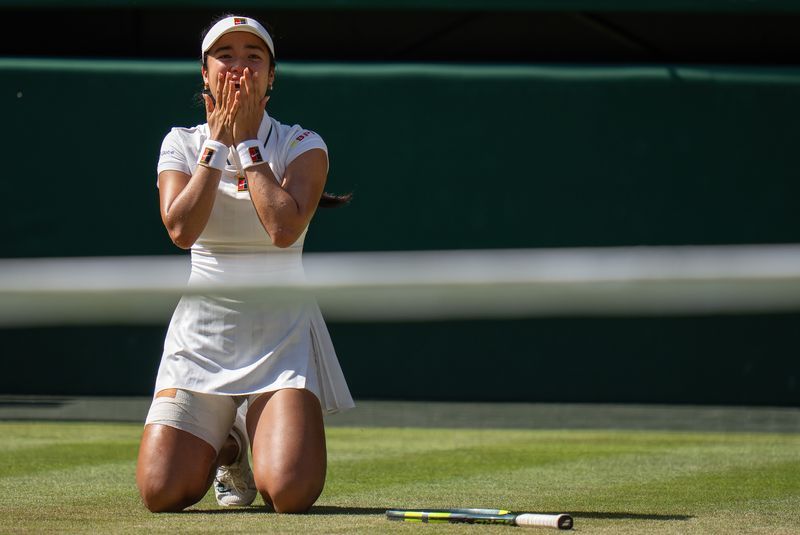
At 21 years old, Alexandra Eala has accomplished what few athletes from the Philippines have managed in tennis—she has captured global attention and won decisively against one of the sport's established names. Her Saturday victory over Iga Swiatek at Wimbledon represents more than a tournament result; it signals the arrival of a talent with genuine potential to reshape how Philippine sport is perceived internationally. Eala's upset win propelled her into the last 16 of a Grand Slam for the first time, a milestone that underscores the genuine quality of her game and the trajectory she has been following since emerging on the professional circuit.
The narrative surrounding Eala extends well beyond the tennis court itself. In a nation where athletic achievement has historically revolved around Manny Pacquiao's boxing legacy, the emergence of a young female tennis player capable of competing with elite international opposition fills a void that has existed for decades. Eala represents a different sporting paradigm—one where individual excellence in a traditionally global sport opens pathways that previously seemed impossible for Filipino athletes. Her performances at consecutive Grand Slams have drawn substantial crowds, many of them Filipino spectators following her journey with genuine investment in her success.
What makes Eala's breakthrough particularly noteworthy is not merely her technical ability with a tennis racket, but the consciousness she brings to her platform and influence. During her post-match press conference, she articulated a philosophy that extends her impact beyond tournament statistics. Rather than viewing her success as the endpoint of aspiration for younger Filipinos, Eala explicitly rejected the idea that others should model themselves on her trajectory. This distinction reveals maturity uncommon in athletes of her age and experience level. She recognises that her visibility carries responsibility, and she has chosen to leverage that attention toward encouraging individual authenticity rather than blind emulation.
Eala's message to young people back home centres on self-determination and originality. In her remarks, she emphasised wanting others to aspire toward becoming the best version of themselves rather than the next iteration of her. This approach acknowledges the profound psychological weight that celebrity athletes often place on younger generations, particularly in smaller countries where sporting heroes become national symbols. By deliberately steering away from that model, Eala demonstrates an understanding that sustainable sporting development requires diversity of approach and multiple pathways to excellence, not concentration around singular exemplars.
The emotional depth of her Wimbledon victory further humanised Eala in the eyes of observers. Immediately after defeating Swiatek, she dropped to the ground overcome with tears, a raw display of emotion that captured the significance of the moment. Yet even in that celebratory instant, she refused to become consumed by satisfaction or complacency. Her next opponent is Jasmine Paolini, the 2024 Australian Open runner-up, a formidable challenger representing the next level of competition Eala must navigate to maintain her upward trajectory. This mental transition from celebration to renewed focus reveals something essential about her competitive character.
Eala herself identified this capacity to compartmentalise emotion and refocus as perhaps her most valuable skill. She described it not as something she had deliberately trained, but rather as something intrinsic to her nature that she continues to refine through competition. This quality—the ability to experience genuine joy in achievement while simultaneously maintaining the psychological distance necessary to prepare for the next challenge—distinguishes athletes who sustain excellence from those who experience singular breakthrough moments. For Eala, the victory over Swiatek is not a destination but a waypoint on a longer journey.
From a Southeast Asian perspective, Eala's emergence carries implications beyond the Philippines alone. Women's tennis across the region has remained underdeveloped compared to established markets in Europe, North America, and East Asia. Thailand, Vietnam, Indonesia, and Malaysia have produced occasional players of note, but none have achieved Eala's level of sustained performance at the sport's highest level. Her success demonstrates that the region possesses both the talent development infrastructure and the individual athletes necessary to compete globally. The visibility she generates through her Wimbledon run inevitably increases interest in tennis among young women across Southeast Asia, potentially catalysing investment in training facilities and coaching programs that benefit the broader region.
The economic and commercial dimensions of Eala's rise deserve consideration alongside the sporting narrative. As she advances further through major tournaments, her earning potential through sponsorships and appearance fees increases substantially. More significantly, her success at global sporting events elevates the Philippines' profile on the international sports calendar. Tennis broadcasters now pay attention to matches involving Eala; major publications dedicate column space to her story; and international audiences develop familiarity with both her name and her nation. This exposure creates diplomatic and cultural soft power that extends well beyond the tennis sphere.
Eala's path also illuminates the challenges that international-level athletes from smaller nations must overcome. Her journey to Wimbledon success involved training primarily outside the Philippines, accessing coaching and facilities that her home country could not provide at the requisite level. This reality reflects the continuing infrastructure gaps that exist in Southeast Asian tennis development. While Eala has navigated these obstacles successfully through talent and determination, the system that produced her remains fragile and insufficiently supported by institutional investment. The question remains whether her individual success will catalyse systematic change in Philippine sports development or whether she will remain an exceptional outlier.
Looking forward to her round-of-16 encounter with Paolini, Eala enters as a considerable underdog despite her recent victory over Swiatek. Paolini's experience at the highest level and her proven ability to perform under pressure in major tournaments present formidable obstacles. Yet the mere fact that Eala has positioned herself to face such competition at Wimbledon represents a fundamental shift in global tennis hierarchies. Smaller nations and underrepresented regions increasingly appear at the business end of Grand Slam tournaments, evidence that the sport is gradually becoming more genuinely global in character. Eala belongs to this emerging cohort of international talent challenging the dominance of traditionally established tennis powers.

