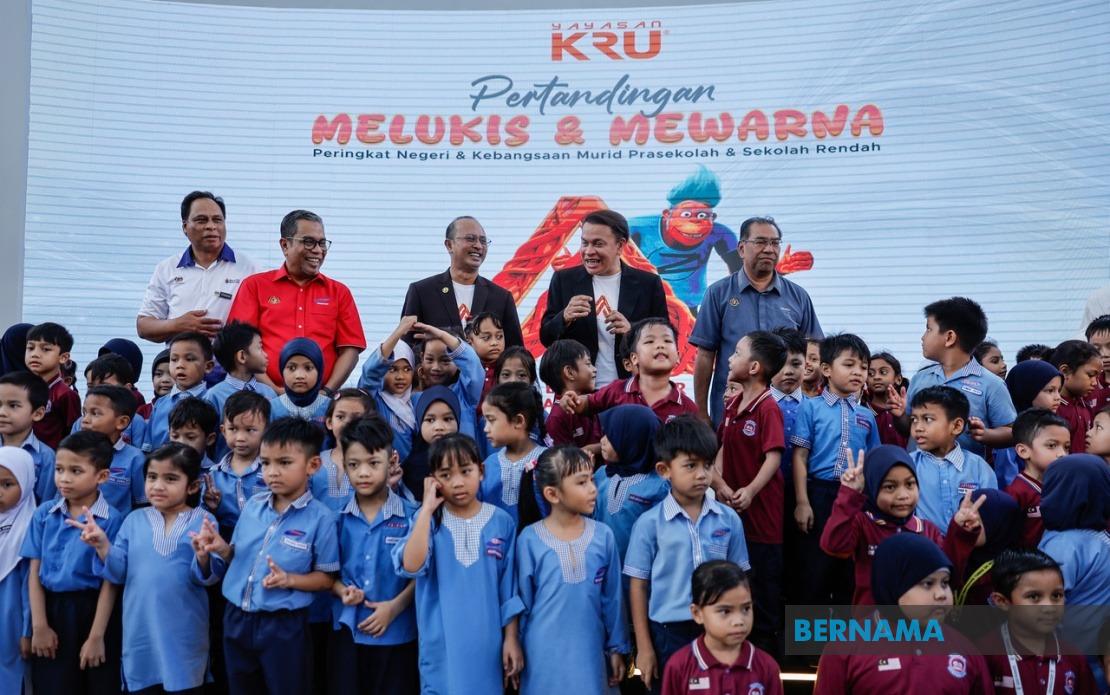
A nationwide colouring competition organised by Yayasan KRU has made history by setting a new Malaysia Book of Records benchmark for the largest participation of preschool children in such an initiative. The AKAR 2026 Awards drew more than 153,000 children from KEMAS and Unity kindergartens across the country, demonstrating the considerable appetite for creative programmes among Malaysia's youngest learners and their institutions.
The achievement represents a collaborative effort spanning multiple government bodies and educational institutions. The National Higher Education Fund Corporation (PTPTN), Education Ministry (MOE), Community Development Department (KEMAS), and Department of National Unity and National Integration (JPNIN) all played instrumental roles in bringing the competition to fruition. This multi-agency coordination underscores the government's commitment to integrating creative learning into the early childhood development agenda, particularly through partnerships with the private philanthropic sector.
Beyond the headline numbers, the competition integrated an environmental consciousness component through its "I Love Orangutans" campaign, weaving conservation messaging into creative activities targeting impressionable young minds. Such dual-purpose programming has become increasingly common in Malaysian educational initiatives, where soft skills development and awareness-raising are combined within single structured activities. For preschoolers, exposure to environmental themes during formative years can establish foundational attitudes toward sustainability and wildlife protection.
Yayasan KRU Board of Trustees president Datuk Norman Abdul Halim characterised the milestone as historically significant, emphasising that the programme addressed multiple policy objectives simultaneously. His remarks highlighted how the initiative fulfilled the dual mandate of nurturing creativity—a critical competency in contemporary economies—whilst promoting environmental stewardship. The framing reflects broader national conversations around skills development for future competitiveness and the integration of environmental values into educational curricula.
The financial incentive structure demonstrates commitment to recognising and rewarding participating children. Approximately RM100,000 in prize money was allocated across state and national competition levels, with winnings credited directly into recipients' National Education Savings Scheme (SSPN) accounts. This approach serves multiple purposes: it acknowledges excellence, provides tangible educational investment for families, and creates a documented savings record that contributes to children's future educational financing. The top national prize of RM3,000 represents meaningful recognition at the culmination of the competition journey.
National finals will take place in Putrajaya on August 29, where state-level winners advance to compete for ultimate honours. This tiered structure—with simultaneous nationwide participation funnelling into centralised finals—enabled the massive scale whilst maintaining competitive integrity. The logistics of coordinating over 153,000 participants through multiple kindergarten systems across all states reflects considerable organisational capability and institutional coordination capacity.
KEMAS director-general Datuk Mohd Hanafiah Man contextualised the competition within broader workforce development frameworks, noting that creativity constitutes an essential skill for building competitive generations. His intervention signalled institutional recognition that preschool-level interventions, whilst appearing modest in scope, contribute to human capital formation. The statement acknowledged the administrative effort expended by KEMAS preschool staff nationwide in executing the competition simultaneously, underscoring how such programmes depend on frontline institutional commitment.
For Malaysian parents and educators, the AKAR 2026 initiative illustrates how government and philanthropic partnerships can create large-scale creative opportunities accessible to preschool populations across socioeconomic strata. KEMAS kindergartens serve predominantly lower-income and rural communities, making the initiative's inclusive reach particularly significant. Through PTPTN's involvement and direct SSPN contributions, the programme created structured pathways linking early creative participation to documented educational savings, potentially influencing tertiary education accessibility for participating families.
The recognition by Malaysia Book of Records adds institutional validation to the initiative, providing measurable benchmark status that distinguishes AKAR 2026 among similar programmes. Such record-setting serves multiple functions: it generates publicity amplifying awareness of creative development opportunities, establishes aspirational targets for future iterations, and provides participating institutions with tangible evidence of programmatic significance and scale. For Yayasan KRU specifically, the MBOR recognition enhances institutional credibility and demonstrates capacity to execute large-scale, multi-stakeholder initiatives.
Regionally, Malaysia's achievement reflects broader Southeast Asian trends toward integrating environmental messaging into early childhood programmes and utilising creative competitions as vehicles for skill development and values transmission. The scale of 153,000 participants positions this initiative competitively within the region, whilst the institutional backing through PTPTN, MOE, and other government bodies demonstrates whole-of-government commitment to early childhood development as policy priority. For other Southeast Asian nations grappling with similar early childhood development objectives, the AKAR 2026 model offers a replicable framework combining reach, environmental integration, and financial incentivisation.
The intersection of creative development, environmental conservation, and educational financing within a single preschool-targeted programme demonstrates evolving sophistication in Malaysian policy design. Rather than treating these as separate policy domains, AKAR 2026 creates synergies enabling multiple objectives to be pursued simultaneously through coordinated institutional action. As Malaysia continues refining human capital development strategies and positioning itself competitively within increasingly technology-driven economies, such early-intervention programmes combining creativity nurturing with values formation represent practical instantiations of long-term capability building.

