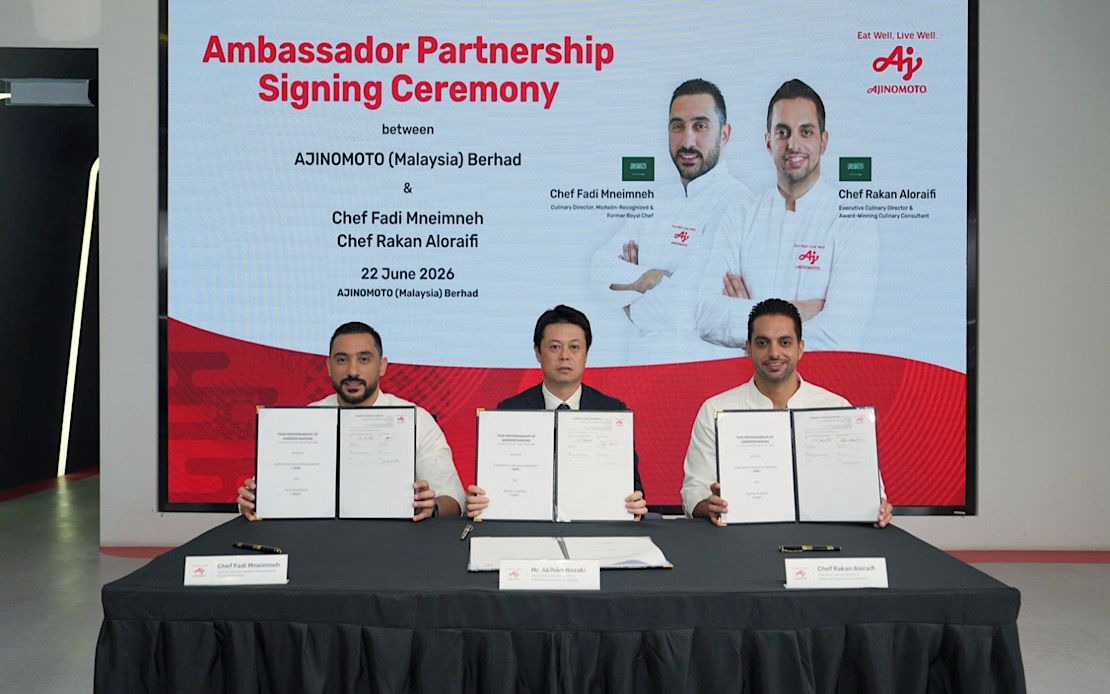
Ajinomoto (Malaysia) Berhad is making a calculated push into the lucrative Middle Eastern market through a high-profile partnership with Chef Fadi Mneimneh and Chef Rakan Aloraifi, two of the Arabian Peninsula's most respected culinary personalities. The collaboration signals the company's recognition that capturing market share in the halal food sector requires more than product quality alone—it demands credibility within local culinary circles and a deep understanding of regional taste preferences.
The strategic alignment addresses a fundamental challenge for Malaysian food exporters targeting the Gulf Cooperation Council nations: establishing trust with professional chefs and hospitality decision-makers who wield significant influence over ingredient adoption in hotels, restaurants and institutional kitchens. By engaging two Michelin-starred and award-winning figures, Ajinomoto Malaysia is leveraging their networks and reputations to position its products as premium solutions rather than commodity ingredients. Chef Fadi's background as a former royal chef particularly matters—palace food services set standards that cascade through the hospitality industry.
The centrepiece of this partnership manifested in an exclusive factory tour of Ajinomoto Malaysia's facility in Bandar Enstek, Negeri Sembilan, where both chefs experienced first-hand the manufacturing processes, quality controls and halal certification frameworks that underpin the company's product portfolio. This transparency serves multiple purposes: it demystifies Malaysian food production for Gulf consumers accustomed to scepticism about imported ingredients, it allows chefs to examine ingredients they will recommend to peers, and it transforms them into authentic brand ambassadors rather than paid endorsers.
A central theme of the engagement centred on educating Middle Eastern culinary professionals about umami—the fifth taste that Japanese food science has long championed. This educational angle reveals Ajinomoto Malaysia's sophisticated marketing approach. Rather than simply promoting seasoning products, the company is framing umami as a culinary tool that enhances traditional Middle Eastern dishes without diluting their authenticity. This positioning matters enormously in a region where food heritage is culturally significant and where consumers actively resist the perception that their cuisine requires external modification.
The live culinary demonstrations conducted by Chef Fadi and Chef Rakan became the experiential proof point for this concept. By preparing authentic Middle Eastern recipes using Ajinomoto products and displaying how umami deepens flavour complexity without introducing foreign tastes, they provided evidence that Japanese food science and Arabian culinary tradition are complementary rather than competing frameworks. This type of hands-on demonstration carries far greater persuasive weight than any laboratory analysis or marketing claim could achieve.
The timing and scope of the initiative also reflect Ajinomoto Malaysia's longer-term expansion strategy. The company has scheduled participation in the Hotel, Restaurant and Café (HORECA) event across Riyadh and Jeddah for October 2026, where the two chefs will conduct additional live demonstrations for procurement professionals, hotel executives and restaurant operators. This twelve-month runway allows for relationship-building, word-of-mouth effects among industry networks, and structural preparation for a coordinated market entry when the exhibition occurs.
For Malaysian exporters more broadly, this case study illustrates the evolved requirements for success in premium Gulf markets. The halal certification that once differentiated Malaysian producers is now table stakes rather than competitive advantage—most major food manufacturers in Southeast Asia now maintain halal credentials. The new frontier involves demonstrating technological sophistication, building credibility within professional networks, and creating narratives that position imported products as enhancing rather than replacing local traditions. Ajinomoto Malaysia's approach does precisely this through its partnership structure.
The inclusion of Ajinomoto's distributor representative in Brunei during the Saudi chefs' visit also hints at a networked regional strategy. By creating connection points among stakeholders across Southeast Asia and the Middle East, the company is fostering an ecosystem effect where regional partners see themselves as part of a cohesive commercial platform rather than operating as isolated distributors. This approach potentially opens pathways for cross-regional business development and shared market intelligence.
The halal food market that Ajinomoto Malaysia is targeting has experienced robust growth as affluence rises across the Gulf states and consumer expectations for premium, certified products intensify. The global halal food market exceeded $1.5 trillion in recent years, with Middle Eastern markets representing a disproportionately valuable segment due to per-capita spending patterns and regulatory requirements. For a Malaysian company, capturing even modest market share in this space translates into significant revenue impact.
Beyond commercial considerations, Ajinomoto Malaysia's initiative represents a broader strategy to position Malaysia's food manufacturing capability as a quality-focused, innovation-embedded sector rather than a low-cost production hub. The emphasis on factory transparency, halal integrity, modern manufacturing capabilities and culinary partnerships all contribute to elevating perceptions of Malaysian food products in international markets. This rebranding effort has implications across Malaysia's entire food and beverage export industry.
The partnership also underscores how Malaysian companies are increasingly willing to invest in relationship-building and market education rather than relying solely on price competitiveness or existing distribution channels. This represents a maturation of commercial strategy that reflects higher operating margins, confidence in product differentiation and recognition that durability in premium markets requires sustained engagement rather than transactional deals.
Looking forward, the success of this initiative will likely be measured not just by immediate sales volume but by the degree to which Chef Fadi and Chef Rakan become authentic advocates within their professional communities. If their endorsements influence purchasing decisions among mid-tier and premium restaurants, hotels and catering operations across the Kingdom of Saudi Arabia and neighbouring states, the partnership will have achieved its strategic objective of establishing Ajinomoto Malaysia as the preferred halal ingredient choice for discerning culinary professionals. The October 2026 HORECA events will serve as a critical inflection point for scaling this initial relationship into sustained market penetration.

