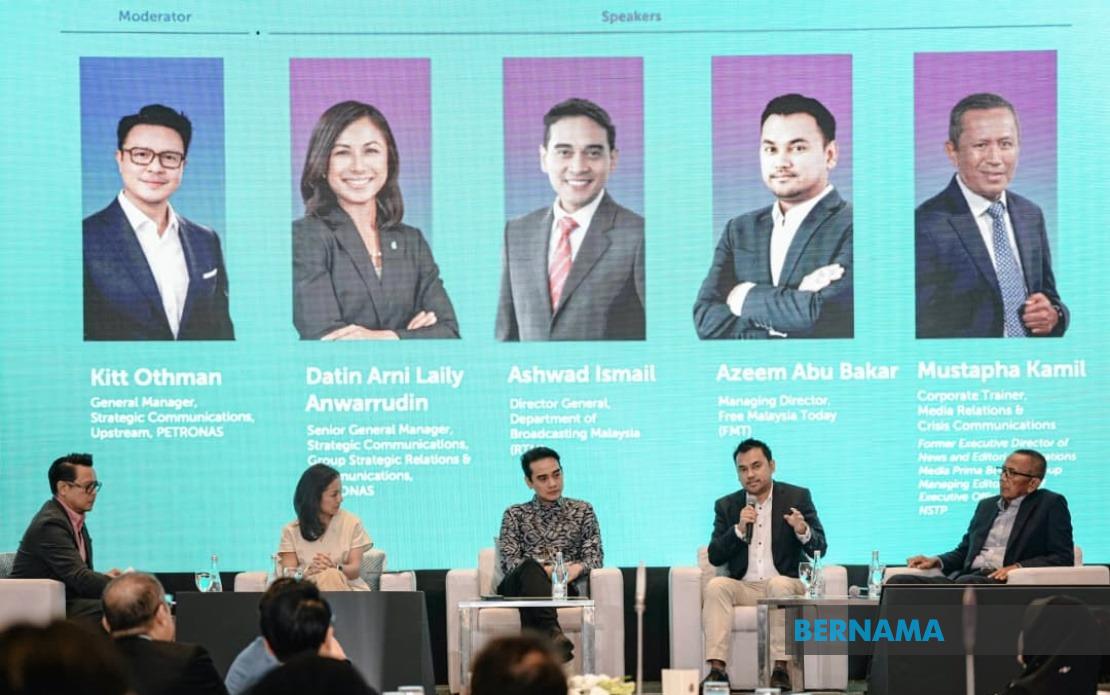
The accelerating pace of artificial intelligence deployment and real-time digital information flows are fundamentally upending how Malaysian corporations and newsrooms manage their public image and respond to crises, according to senior communications executives and media leaders gathered for a high-level forum in Kuala Lumpur. The consensus view suggests that yesterday's rulebooks for managing corporate reputation have become largely redundant, forcing organisations across sectors to entirely reconsider their approach to stakeholder communication in an era where misinformation can circle the globe faster than traditional fact-checking mechanisms can respond.
Datin Arni Laily Anwarrudin, Senior General Manager of Strategic Communications at PETRONAS, outlined the central dilemma facing large organisations today: the uncontrolled spread of unverified information through AI-powered channels now poses a threat to brand reputation that most corporations are ill-equipped to counter. She stressed that organisations can no longer afford to remain passive observers of how their story is told in the public domain. Instead, companies must assertively own their corporate narrative through transparent communication, or risk allowing third parties—whether competitors, activist groups, or malicious actors—to shape public perception unchallenged. This represents a substantial departure from historical practice, where corporations could afford longer deliberation periods before responding to adverse developments.
The discussion took place during PETRONAS Lunch Escape 2026, a forum organised jointly by the national oil company's Group Strategic Relations & Communications division and the Malaysian Press Institute to examine the intersection of media credibility and artificial intelligence. The gathering brought together a cross-section of Malaysia's media and corporate leadership, including Radio Televisyen Malaysia director-general Ashwad Ismail, Mustapha Kamil Mohd Janor from Media Prima Berhad and NSTP Group, and Azeem Abu Bakar of Free Malaysia Today, alongside Bernama executives Datin Paduka Nur-ul Afida Kamaludin and Arul Rajoo Durar Raj.
Arni Laily identified the obsolescence of traditional crisis response timelines as a critical vulnerability in corporate communication structures. The long-established convention that organisations had approximately sixteen hours to formulate a response before newspaper publication has evaporated entirely. In the current environment, news breaks and circulates instantaneously across social media platforms, messaging applications, and AI-aggregated news feeds, leaving corporate communications teams with mere minutes to verify facts, consult internal stakeholders, and craft an appropriate response. She emphasised that while the pressure to react quickly is intense, organisations cannot allow urgency to override the fundamental imperative to establish factual accuracy before making public statements.
Mustapha Kamil Mohd Janor reinforced this assessment from his perspective as a long-time media executive. He underscored that news cycles have compressed to near-instantaneous timeframes, fundamentally altering the competitive landscape for corporate communications. He pointedly advised organisations that lack a structured, dedicated media crisis communication team to establish one without delay, given that the ability to coordinate rapid, accurate, and strategic responses has become essential infrastructure for managing reputational risk. The implication is clear: in Malaysia's increasingly sophisticated corporate environment, crisis communication capability is no longer a peripheral function but rather a core operational necessity.
Yet despite these seismic shifts in the information ecosystem, Mustapha Kamil articulated a conviction that journalism's fundamental role remains unchanged and arguably more vital than ever. He characterised journalists as society's searchlight, directing public attention toward consequential issues and helping citizens navigate complex information landscapes to make informed decisions. This framing suggests that while the mechanics of media distribution have transformed dramatically, the democratic function of independent journalism—to illuminate truth and hold power accountable—remains as indispensable as ever. For Malaysian readers and citizens, this perspective offers reassurance that professional journalism retains its moral authority even as the medium through which it operates undergoes radical transformation.
Azeem Abu Bakar from Free Malaysia Today offered a more nuanced perspective on the role artificial intelligence can play within media organisations. Rather than viewing AI as a wholesale replacement for human journalism, he suggested that technology should be deployed to automate routine operational tasks, thereby freeing human journalists to concentrate on capabilities that algorithms cannot replicate. He introduced the concept of cultivating "SUPER" journalists—individuals distinguished by sources, understanding, pattern recognition, efficiency, and reputation. These journalists would leverage their networks, contextual knowledge, pattern identification skills, operational agility, and established credibility to produce reporting that AI-generated content cannot match. This framework suggests a collaborative rather than adversarial relationship between human expertise and technological capability.
The distinction Azeem drew between what AI can and cannot accomplish has particular resonance for Malaysian media organisations facing resource constraints and competitive pressures. While artificial intelligence excels at data aggregation, formatting, and routine content production, it fundamentally lacks the investigative instinct, source cultivation relationships, and trustworthiness that define premium journalism. Malaysian newsrooms can thus position themselves competitively not by attempting to out-automate technology but by deliberately investing in the irreplaceably human dimensions of journalism that AI cannot and should not replicate. This represents an opportunity for Malaysian media to differentiate and strengthen their market position through authentic human expertise.
The broader implications of this discussion extend across Malaysian business and society. Organisations across energy, finance, manufacturing, and services sectors must recalibrate their communication strategies to reflect the reality that information now moves at digital velocity. The old assumptions about having adequate time to formulate consensus, vet messaging, and coordinate stakeholder positions before public disclosure have dissolved. Simultaneously, the proliferation of AI-powered misinformation channels and deepfakes creates an environment where corporate credibility becomes more fragile yet more commercially valuable than ever. Companies that fail to adapt their communication infrastructure and governance to this new reality face exponentially greater reputational risk.
For Malaysia's media industry specifically, the challenge is to harness AI's capabilities while preserving journalistic integrity, editorial independence, and the investigative capacity that distinguishes professional journalism from automated content generation. The consensus at the PETRONAS forum suggests that Malaysian media leaders are acutely aware of these tensions and committed to navigating them thoughtfully. Rather than succumbing to technological determinism, they are articulating frameworks for maintaining journalism's democratic function while strategically adopting tools that enhance efficiency and reach.
The discussion also highlighted the urgency with which Malaysian corporations must evolve their crisis communication protocols. The sixteen-hour window referenced by both Arni Laily and Mustapha Kamil represents not merely a timing convenience but a structural pillar of decision-making processes that many organisations have relied upon for decades. The compression of response timeframes creates substantial pressure to automate and pre-script crisis responses, yet doing so risks producing statements that appear dismissive, inauthentic, or factually incorrect. Navigating this tension between speed and thoughtfulness will define the quality of corporate communication in Malaysia's digital era.
Ultimately, the insight emerging from this forum is that artificial intelligence and instant digital communication are not simply technological phenomena to be managed but rather catalysts for reconsidering fundamental questions about organisational transparency, institutional credibility, and the social contract between corporations, media, and the public. For Malaysian organisations—whether corporate entities, government agencies, or newsrooms—this represents a moment to move beyond incremental adaptation toward genuine strategic reimagining of how communication occurs in an environment where information velocity has fundamentally changed the rules governing reputation, trust, and public legitimacy.

