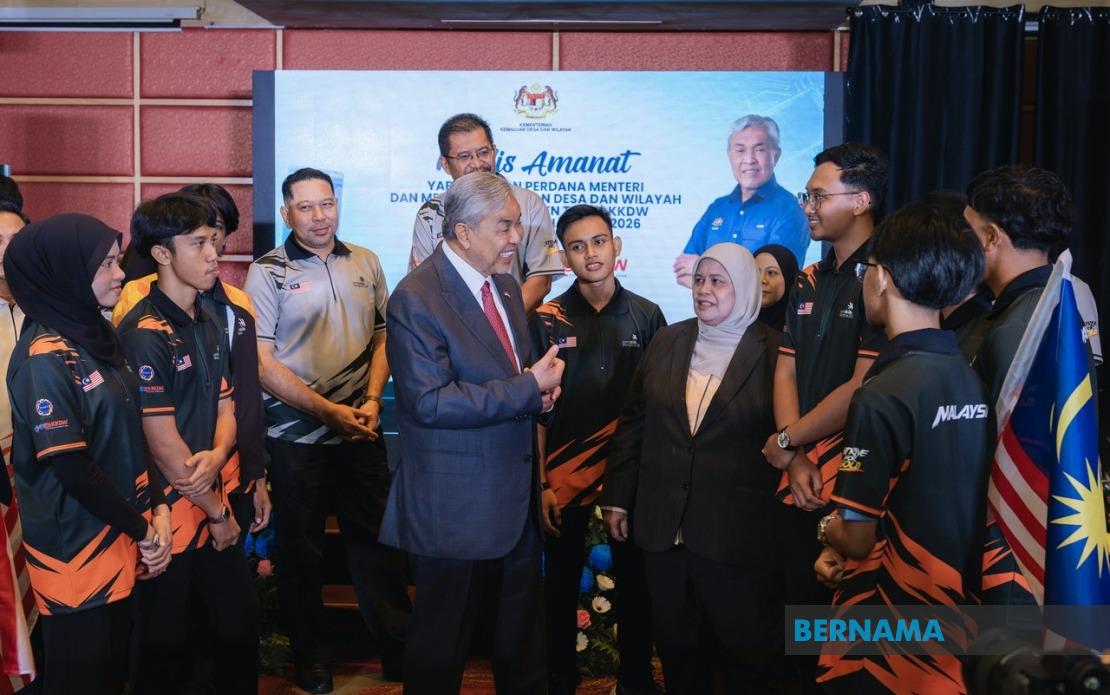
Deputy Prime Minister Datuk Seri Dr Ahmad Zahid Hamidi has made an ambitious pledge to underwrite umrah journeys for technical vocational trainees who secure gold medals at the upcoming WorldSkills Competition 2026, scheduled to take place in Shanghai, China between September 22 and 27. The initiative represents a significant personal commitment from Ahmad Zahid, who simultaneously holds the Rural and Regional Development portfolio, to recognise and reward excellence among Malaysia's emerging skilled workforce.
Announcing the scheme during a gathering with the Malaysian contingent destined for the Shanghai competition, Ahmad Zahid emphasised that the financial support would flow entirely from his personal resources rather than government coffers. This distinction underscores the magnitude of his confidence in the abilities of the nine participants representing Malaysia's Technical and Vocational Education and Training sector under the Ministry of Rural and Regional Development. The gesture reflects broader government efforts to elevate the status and recognition of vocational training pathways, which have historically received less prominence than university education in Malaysia's academic hierarchy.
The scope of Ahmad Zahid's commitment extends beyond the competitors themselves. He pledged to fund not only the gold medallists' umrah journeys but also those of their parents, acknowledging the family sacrifices required to nurture technical excellence. The Deputy Prime Minister articulated this with characteristic directness, stating that should all nine Malaysian participants capture gold medals, he would personally arrange and finance umrah pilgrimages for all eighteen individuals. This amplified commitment signals genuine determination to incentivise peak performance among Malaysia's vocational contingent.
The nine-member Malaysian team competing at WorldSkills 2026 spans a diverse range of technical disciplines reflective of contemporary skills demands across Southeast Asia's economic sectors. Nadratulliyana Ab Malek will represent Malaysia in Fashion Technology, while Haziq Syahmi Nazri competes in Automobile Painting. The team's digital and engineering focus is evident through entries in Cyber Security, Electronics, and Rail Vehicle Technology, demonstrating Malaysia's pivot toward industrial modernisation. Three participants—Khairul Idham Bahari, Muhamad Nashrul Zulkifli, and Muhammad Haziq Lailla Zamri—will pursue recognition in Cabinetmaking, Digital Construction, and Electrical Installations respectively, addressing traditional skilled trades. Muhammad Huzairy Mohamad Thes rounds out the contingent with expertise in Mechanical Engineering CAD, whilst Mohammad Ezaly Iman Ramli and Wan Hamiz Ozai Wan Hamidzi bring specialisation in Cyber Security and Rail Vehicle Technology.
The WorldSkills platform carries significant strategic importance for Malaysia's economic positioning. Competition at this level attracts participants from over 60 countries and territories, offering Malaysian technicians exposure to global best practices and peer recognition alongside representatives from developed economies. Success at WorldSkills 2026 would strengthen Malaysia's international reputation as a source of technically capable workers, potentially enhancing the country's attractiveness to foreign manufacturers and technology firms seeking skilled labour. For the participants themselves, gold medal recognition opens pathways to enhanced employment prospects and career acceleration across multinational corporations operating within Southeast Asia.
Ahmad Zahid's initiative reflects broader government recognition that vocational education represents a strategic imperative for Malaysia's future competitiveness. As economies across the region transition toward higher-value manufacturing and services, demand for skilled technicians in automotive, electronics, construction, and digital domains continues expanding. Malaysian policymakers have increasingly acknowledged that over-emphasis on university pathways has created workforce imbalances, leaving critical skills shortages in trades where experienced practitioners command premium compensation. By attaching high-profile ministerial recognition and personal financial incentives to vocational achievement, Ahmad Zahid signals that technical excellence merits social status equivalent to academic credentials.
The umrah sponsorship mechanism itself warrants consideration within Malaysia's broader social and cultural context. For Muslim Malaysians, umrah represents a spiritually significant pilgrimage offering personal fulfilment and religious observance. By framing vocational excellence as worthy of this reward, Ahmad Zahid integrates technical achievement with spiritual recognition, potentially elevating the perceived value of TVET pathways among Malaysian families traditionally oriented toward university education. This cultural reframing could prove instrumental in attracting higher-calibre students into technical training programmes and fostering parental support for vocational career trajectories.
Deputy Rural and Regional Development Minister Datuk Rubiah Wang's attendance at the pledge announcement underscores institutional support for the initiative. The presence of senior ministry figures communicates that TVET advancement constitutes a priority policy objective rather than peripheral activity. Within the ministry structure, the TVET@KKDW designation acknowledges formal integration of vocational education programming into rural and regional development mandates, reflecting recognition that technical skills constitute essential infrastructure for rural economic diversification and employment creation beyond urban centres.
The competitive environment at WorldSkills 2026 will prove demanding. Shanghai's hosting of the competition places Malaysian participants in direct competition against teams from economically advanced nations investing substantially in vocational training infrastructure and competitor preparation. China's own team, representing the host nation with exemplary technical infrastructure and manufacturing sophistication, will present formidable opposition. Nonetheless, Malaysian participants have previously demonstrated competitive capacity at international skills competitions, suggesting the nine-member contingent enters Shanghai with realistic prospects of podium finishes across multiple categories.
Sustaining momentum beyond the Shanghai competition will require systematic investment in TVET ecosystem development. While Ahmad Zahid's personal pledge provides immediate incentive for the 2026 cohort, Malaysia's longer-term competitiveness depends on institutional capacity building within TVET institutions, instructor development, equipment modernisation, and curriculum alignment with evolving industrial requirements. The government has articulated ambitions to position Malaysia as a regional TVET hub, attracting students from neighbouring countries whilst exporting technical expertise. Competition success at WorldSkills could catalyse broader acceptance of this positioning.
Looking forward, the 2026 competition represents a pivotal moment for Malaysian vocational education's international standing. Gold medals would validate the ministry's TVET development strategy and potentially unlock broader policy support and resource allocation toward technical training expansion. For Ahmad Zahid personally, successful outcomes would demonstrate tangible returns on his public commitment and strengthen his credentials as a champion of skills development. The pledge thus carries symbolic weight extending beyond the immediate participants, signalling government determination to rebuild national technical capacity and restore vocational pathways to prominence within Malaysia's educational landscape.

