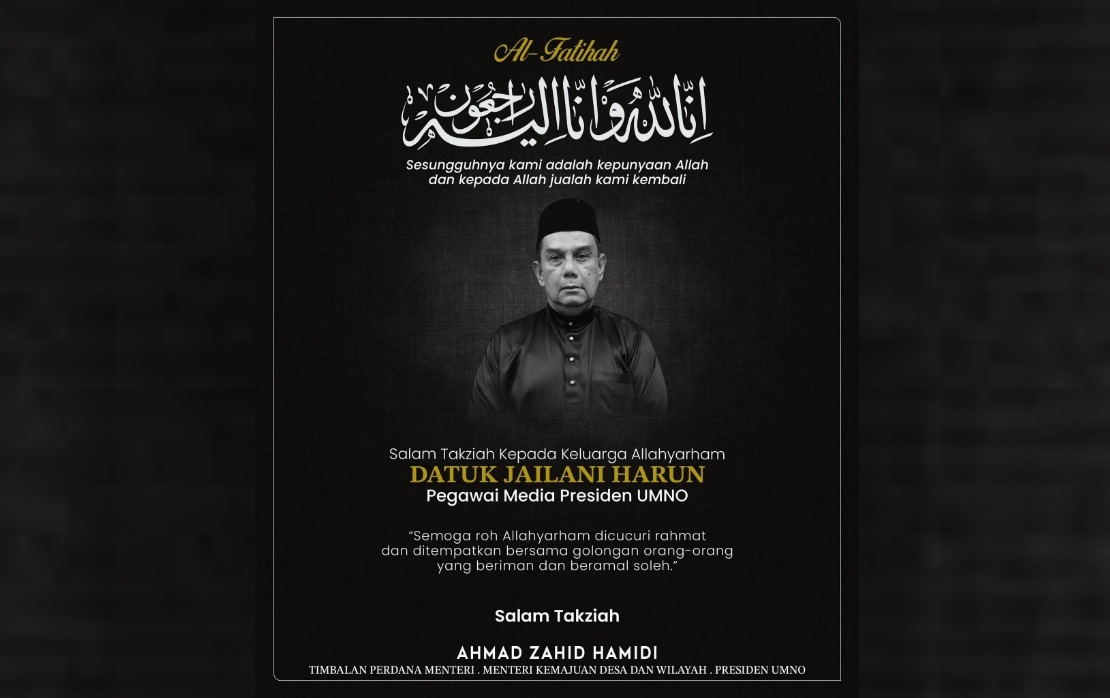
Deputy Prime Minister Datuk Seri Dr Ahmad Zahid Hamidi has conveyed his deepest sympathies to the bereaved family of Datuk Jailani Harun, a distinguished figure in Malaysian journalism and communications who served the UMNO party for many years as a media officer attached to the president's office. The 66-year-old passed away at Serdang Hospital on July 7, prompting heartfelt tributes from party leadership and political circles.
Ahmad Zahid, who holds the presidency of UMNO, visited Jailani at the hospital early in the morning on the day of his death, gaining firsthand observation of his health condition. The Deputy Prime Minister's Facebook statement reflected the emotional weight of that encounter, revealing that he had harboured hopes for recovery even as the situation remained grave. His account underscores the personal connection many senior UMNO figures maintained with Jailani over what appears to have been an extensive career spanning journalism and political communications.
In his statement, Ahmad Zahid characterised Jailani as an individual distinguished by his kindness, humility and broad respect within professional and party circles. Such descriptions suggest a person who had earned esteem not merely through his formal position but through the manner in which he conducted himself. The Deputy Prime Minister's recollection of visiting Jailani at the hospital, coupled with his expression of emotional grief at witnessing the deterioration, points to a relationship that extended beyond purely official interaction.
The timing of Jailani's death, occurring at 11.34 am on July 7, marked the end of a career that had positioned him at the intersection of Malaysian media and politics. As someone who transitioned from journalism into the communications apparatus of UMNO's highest office, Jailani would have been privy to significant developments within the party during his tenure. His dual expertise in both journalistic practice and political communication likely made him a valuable figure in shaping how the party's messaging reached the public.
Ahmad Zahid invoked religious sentiments in his condolences, praying that Allah would grant forgiveness for any transgressions and place Jailani among the faithful and righteous. These invocations reflect the Islamic framework within which many Malaysian public figures express grief and loss, and serve to extend consolation beyond the immediate family to the broader Muslim community. The Deputy Prime Minister's words signalled that Jailani's passing was viewed as a loss not just to his family but to UMNO and Malaysia's political-media establishment more broadly.
The funeral arrangements reflected the customary practices within Muslim communities in Malaysia. Jailani's burial took place at Alam Damai Muslim cemetery in Cheras following asar prayers, providing a final resting place within the capital city where he had spent much of his professional life. This locality, serving the Muslim community in the Cheras area, is where many prominent Malaysians have been interred over the decades.
Jailani's career path illustrates a particular trajectory common among Malaysian political communicators of his generation—beginning in journalism before transitioning into formal political communications roles. This movement between the two spheres reflects the close relationship between Malaysia's media landscape and its political institutions, where individuals with journalistic credentials often bring credibility and professional standards to government and party communications functions. His long association with UMNO's presidency suggests he navigated this transition successfully.
The death of figures like Jailani invariably prompts reflection on the institutional knowledge they carry. Having worked within UMNO's highest councils as a media officer, he would have accumulated understanding of party dynamics, policy development processes, and the evolution of its communications strategies across multiple administrations. Such individuals often serve as bridges between different eras of party leadership and as keepers of institutional memory.
For Malaysian newsrooms and political observers, Jailani's passing represents the loss of someone who had witnessed and documented significant chapters of the nation's political history. Journalists who worked alongside him or covered stories he helped communicate would have viewed him as a knowledgeable resource on party matters and political developments. His accessibility and professional approach, as reflected in Ahmad Zahid's tribute, likely contributed to his effectiveness in his communications role.
The Deputy Prime Minister's public expression of grief, shared through social media to reach UMNO members and the broader Malaysian public, underscores the significance accorded to individuals who serve in institutional roles within major political parties. Though not elected to office himself, Jailani occupied a position of trust and responsibility that brought him into contact with the highest echelons of party leadership across multiple decades. Such figures, though often operating behind the scenes, play essential roles in shaping how political organisations present themselves to the public and manage their communications during critical moments.

