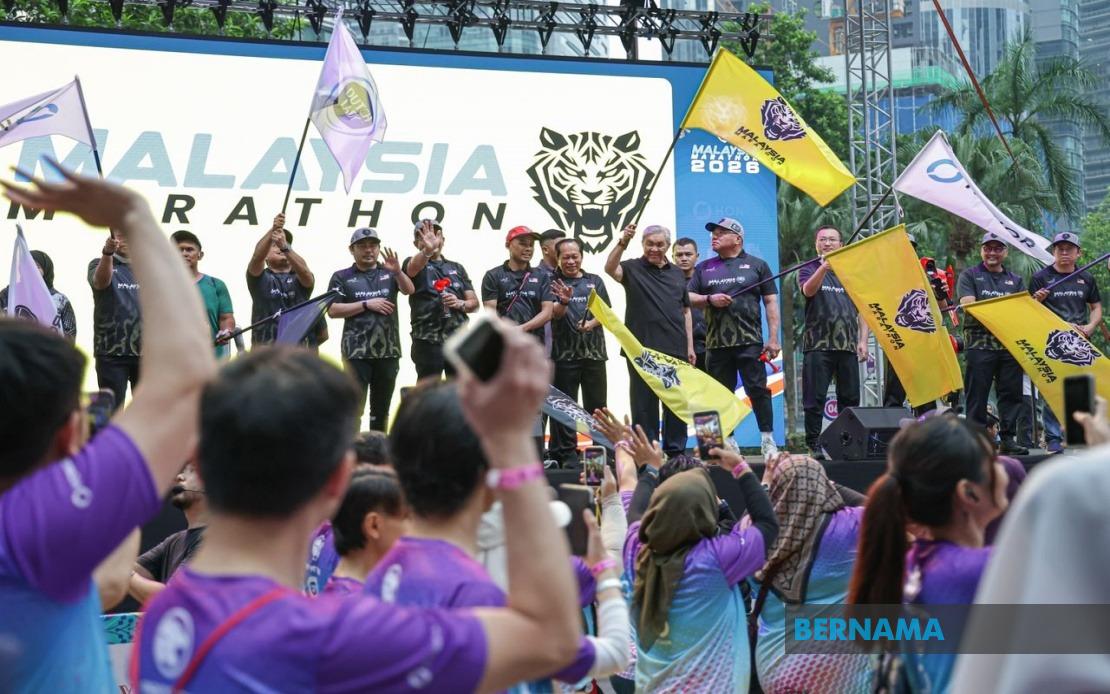
Deputy Prime Minister Datuk Seri Dr Ahmad Zahid Hamidi presided over the launch of Malaysia Marathon 2026 on August 30, setting off 10,000 participants on a 5-kilometre recreational route that formed part of the day's expanded festivities honouring the nation's independence. The event unfolded across the Kuala Lumpur City Centre grounds, strategically timed to align with Malaysia's 2026 National Day observances and positioning the marathon as a flagship celebration of national pride and civic engagement.
The morning's ceremonial proceedings maintained traditional protocol, opening with the rendition of Negaraku before the Malaysian Armed Forces band performed for the assembled crowd. This ceremonial anchor reflected the government's framing of the marathon as more than merely a sporting endeavour—positioning it as a patriotic gathering that interweaves national symbols with contemporary wellness initiatives. The formality underscored official recognition of the event's significance within the broader calendar of national commemorations.
Tourism, Arts and Culture Minister Datuk Seri Tiong King Sing and Deputy Works Minister Datuk Seri Ahmad Maslan flanked Ahmad Zahid throughout the proceedings, their presence signalling cross-ministerial commitment to the initiative. Notably, Tiong had earlier in the morning launched the 42-kilometre Full Marathon division from Pavilion Kuala Lumpur, demonstrating the political establishment's deep engagement with different competition tiers. This staggered start methodology—with the full marathon commencing earliest, followed sequentially by half and 10-kilometre divisions—allowed the fun run to serve as the culminating public ceremony while maintaining competitive integrity across distance categories.
The Malaysia Marathon 2026 achieved recognition from World Athletics, the international governing body for track and field, lending credibility and global standing to the competition. This accreditation signals Malaysia's capacity to host athletics events meeting international standards, relevant given Southeast Asia's emerging role as a major sports tourism destination. The certification carries practical implications for attracting elite international runners and ensuring compliance with professional competition protocols, distinguishing this event from purely domestic recreational initiatives.
Across the entire marathon programme, organisers assembled an impressive field of 25,000 runners distributed among four distance categories. The 42-kilometre full marathon drew 2,000 competitors, representing the most committed athletic participants. The 21-kilometre half-marathon accommodated 8,000 runners, while the 10-kilometre category enlisted 5,000 participants. The fun run swelled these totals significantly, bringing the overall participation to a scale that necessitated careful logistical coordination and course management across multiple starting points and venues throughout Kuala Lumpur.
A particularly noteworthy element involved approximately 1,000 students from Kolej Poly-tech MARA (KPTM) Bangi participating in a one-kilometre Malaysian flag parade integrated into the fun run festivities. This youth engagement component imbued the event with educational dimensions beyond athletic participation, exposing polytechnic students to mass civic participation while linking institutional communities to national commemoration. The flag parade added visual spectacle and demonstrated how large-scale sporting events can incorporate nation-building messaging accessible to younger generations.
The KLCC grounds served as the unified finish line for all race categories on this occasion, marking a departure from established tradition. Historically, Dataran Merdeka has functioned as the traditional terminus for marathon events in Kuala Lumpur. The decision to utilise KLCC reflects both practical considerations regarding crowd management and modern venue capabilities, while simultaneously repositioning the event within one of the city's most recognisable commercial and architectural landmarks. This venue shift carries subtle symbolic resonance, anchoring the marathon within contemporary urban Malaysia rather than heritage sites, though it may provoke discussion among traditionalists regarding the displacement of such events from symbolic national spaces.
The timing of Malaysia Marathon 2026 carries particular significance for Southeast Asian sporting calendars. As the region increasingly competes for international athletic tourism and seeks to establish signature national sporting events, Malaysia's investment in this marathon reflects broader ambitions to enhance its profile within global endurance sports communities. The event's World Athletics recognition positions it competitively within a regional landscape where Thailand, Singapore, and Indonesia similarly promote marathons as lifestyle and tourism draws.
For Malaysian participants, the marathon structure accommodates varying fitness levels through its multiple distance offerings, democratising participation beyond elite athletes. The fun run particularly enables families and recreational runners to participate in festivities without demanding the intensive training regimens required for full or half-marathon distances. This tiered approach expands the event's accessibility and social reach, transforming what might otherwise remain an elite athletic competition into a broader public celebration spanning diverse fitness constituencies.
The integration of National Day commemoration with contemporary sporting culture reflects evolving approaches to national celebration in Malaysia. Rather than confining independence observances to ceremonial or historical retrospectives, the government increasingly embeds them within dynamic, participatory activities that engage citizens across demographic boundaries. The marathon format encourages physical fitness promotion while simultaneously serving nationalism-building objectives, accomplishing multiple policy goals through singular well-coordinated events.
For tourist sectors and hospitality industries, major marathons generate measurable economic benefits through visitor accommodation, dining, transportation, and entertainment spending. The 25,000-participant scale of Malaysia Marathon 2026, combined with expected support from family members and international visitors, positions the event as a meaningful contributor to Kuala Lumpur's tourism economy. Hotels, restaurants, and transportation services anticipate increased demand during race periods, making such sporting events strategic components of tourism development strategies.

