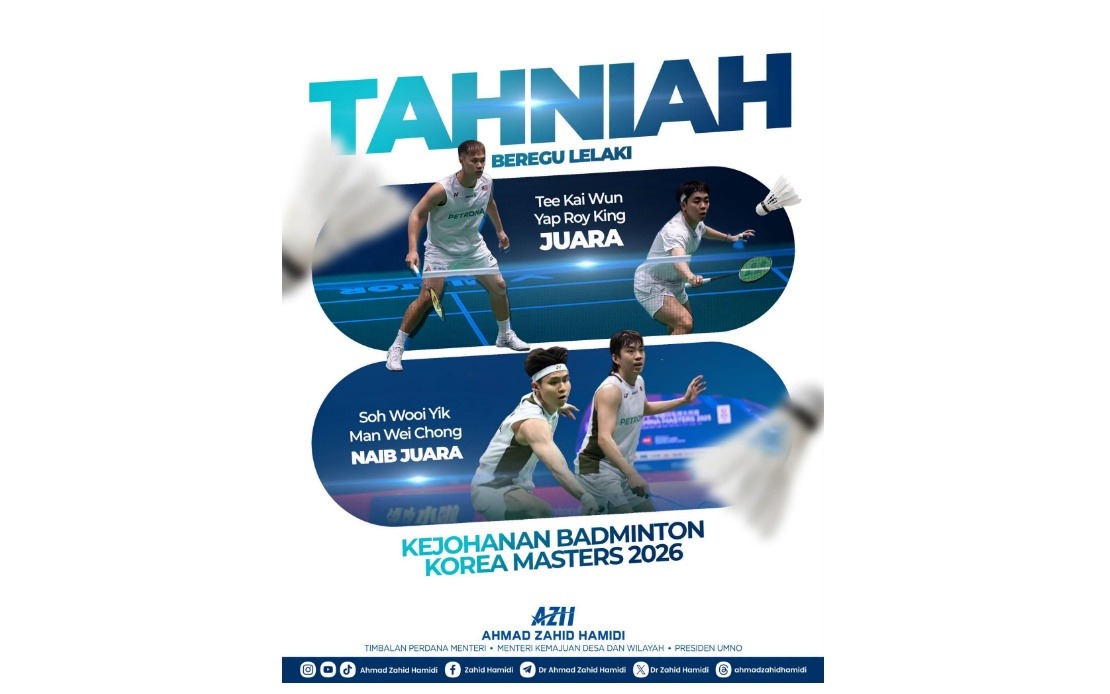
Malaysia's badminton dominance at the 2026 Korea Masters has drawn official commendation from the country's highest sporting circles, with Deputy Prime Minister Datuk Seri Dr Ahmad Zahid Hamidi offering public congratulations to the men's doubles pairs that swept the podium at the tournament. The achievement represents a significant milestone for the sport and underscores the depth of talent emerging from Malaysia's badminton development programmes.
In what proved to be an all-Malaysian showdown, Tee Kai Wun and Yap Roy King captured the title at the Yi Sun-sin Gymnasium in Asan through a clinical performance, dispatching their compatriots Soh Wooi Yik and Man Wei Chong 21-13, 21-18 in a match that lasted 31 minutes. The victory marks the pair's breakthrough moment on the Korea Masters stage, representing their maiden triumph at this prestigious tournament where they had competed previously without reaching the summit.
The dominance displayed by both Malaysian pairings speaks volumes about the competitive standard within the domestic badminton ecosystem. Having two pairs capable of reaching the final and competing at such a level suggests a robust talent pipeline and effective coaching infrastructure that continues to produce world-class athletes. This concentration of success—with Malaysia claiming both the champions and runners-up positions—reflects years of investment in badminton development and the competitive environment cultivated within the Malaysian system.
Ahmad Zahid's public acknowledgement carries particular weight given his standing as the nation's second-highest political figure, signalling that badminton success remains a matter of national importance and pride. In his Facebook statement, the Deputy Prime Minister characterised the performances as providing encouragement for the athletes to sustain their trajectory on the international stage. His remarks underscore how sporting achievement intersects with national identity and collective aspiration, particularly in a sport where Malaysia has established itself as a regional powerhouse.
The Korea Masters holds special significance within Malaysia's badminton narrative. The tournament represents one of the sport's most competitive international venues, where top-ranked pairs from across the globe converge. Success here carries the weight of genuine achievement rather than victories at lesser tournaments. For a Malaysian pair to emerge victorious—let alone for two pairs to dominate the men's doubles bracket—constitutes validation of their standing among the world's elite players.
Historical context further amplifies the achievement. Malaysia previously captured the Korea Masters men's doubles crown in 2024, when Soh Wooi Yik combined with Aaron Chia to claim the title. The recurring success at this particular tournament suggests that Malaysian badminton possesses genuine competitive advantages in doubles play and sustained excellence rather than isolated performances. The fact that Wooi Yik has now featured in two championship-winning efforts at this tournament—once as champion and once as runner-up—demonstrates remarkable consistency and adaptability.
The competitive nature of the final, which remained closely contested throughout and lasted only 31 minutes despite the two-set scoreline, indicates that both Malaysian pairings operated at peak efficiency. Neither pair could be characterised as dominant in the conventional sense; rather, Kai Wun and Roy King executed their tactical approach more effectively under pressure, securing the title through superior execution in critical moments. This quality of competition between the finalists reflects the strength of Malaysian doubles badminton.
For regional badminton development, Malaysia's performance carries implications beyond national borders. The country's consistent tournament victories at the Korea Masters and similar venues reinforce Southeast Asia's credentials as a badminton powerhouse and demonstrate that the region can compete effectively with established badminton nations. Indonesian, Thai, and Vietnamese badminton programmes benefit from the competitive environment that Malaysia helps create through these performances.
The pathway forward for both pairs involves maintaining this momentum into subsequent tournaments while managing the expectations that accompany championship success. Previous Korean Masters champions have found that retaining form across different tournament schedules and opponents presents considerable challenges. Both Malaysian pairings will need to demonstrate consistency, resilience, and continued tactical innovation to sustain their upward trajectory.
Ahmad Zahid's commendation also reflects the broader political recognition that sporting achievement carries diplomatic and soft-power implications. Nations frequently leverage badminton success to enhance international standing and cultural influence. Malaysia's recurring excellence in this arena positions the country as a serious player in international sports, complementing its political and economic engagement with other nations, particularly within Asia-Pacific contexts where badminton enjoys significant cultural resonance and viewership.
Looking forward, the challenge for Malaysia's badminton infrastructure involves converting individual tournament victories into sustained competitive advantage across multiple tournaments and seasons. While the Korea Masters success provides immediate validation and motivation, the true measure of programme effectiveness emerges through consistency across major world championships, Olympics, and consistently competitive tournaments throughout the badminton calendar.

