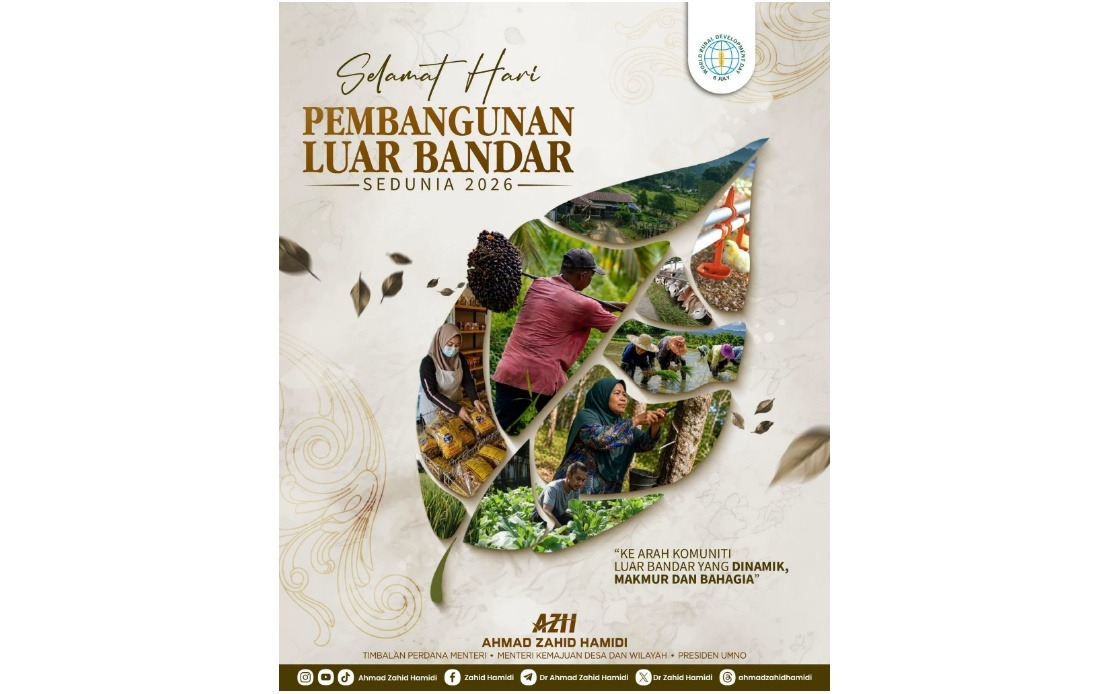
Deputy Prime Minister Datuk Seri Dr Ahmad Zahid Hamidi has underscored the critical responsibility shouldered by the Ministry of Rural and Regional Development (KKDW) in propelling the nation's rural development framework forward with greater urgency and scope. Speaking on the occasion of World Rural Development Day (HPLBS) 2026, Ahmad Zahid emphasised that the ministry must operate with renewed commitment to delivering tangible improvements in the quality of life for Malaysia's rural populations across multiple dimensions.
The designation of July 6 as the annual observance date carries profound symbolic weight within Malaysia's development narrative. Ahmad Zahid highlighted that this particular date corresponds with the founding of the Centre on Integrated Rural Development for Asia and the Pacific (CIRDAP), an institution that has maintained a substantial presence in shaping rural development policies and programmes throughout the Asia-Pacific region for decades. This alignment reflects a deliberate connection between Malaysia's rural aspirations and the broader regional development framework, positioning the country within a larger ecosystem of rural transformation initiatives.
As both Deputy Prime Minister and Rural and Regional Development Minister, Ahmad Zahid articulated a comprehensive vision for rural Malaysia that extends beyond basic infrastructure provision. His statement reflected commitments to expand economic participation among farming and non-farming rural households, enhance public service delivery in remote areas, and foster conditions where rural communities can access opportunities previously concentrated in urban centres. The emphasis on broader economic integration suggests recognition that sustainable rural prosperity depends on connecting village economies to national and regional value chains rather than viewing rural development as a separate policy domain.
The inaugural celebration of World Rural Development Day took place at the Tun Abdul Razak Stadium in Jengka, located near Maran in Pahang state, anchoring the observance within a specific geographical location while signalling the government's commitment to taking the event beyond symbolic gestures. The choice of venue in peninsular Malaysia's interior underscores the practical dimension of rural engagement rather than confining commemoration to capital city venues. This approach demonstrates intentionality in bringing governmental focus directly to communities that form the backbone of agricultural production and resource management in Malaysia.
Three pillars formed the structural foundation of the inaugural celebration: community innovation, rural digitalisation, and rural entrepreneurship development. These pillars represent an evolution in how Malaysia conceptualises rural progress, moving away from purely agrarian frameworks toward a more diversified economic vision. Community innovation acknowledges that rural residents themselves often possess contextual knowledge and problem-solving capacity that government programmes should leverage rather than bypass. This participatory approach contrasts with top-down development models that have historically characterised infrastructure-focused rural initiatives.
The rural digitalisation component addresses a persistent gap in Malaysia's development geography. Despite the nation's advanced digital infrastructure in urban areas, many rural communities remain underserved by high-speed internet, digital payment systems, and e-commerce platforms. Incorporating digitalisation into the World Rural Development Day framework signals governmental recognition that rural economic participation increasingly depends on technological access. For agricultural producers, traders, and service providers in rural Malaysia, digital connectivity translates into market access, price transparency, and ability to participate in the emerging digital economy without relocating to cities.
Rural entrepreneurship development speaks directly to employment generation and income diversification in communities where agricultural returns alone may prove insufficient to sustain viable livelihoods. By elevating entrepreneurship as a central pillar, the government acknowledges that rural Malaysia requires not just farming support but pathways for residents to establish non-agricultural enterprises, from agritourism ventures to small-scale manufacturing. This holistic approach recognises that contemporary rural economies function best when households can combine agricultural activity with supplementary income sources, reducing vulnerability to commodity price fluctuations and climate variability.
For Malaysia's development trajectory, the establishment of an annual commemoration dedicated specifically to rural progress carries implications beyond ceremonial acknowledgement. It institutionalises rural development within the national policy calendar, potentially compelling government agencies and private sector entities to conduct regular assessments of rural programme effectiveness and alignment with stated objectives. The designation also creates an annual focal point where civil society, academic institutions, and international development partners can evaluate progress against rural development benchmarks and propose recalibrations where current initiatives demonstrate insufficient impact.
Regionally, Malaysia's celebration of World Rural Development Day positions the country as an active participant in Asia-Pacific discourse on rural transformation. Many neighbouring countries confront similar challenges regarding agricultural productivity, youth migration from villages, environmental sustainability in farming regions, and equitable distribution of development benefits across urban-rural divides. By engaging with CIRDAP's frameworks and international best practices, Malaysia can both contribute its own policy experiences to regional dialogue and adapt proven innovations from other contexts to local circumstances. This reciprocal learning approach strengthens the analytical foundation underpinning national rural strategies.
For Malaysian rural communities themselves, the World Rural Development Day 2026 celebration represents governmental affirmation that their concerns command national attention and that rural prosperity constitutes a legitimate developmental objective rather than a secondary consideration addressed only when urban priorities are satisfied. The commemorative event, coupled with Ahmad Zahid's emphasis on KKDW's expanded mandate, potentially signals that budget allocations, policy focus, and institutional capacity within the ministry will receive corresponding increases. However, translating such commitments into observable improvements in rural living standards, income levels, and service quality will require sustained implementation effort and measurable accountability mechanisms that extend well beyond annual celebrations.

