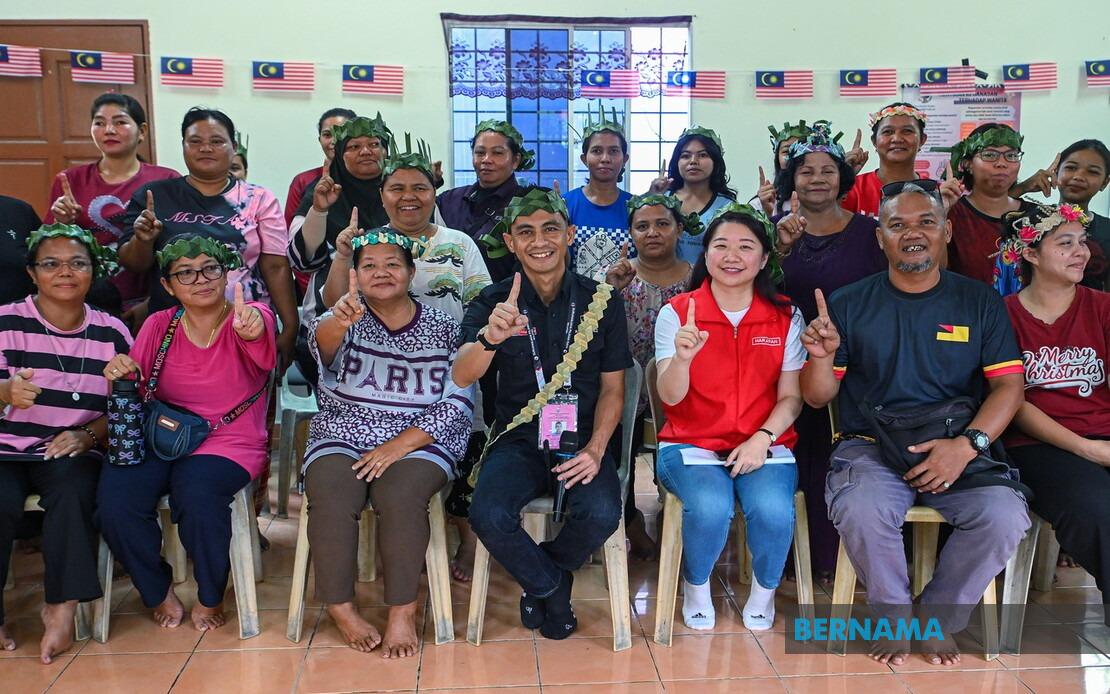
Datuk Ahmad Faez Abdul Razak, the Pakatan Harapan contender for the Labu state assembly seat, has positioned indigenous welfare and community development as central planks of his campaign ahead of the Negeri Sembilan state election. The candidate outlined a comprehensive approach to raising living standards among the Orang Asli population in his constituency, emphasising that economic empowerment and infrastructure expansion would form the backbone of his tenure if voters grant him the mandate.
Speaking after participating in an Orang Asli Women Empowerment programme at Kampung Orang Asli Tekir, Ahmad Faez identified several immediate priorities that directly address long-standing community concerns. Chief among these is bringing the matter of customary land rights in Kampung Orang Asli Tekir before the State Legislative Assembly—a persistent issue that touches on indigenous land security and resource access. This pledge signals recognition of how land rights remain fundamental to economic autonomy and cultural preservation for Orang Asli communities across Malaysia.
Beyond land matters, Ahmad Faez committed to substantial investment in basic amenities that many rural Orang Asli settlements still lack. Road infrastructure and internet connectivity feature prominently in his platform, reflecting an understanding that physical and digital isolation compounds development challenges. These utilities, often taken for granted in urban areas, remain critical bottlenecks limiting market access and educational opportunities for indigenous communities in peripheral regions. The emphasis on internet infrastructure is particularly significant in a post-pandemic context where digital connectivity shapes economic participation and access to services.
Education and youth development represent another pillar of his approach, with Ahmad Faez acknowledging that the younger Orang Asli population possesses considerable potential that remains underutilised without targeted skill-building support. This recognition aligns with broader national conversations about human capital development, though youth empowerment in indigenous communities requires culturally-sensitive programming that respects traditional knowledge while facilitating modern skill acquisition and income generation pathways.
The candidate has identified handicraft production as a sector ripe for development within Kampung Orang Asli Tekir. Rather than proposing extraction or resource-intensive industries, this focus on artisanal goods demonstrates an appreciation for existing community capabilities and cultural practices that can serve as commercial assets. Expanding market access for indigenous handicrafts through structured marketing channels could generate sustainable income while preserving traditional skills—a model increasingly recognised as preferable to wholesale industrialisation in indigenous economies.
Agricultural modernisation forms another component of Ahmad Faez's economic strategy. The introduction of advanced techniques such as fertigation systems would enhance yield reliability and create more weather-resilient farming operations. For communities heavily dependent on agriculture, upgrading production methods addresses both income stability and food security simultaneously, transforming farming from subsistence practice into a more viable economic enterprise capable of supporting population growth.
Ahmad Faez has emphasised continuity in his engagement with the Labu constituency, claiming two years of consistent ground presence and assistance provision prior to the election campaign. This assertion—that his involvement predates the formal election season—attempts to distinguish his candidacy from electoral opportunism, a persistent concern among voters wary of politicians who appear only during campaign periods. Whether this claim withstands scrutiny will influence voter perception of his authenticity and long-term commitment.
Village chief Nasir Musil has lent credibility to Ahmad Faez's claim of sustained engagement, confirming that the candidate numbers among leaders who regularly visit and provide tangible assistance. The village, comprising 796 residents, faces practical challenges that extend beyond developmental priorities—stray cattle constitute a recurring road safety hazard that has escaped resolution despite being a manageable problem. That such basic issues persist underscores governance gaps at state and local levels, and resolution would constitute meaningful delivery on constituent concerns.
Ahmad Faez faces a three-way contest against incumbent Mohamad Hanifah Abu Baker of Parti Pribumi Bersatu Malaysia and Siti Nur Umaira Hasim representing Barisan Nasional. As a first-time contestant, Ahmad Faez enters without the incumbency advantage that typically strengthens sitting representatives, particularly when they have exercised patronage networks and accumulated electoral goodwill. The presence of an incumbent and a Barisan candidate suggests a competitive race where Orang Asli voter preferences could prove decisive in a divided electorate.
The Negeri Sembilan state election framework provides early voting on July 28 with main polling scheduled for August 1. This compressed timeline means Ahmad Faez must rapidly build campaign momentum and translate his policy commitments into concrete voter engagement. For indigenous communities accustomed to political neglect, detailed policy proposals addressing specific grievances may resonate more powerfully than generic development promises that have characterised previous campaigns.
The Orang Asli vote, while numerically modest, holds strategic importance in constituencies with significant indigenous populations. Ahmad Faez's deliberate focus on Kampung Orang Asli Tekir and related Orang Asli concerns reflects calculation that these communities represent winnable segments where targeted advocacy differs from mainstream party messaging. Whether his proposals represent genuine policy commitment or tactical positioning will become evident only through implementation if he secures office.
Broader implications extend beyond the Labu seat. Indigenous welfare has emerged sporadically in Malaysian electoral discourse, typically absent from mainstream party platforms despite Orang Asli constituting 0.6 percent of the national population. Ahmad Faez's foregrounding of customary land rights, infrastructure equity, and community-based economic development—even if solely for electoral advantage—reflects shifting political attention toward historically marginalised communities whose participation in electoral processes remains inconsistent.

