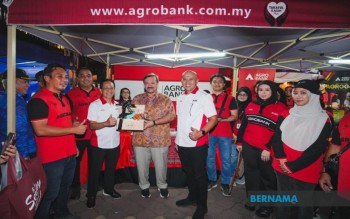
Agrobank is making measurable progress in its mission to democratise access to financing for Malaysia's informal trading sector, with over RM8 million in loan applications gathered through a series of targeted engagement sessions held at night markets and farmers' markets. The initiative represents a deliberate shift towards meeting small business owners where they operate, rather than expecting them to navigate the traditional banking establishment. Finance Minister II, Datuk Seri Amir Hamzah Azizan, attended sessions in Sabah, underlining the government's backing for this approach to financial inclusion.
The bank's outreach strategy has now expanded beyond the Klang Valley to Sabah, with two major engagement events held at the Api-Api Night Market on Jalan Gaya in Kota Kinabalu and the Papar Tamu Farmers' Market. These venues were deliberately selected due to their status as vital nodes of local economic activity, where hundreds of small traders congregate daily to sell goods and services. The Api-Api session alone engaged 153 hawkers and entrepreneurs, while Papar Tamu attracted 95 traders, demonstrating substantial interest among the informal sector in understanding what financing options are available to them.
The significance of this expansion to Borneo cannot be understated for regional development policy. Sabah's small business ecosystem, particularly its hawker and market trader communities, has historically received less targeted financial support compared to urban centres on the peninsula. By bringing Agrobank's engagement directly to trading hubs in the state, the initiative addresses a genuine gap in financial accessibility that has long disadvantaged East Malaysian entrepreneurs. The ground-level approach allows bank representatives to explain complex financing products in straightforward language, reducing the information asymmetry that typically deters informal traders from pursuing formal credit.
Agrobank Group president and chief executive officer, Datuk Tengku Ahmad Badli Shah Raja Hussin, framed the expansion as recognition that different business communities face distinct challenges requiring customised solutions. The bank's presence in Sabah enables staff to develop deeper understanding of local trading patterns, supply chain dynamics, and seasonal income fluctuations that characterise Borneo's informal economy. Rather than applying standardised urban-centric lending criteria, this on-the-ground methodology allows the bank to design financing packages that genuinely fit how small traders actually operate their businesses across the state.
The financing applications being collected focus heavily on working capital needs and business expansion, the two most pressing capital requirements for hawkers operating on thin margins. Working capital—cash needed to purchase daily stock, pay rental stalls, and cover other operational expenses—remains a persistent constraint for informal traders who lack collateral accepted by conventional banks. By specifically targeting this need, Agrobank addresses a real pain point: many hawkers rely on informal credit sources at punitive interest rates or depend on family lending, limiting their ability to invest in growth or weather financial shocks.
This initiative operates within a broader government push to accelerate small business financing across the economy. Prime Minister Datuk Seri Anwar Ibrahim has directed financial agencies to step up their outreach efforts and disburse RM5 billion in financing to small traders. Agrobank's engagement sessions represent one tangible mechanism through which this directive is being operationalised, moving beyond policy announcements to create actual lending pipelines. The RM8 million in applications already gathered demonstrates that when banks make financing accessible and comprehensible to informal traders, demand responds quickly.
The hawker and micro-entrepreneur sector occupies an outsized role in Malaysia's economy and society. Beyond their contribution to GDP and employment, night markets and farmers' markets are cultural and social institutions, gathering places where communities interact. They also function as training grounds where young Malaysians learn business fundamentals. Yet this sector has historically been underserved by formal finance, a gap that perpetuates cycles of slow growth and limits intergenerational mobility. Agrobank's programme, by improving access to capital and financial advisory services, creates potential for more structured, sustainable business development.
The non-financial support components of Agrobank's initiative deserve particular attention. Beyond extending credit, the bank is positioning itself as a provider of business guidance and management support tailored to small traders. This holistic approach recognises that capital alone does not guarantee business success; traders require knowledge on bookkeeping, inventory management, pricing strategy, and risk management. By bundling financing with advisory services, Agrobank increases the likelihood that borrowed capital is deployed effectively, reducing default risk while genuinely improving business outcomes.
The expansion to Sabah also reflects shifting demographic and economic realities within Malaysia. Sabah's population continues to grow, and urbanisation in Kota Kinabalu and other towns has created expanding hawker and trader communities. Yet the state's financial infrastructure has not always kept pace with this growth. Banking penetration among informal traders in Sabah lags behind peninsula figures, partly due to geographical dispersion and partly due to limited engagement by major financial institutions. Agrobank's presence directly addresses this infrastructure gap.
Looking forward, the engagement sessions are likely to continue expanding to other states and markets. The model is replicable across Malaysia, from Peninsular Malaysia's numerous night markets to Sarawak's tamu trading networks. Each region has unique characteristics that Agrobank's teams will need to understand, but the core principle—bringing financing options directly to traders in their own commercial spaces—remains universally applicable. If sustained and scaled appropriately, this programme could catalyse significant improvements in informal sector access to formal credit.
The strong response evident in the RM8 million in applications suggests that supply-side barriers to informal trader financing may be more significant than demand-side constraints. Many traders have expressed willingness to borrow formally if terms are reasonable and processes are transparent. The challenge has been one of institutional reach and willingness, which Agrobank's strategy directly confronts. As more applications progress through the approval process and capital flows to traders, the real test will emerge: whether this financing actually translates into sustained business growth and improved livelihoods for Malaysia's informal business community.

