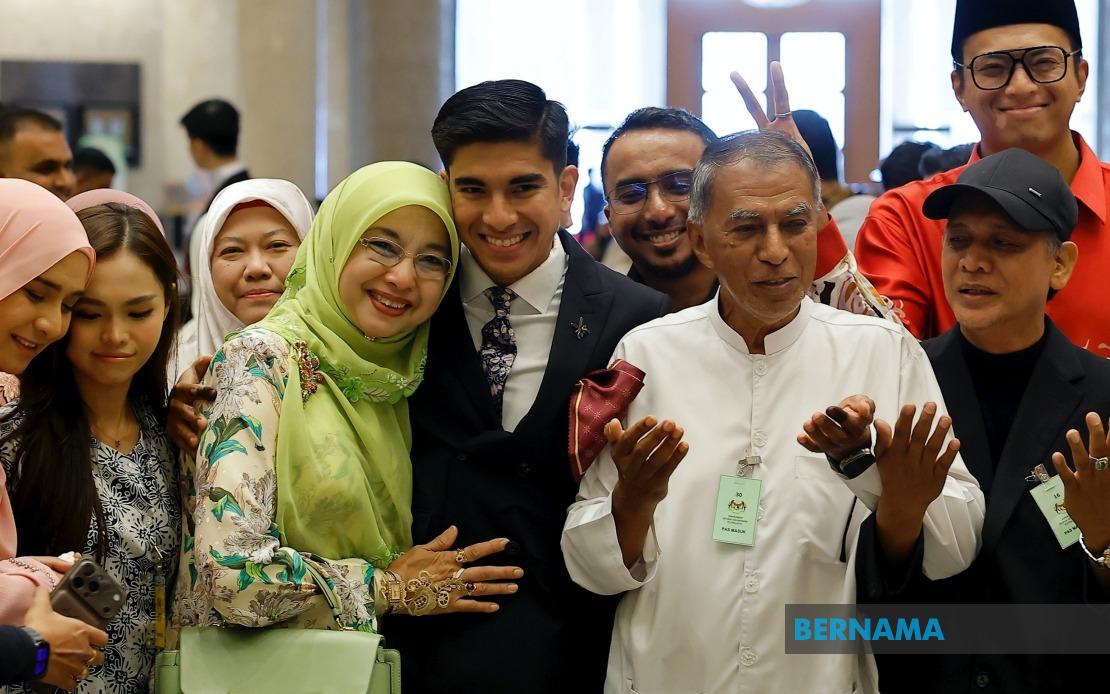
The Federal Court has brought to a close a prolonged legal chapter for Muar Member of Parliament Syed Saddiq Syed Abdul Rahman, upholding his complete acquittal on four charges of abetting criminal breach of trust, misappropriation of property, and money laundering connected to funds belonging to Angkatan Bersatu Anak Muda (Armada). The 33-year-old politician, who performed a sujud syukur alongside his family upon hearing the verdict at the Palace of Justice in Putrajaya on July 13, characterised the outcome as vindication that justice and truth ultimately triumph—a statement that resonates beyond his personal circumstances and carries weight for Malaysia's broader judicial standing.
The journey spanning six years has proven consequential not merely for Syed Saddiq himself but for his immediate family, political circle, and supporters who witnessed the protracted proceedings. His observation that the ordeal affected "not only me, but especially my parents, family, friends, supporters and the political landscape" underscores the ripple effects of prolonged criminal litigation on public figures. For Malaysian readers accustomed to high-profile political prosecutions, the case exemplifies both the capacity of the courts to eventually exonerate defendants and the substantial personal toll such processes exact, particularly when they span multiple years and involve allegations touching governance and institutional integrity.
In remarks delivered to assembled journalists at the Palace of Justice, Syed Saddiq articulated a philosophical position grounded in principle and institutional faith. He stressed that his conviction that "courage comes from being in the right" sustained him through what he characterised as seemingly hopeless circumstances. This framing carries significance for Malaysian political discourse, where questions about the impartiality and independence of the judiciary have periodically surfaced. By publicly endorsing the independence of Malaysia's justice system and describing it as foundational to national strength, the acquitted politician has signalled confidence in judicial institutions at a moment when such affirmations matter for public confidence.
The former youth and sports minister's emphasis on maintaining integrity and dignity "even when there appears to be no light at the end of the tunnel" reflects a personal philosophy that extends beyond his individual case. For observers tracking Malaysia's political trajectory, his insistence that one should "never compromise our principles, integrity or dignity for an easy way out" carries implicit commentary on how political figures ought to conduct themselves under legal pressure—a message pertinent in a regional context where questions of governance and institutional accountability remain contested terrain.
Syed Saddiq's announcement that he intends to step back from active political engagement to concentrate on family matters and settle personal affairs suggests that the legal ordeal has prompted a recalibration of priorities. Though he confirmed his ongoing affiliation with MUDA and his obligation to attend parliamentary sittings, his explicit statement that he requires time before determining his political future indicates the exhaustion accompanying extended legal proceedings. For MUDA and its supporters, this development introduces uncertainty regarding leadership direction and the party's trajectory as it matures beyond its initial formation phase.
The politician's reference to obtaining parental blessing to proceed with wedding plans provides a human dimension often absent from conventional political reporting. This detail illustrates how criminal litigation intersects with the ordinary life events of public figures, and how vindication permits the resumption of personal milestones that may have been deferred during the pendency of charges. It also reflects the family-centred considerations that frequently shape the decision-making of Malaysian political actors, where parental approval carries substantial significance.
Counsel Datuk Hisyam Teh Poh Teik's expression of gratitude to the judicial panel and acknowledgement of the defendant's family trust signalled professional satisfaction with the verdict while honouring the collaborative dimension of legal defence. The lawyer's statement reflected standard practice in high-profile cases where legal teams operate under considerable scrutiny and where vindication requires not only judicial confidence but also coordination among multiple practitioners.
The prosecution's posture, as articulated by Deputy Public Prosecutor Datuk Wan Shaharuddin Wan Ladin, emphasised respect for the court's determination whilst preserving the possibility of seeking review of the decision. His statement that the Attorney General's office would determine whether to pursue such recourse underscores the bureaucratic dimensions of criminal procedure, where institutional actors must weigh the costs and benefits of continued litigation against the finality that judgements represent. The fact that the prosecution had not immediately decided on this question suggests ongoing internal deliberation about the strategic implications of further legal contest.
For Malaysia's legal profession and judicial observers, the case's conclusion represents a moment of institutional validation. The Federal Court's decision to uphold the acquittal affirms that even when prosecutions proceed through extended timeframes and reach appellate levels, courts retain capacity to scrutinise evidence rigorously and acquit defendants where foundations prove insufficient. This capacity matters for the maintenance of public confidence in judicial processes, particularly when ordinary citizens observe high-profile figures navigating the system.
The broader context for Malaysian readers extends to questions about how prosecutions involving political figures are initiated, managed, and concluded. The Armada funds case emerged during a period of significant political upheaval and transition in Malaysian governance, and its resolution at this juncture allows reassessment of whether prosecutorial decisions reflected genuine criminal malfeasance or represented expressions of broader political contestation. The acquittal necessarily invites reflection on these origins, though judicial proceedings themselves remain focused on evidentiary sufficiency rather than prosecutorial motivations.
Syed Saddiq's expressed determination to advocate for judicial independence suggests that the experience has crystallised his commitment to institutional strengthening rather than diminished his engagement with governance questions. His statement that he would "continue defending the independence of the country's justice institutions" positions him as a stakeholder in broader conversations about rule of law and institutional architecture—conversations increasingly salient across Southeast Asia as democracies navigate questions about judicial autonomy and political accountability.

