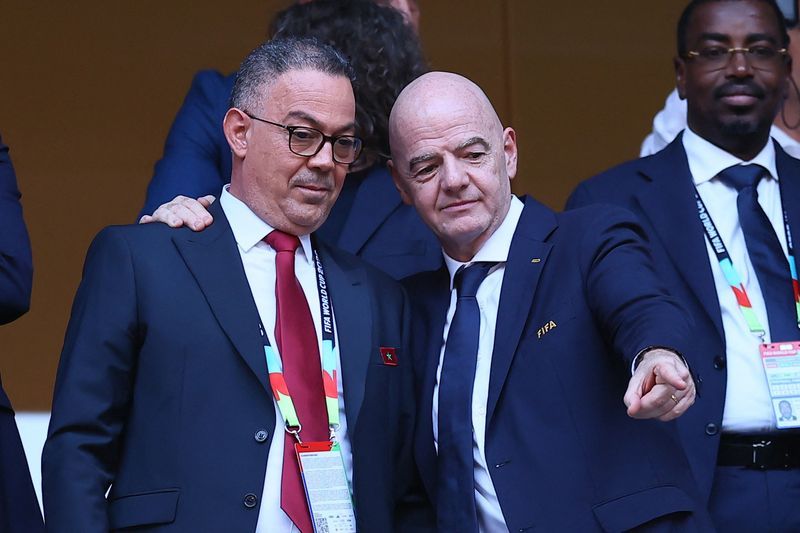
Gianni Infantino's embattled presidency received a significant lifeline from Africa's football establishment this week, with influential continental administrators throwing their weight behind the FIFA chief as he navigates mounting pressure from other regions questioning his leadership. The carefully timed declarations of support from African football figures offer Infantino a potential bulwark against criticism that has already cost him backing elsewhere, positioning the continent's 54 member associations as his most reliable voting bloc when FIFA's membership heads to the polls in March for the presidential election.
The backing comes strategically positioned after Infantino abandoned his FIFA Forward Enterprise initiative, a controversial proposal that would have generated $4.2 billion by establishing a new commercial entity to monetise future World Cup broadcasting and sponsorship rights. The plan's collapse under sustained global pressure appears to have satisfied key African decision-makers, who have issued statements welcoming the about-face while simultaneously endorsing Infantino's continued leadership of world football's governing body. This calculated timing suggests African football leaders view the revenue scheme's termination as a sufficient concession whilst remaining committed to maintaining their alliance with the FIFA president.
Asia, Europe, and CONCACAF—the regional confederation overseeing North and Central America and the Caribbean—had already withdrawn their confidence in Infantino's direction within days of the revenue proposal's announcement. The Confederation of African Football, however, has adopted a notably measured stance, neither rushing to condemn Infantino nor explicitly endorsing him at the continental level. This strategic restraint appears deliberate, allowing individual influential figures to express personal support whilst keeping CAF's formal machinery noncommittal, a positioning that affords African football maximum flexibility in the months ahead.
Five prominent African football administrators have emerged as Infantino's most vocal supporters, creating a faction within CAF that elevates his prospects substantially. Fouzi Lekjaa, CAF's Vice President from Morocco, and fellow FIFA Council members Hany Abo Rida of Egypt, Hamidou Djibrilla of Niger, and Ahmed Yhaya of Mauritania have all released statements endorsing the FIFA president. Additionally, Veron Mosengo-Omba, the newly elected president of the Democratic Republic of Congo's football federation and a former CAF general secretary, has added his voice to the chorus—a particularly notable endorsement given his personal connection with Infantino through university studies together in Switzerland.
The arithmetic of FIFA electoral politics explains why African support matters so decisively to Infantino's survival. African nations provided the foundation for his initial election victory in 2016, driven largely by his pledge to dramatically expand the volume of development funding channelled to member associations across the continent. This financial commitment has proven remarkably sticky, keeping Infantino broadly popular among African football federations that operate under chronic budgetary constraints and have become substantially dependent on FIFA's regular disbursements to sustain their operations. The continent's footballing infrastructure, institutional capacities, and competitive capabilities remain inextricably linked to these international finance flows.
The disparity in resources between wealthy and developing football nations remains stark and deeply entrenched. Saïd Ali Athouman, president of the Comoros Football Federation, articulated the fundamental challenge confronting African football administrators: sponsorship remains elusive across most of the continent, leaving member federations unable to finance even basic player development, training facilities, and equipment that wealthier nations take for granted. The consequence is a compounding inequality wherein wealthy European and established Asian football programmes continuously outpace African competitors, a structural disadvantage that cannot be overcome through tactics or organisation alone.
Malawi's football federation similarly struggles with existence-level challenges. Football Association of Malawi President Fleetwood Haiya highlighted the impossible calculus facing government decision-makers in developing nations: basic healthcare, nutrition, and essential public services compete directly with football investment for limited state resources. Under these circumstances, FIFA's financial transfers become not merely beneficial but functionally essential for maintaining any competitive football programme whatsoever. This dependency creates a powerful incentive for African members to maintain favourable relationships with FIFA leadership, particularly presidents who have demonstrated willingness to channel resources toward the continent.
Infantino's financial architecture for supporting member associations remains historically significant. FIFA's baseline funding guarantees each of its 211 member associations an annual payment of $8 million across four-year cycles, supplemented by CAF's own grants to its continental membership. This mechanism originated with Sepp Blatter, Infantino's predecessor, who pioneered the strategy of offering financial payments to member associations as an electoral incentive in his 1998 campaign against European challenger Lennart Johansson. The strategy proved decisive then and has remained politically powerful across three decades, cementing the principle that FIFA leadership willing to redistribute revenue broadly garners substantially stronger global support than those who do not.
Infantino substantially expanded upon Blatter's foundational model, rebranding the initiative from the Goal Project to FIFA Forward whilst simultaneously expanding the financial commitments involved. This amplification has proven politically shrewd, creating a genuine constituency of poorer nations whose operational viability depends materially on Infantino's continued control of FIFA's resource distribution apparatus. The political economy is straightforward: removing Infantino risks disruption to funding flows that African federations have come to expect and budget around, creating rational incentives for African leaders to defend him against external criticism originating from wealthier regions.
CAF's formal stance remains cautious, with the continental confederation indicating the FIFA Forward Enterprise initiative remains on its agenda for internal discussion but offering no guarantee of taking any definitive position on Infantino's presidential prospects. This ambiguity preserves flexibility for CAF leadership whilst individual administrators express personal positions. The distinction between CAF's institutional voice and the statements of particular influential members creates plausible deniability whilst enabling de facto support to crystallise through accumulated individual endorsements. This approach allows African football's formal governance structures to avoid explicit commitment whilst permitting the political reality of African backing to become unmistakable.
The contrast between African leaders' measured response and other regions' swift withdrawals of confidence reflects divergent interests and leverage points. Infantino's relationship with Africa's football community has been substantially mediated through financial distribution mechanisms that other regions either do not require or cannot leverage as effectively. CAF members cannot afford to indulge the luxury of symbolic gestures regarding governance principles when immediate operational survival depends on predictable funding flows. This asymmetry in bargaining power explains why African football's relationship with Infantino differs fundamentally from Asian, European, and North American leadership perspectives, positioning his African support as genuinely consequential for his electoral survival.

