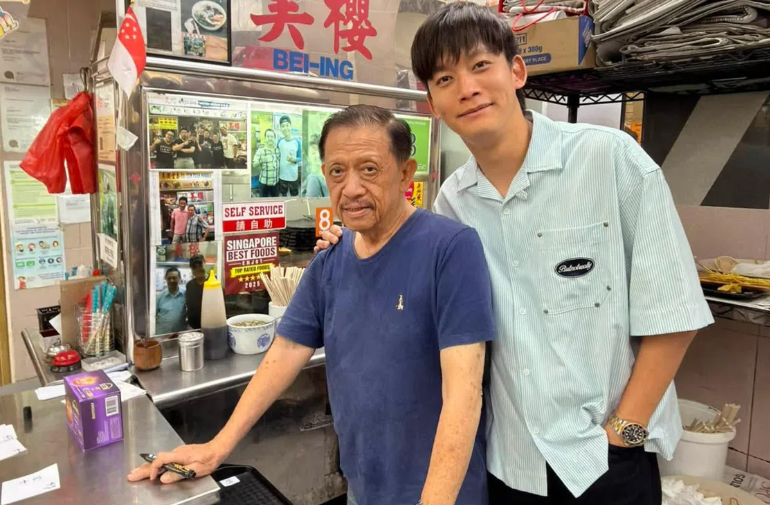
Singaporean actor Noah Yap has rejected criticism from internet users who contend that his visit to an injured elderly hawker at Roxy Square was calculated to generate positive media attention. The actor mounted a spirited defence on social media, responding to allegations that he orchestrated the encounter to capitalise on public sympathy and steal the spotlight during a period when others were also drawing attention to the incident.
Yap's counterargument rested on the foundation of a longstanding relationship with the hawker, identified as Yeo, and his family. According to the actor's account, his patronage of Bei-Ing Wanton Noodle extends back more than two decades, originating during his primary school years. This extended history, Yap contended, rendered the suggestion of opportunism implausible, as the connection predated any contemporary publicity considerations. He emphasised that Yeo and his relatives had consistently shown genuine interest in his life and wellbeing during his regular visits to the stall, with Yeo functioning as a familial figure throughout his formative years.
The dispute arose following an altercation on August 15 involving the elderly hawker and a younger man at a coffee shop, an encounter captured on video that circulated widely across digital platforms. Accounts provided by Yeo and his family members indicated that the hawker had observed a young child he found endearing whilst moving through the establishment after shutting down his stall for the day. In what he characterised as an innocent gesture, Yeo gently placed his hand on the child's head. The girl's father, however, perceived the action differently and subsequently approached Yeo, resulting in a physical confrontation. Surveillance footage that emerged online appeared to depict the younger man forcibly grabbing Yeo and propelling him to the ground, an assault that prompted police involvement.
Yap made his visit to Yeo the afternoon following the incident, on August 16, discovering the elderly hawker in surprisingly positive spirits despite the physical trauma he had endured. Notably, Yeo displayed initial reluctance to obtain professional medical evaluation for his injuries, a reluctance that Yap did not push back against but rather documented and shared across his social media channels. This decision to publicise the encounter became the focal point of subsequent criticism, with online detractors interpreting the social media activity as a calculated effort to amplify the incident for personal benefit and attention.
The actor's response to these allegations carried a notably exasperated tone. He invited the critics to reflect on the constraints of his actual schedule, suggesting they fundamentally misunderstood the demands on his time and energy. The implication was that maintaining the facade of publicity-seeking on social media represented an inefficient allocation of effort compared to his actual professional commitments, including his current starring role in a Channel 5 police drama. Yap's retort functioned simultaneously as both a denial and a mild rebuke of the critics' assumptions regarding celebrity motivation and behaviour.
In his substantive defence communicated through social media, Yap articulated a rationale for publicising his visit centred on raising community awareness regarding the assault itself. Rather than positioning his post as a vehicle for personal aggrandisement, he framed it as a mechanism for drawing attention to an instance of violence against an elderly person and generating broader discussion about the incident. This framing attempted to reposition his social media engagement from self-promotion to community advocacy, a rhetorical distinction that invited consideration of his actual motivations.
Beyond the specific controversy surrounding his visit, Yap's social media statement incorporated a broader moral commentary on the incident. He underscored that violence represents an unacceptable response to any circumstance and appealed to his audience to cultivate greater kindness and compassion toward one another in their daily interactions. This messaging situated the hawker incident within a larger conversation about social values and interpersonal conduct, broadening the dialogue beyond the immediate parties involved to encompass societal norms and expectations.
The police had previously confirmed receipt of a formal report regarding the altercation and indicated that investigations remained ongoing at the time Yap made his public statements. This ongoing investigative process underscored the seriousness with which authorities were treating the incident involving the elderly vendor. The incident, whilst originating in a localised setting at a specific coffee shop, had transcended its original context through viral video circulation, transforming a personal conflict into a matter of broader public discussion and scrutiny.
For Malaysian observers, the episode provides insight into contemporary Singapore's social dynamics and the intersection of celebrity engagement with community issues. The willingness of a prominent public figure to publicly associate himself with an elderly working-class victim of violence, alongside his vigorous defence of doing so against detractors, reflects evolving attitudes toward social solidarity and celebrity responsibility. The incident simultaneously illuminates the pervasive scepticism with which social media engagement from public figures is frequently received, where benign actions risk reinterpretation through suspicion. The exchange between Yap and his critics encapsulates broader tensions within digital discourse regarding authenticity, motivation, and the legitimate role of celebrities in highlighting social grievances, questions that resonate across Southeast Asia's interconnected media landscape.

