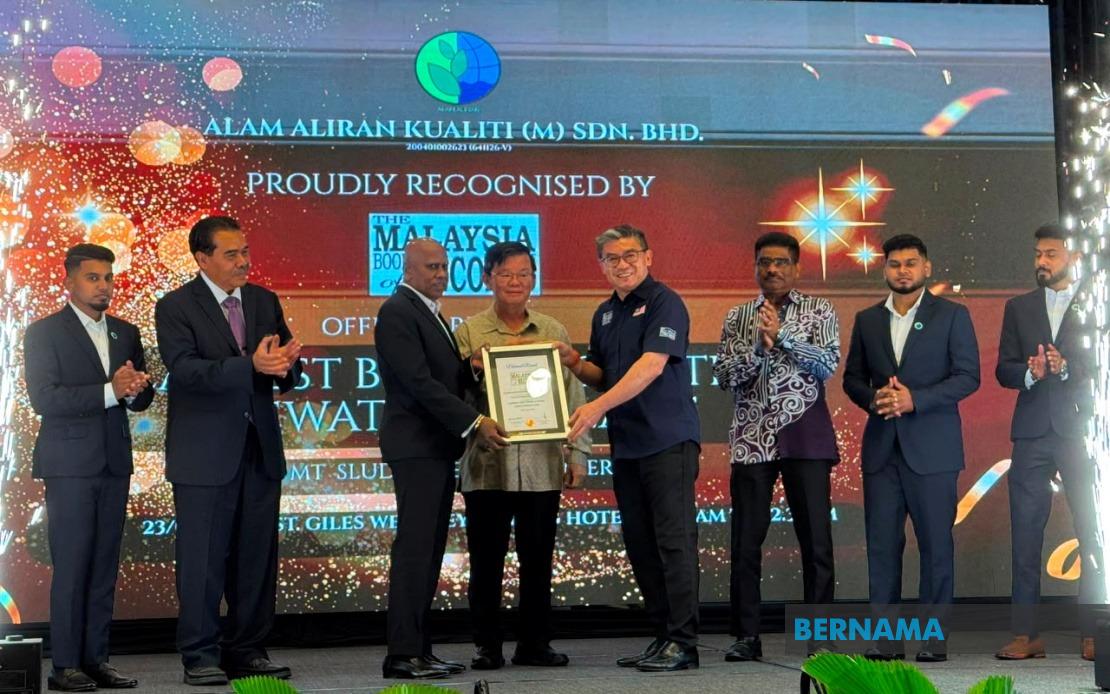
Alam Aliran Kualiti (M) Sdn Bhd (AAK) has been formally recognized by the Malaysian Book of Records (MBOR) for operating the country's largest belt press system dewatering plant, a facility located in Sungai Dua that was jointly developed with Perbadanan Bekalan Air Pulau Pinang (PBAPP). The accolade, presented in George Town on July 23, represents a significant validation of Malaysian engineering capabilities in addressing environmental infrastructure challenges that confront water utilities across Southeast Asia.
The Sungai Dua facility operates at a treatment capacity of 10 million litres per day and handles approximately 450 tonnes of water treatment sludge on a daily basis. This scale of operation positions the plant as a critical component of Penang's water management infrastructure, tackling one of the industry's most persistent problems: the disposal and processing of byproducts generated during conventional water purification. The capacity represents a substantial leap forward in Malaysia's capacity to manage water treatment residuals sustainably, moving beyond traditional landfill disposal methods that have long dominated the sector across the region.
AAK director Gokulaan Balan characterised the MBOR recognition as a launching point rather than a culmination, emphasising that the achievement establishes a foundation for accelerated innovation in environmental engineering. His remarks underscore a broader strategic shift within Malaysian industry toward positioning domestic expertise as competitive with international standards. The director articulated that the recognition validates Malaysian firms' ability to conceptualise, engineer, and operate world-class environmental solutions—a capability particularly valuable as water scarcity intensifies throughout Southeast Asia and neighbouring regions grapple with ageing treatment infrastructure.
What distinguishes this facility from conventional dewatering plants is its integration into a broader circular economy model. The Sungai Dua operation does not merely process and dispose of sludge; rather, it transforms water treatment residuals into Eco Green Cement Bricks, a construction material suitable for industrial applications. This value-addition approach fundamentally alters the economics of waste management, converting a cost centre into a revenue-generating operation while simultaneously addressing Malaysia's construction material demands. The transition reflects evolving thinking among Southeast Asian water authorities, which increasingly recognise that sustainability metrics must incorporate economic viability to achieve genuine long-term implementation.
Penang Chief Minister Chow Kon Yeow highlighted how the facility exemplifies the intersection of innovation and practical economic benefit. By recovering treated water and channelling it back into the treatment process, the plant simultaneously reduces fresh water consumption and mitigates losses within Penang's distribution network—a concern of mounting urgency as the state confronts competing demands from industrial, agricultural, and domestic users. The recovered water mechanism also strengthens Penang's water security posture, creating redundancy and resilience within the supply chain during periods of scarcity or disruption.
The alum sludge processing represents a particularly valuable application within the Malaysian context. Alum sludge constitutes one of the most voluminous byproducts of conventional water treatment, and its disposal has traditionally required dedicated landfill space or long-distance transportation to treatment facilities. By integrating this sludge into construction materials production, the Sungai Dua plant addresses both waste management pressures and material supply constraints simultaneously. For nations throughout Southeast Asia managing rapid urbanisation and construction expansion, the availability of sustainable building materials produced from treatment plant residuals presents an attractive alternative to virgin material extraction.
AAK, established in 2004, has progressively positioned itself as a specialist in environmental engineering and scheduled waste management throughout Malaysia. The company's two-decade operational history demonstrates institutional knowledge in navigating the intersection of regulatory requirements, technical feasibility, and economic viability—domains where many regional competitors falter. The Sungai Dua and associated Eco Green Brick Manufacturing facilities represent the maturation of the company's strategic vision, demonstrating that Malaysian firms can successfully execute complex, integrated waste management systems serving multiple stakeholder constituencies.
The project's structure illustrates how public-private collaboration can advance environmental infrastructure in Malaysia. PBAPP's involvement alongside AAK ensured that operational requirements of a major water utility informed facility design and management protocols from inception. This partnership model contrasts with some regional implementations where facility design and utility operation proceed as separate endeavours, frequently resulting in mismatch between treatment capacity and actual operational needs. The collaborative approach evident in the Sungai Dua project offers valuable lessons for other Malaysian water authorities considering modernisation of treatment infrastructure.
Recognition through the Malaysian Book of Records carries symbolic weight extending beyond the facility itself. Such validation signals to international investors, regional peers, and domestic stakeholders that Malaysian engineering firms possess technical sophistication equivalent to established competitors. For water utilities throughout ASEAN facing comparable challenges, the Sungai Dua precedent demonstrates that solutions need not be imported wholesale from Western firms; instead, domestic expertise can deliver equivalent or superior outcomes while maintaining stronger alignment with local operational contexts and supply chains.
The dewatering plant's significance amplifies as water stress accelerates throughout the region. Penang, despite its historical association with abundant water resources, now ranks among Malaysia's most water-stressed states due to population concentration and competing agricultural demands. The Sungai Dua facility's contribution to overall water security—through process water recovery and reduced treatment residual volume—makes it instrumental to maintaining reliable supply during drought conditions or emergency situations. The model developed at Sungai Dua therefore transcends Penang's administrative boundaries, offering technical and conceptual frameworks applicable to water authorities across Malaysia and Southeast Asia.
Moving forward, the MBOR recognition positions AAK and its partners to explore expansion of the circular economy model beyond water treatment sludge. Opportunities exist to integrate additional waste streams from PBAPP operations, manufacturing facilities, and other industrial sources into the Eco Green Brick production process. Such expansion would further enhance the economic resilience of the facility while addressing multiple environmental challenges simultaneously. The recognition equally creates export potential, as regional utilities facing analogous challenges seek proven solutions that have achieved both technical validation and operational success.
The broader implications extend to Malaysia's positioning within global environmental technology markets. As developed nations increasingly prioritise circular economy principles and sustainable infrastructure, Malaysian firms demonstrating expertise in these domains gain competitive advantage in a sector projected to expand substantially over coming decades. The Sungai Dua facility serves as a tangible asset in marketing Malaysian environmental engineering capabilities internationally, potentially catalysing technology transfer opportunities and joint venture arrangements with regional and global partners seeking local expertise.

