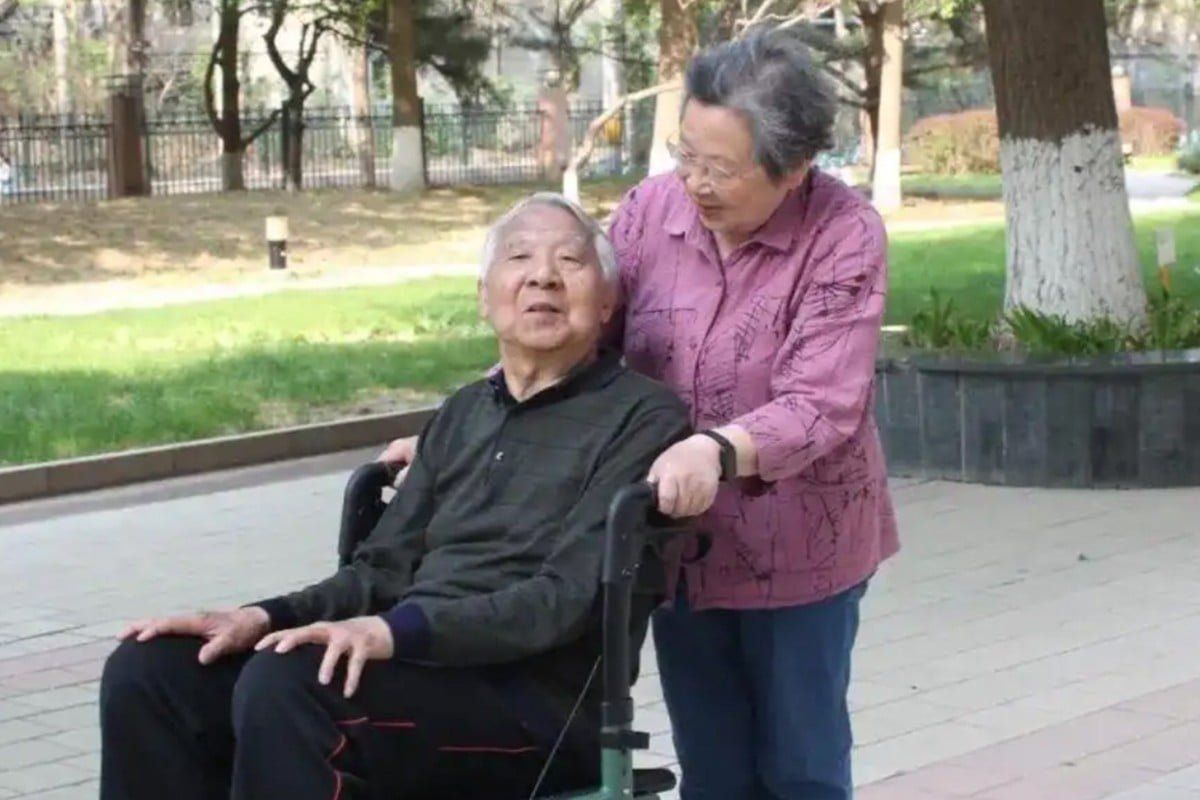
At 90 years old, Wen Bo has become an unlikely digital celebrity across mainland China, not for her own achievements but for the quiet, methodical way she tends to her husband's fading memory. What began as a private mission to maintain her partner's sense of self has blossomed into a movement, with millions following her RedNote diary entries documenting the intimate terrain of Alzheimer's care. Her story carries particular resonance in Southeast Asia, where rapid ageing populations and shifting family structures are forcing societies to reimagine what eldercare looks like and what dignity means when cognitive decline sets in.
Wen and her husband share a romance spanning over six decades. Meeting as teenagers in secondary school, they endured years of long-distance courtship before marrying in 1960, building a life together that weathered China's most turbulent decades. They raised two sons, cultivated active hobbies including swimming and walking, and enjoyed travels across China and beyond. By all measures, they had constructed the kind of partnership many aspire to—one grounded in shared experience and mutual exploration. That stability fractured in 2023 when her husband began losing his grip on memory while facing incontinence issues. The subsequent Alzheimer's diagnosis transformed their relationship overnight from one of companionship between equals to one of caregiver and charge.
Rather than burden her adult sons, who carry their own professional and family responsibilities, Wen made a deliberate choice to become her husband's full-time carer. This decision reflects a value system increasingly at odds with modern family economics, yet it also speaks to the profound commitment that defined their marriage. Working alongside a domestic helper who manages cooking and household logistics, Wen took on the primary responsibility for her husband's cognitive and physical wellbeing. Her sons visit when schedules permit, but the daily labour of care—the medications, the exercises, the emotional scaffolding—falls to her alone.
What distinguishes Wen's approach from conventional caregiving is her philosophical stance. Rather than viewing Alzheimer's as a condition that strips away personhood, she treats cognitive decline as a challenge to be managed while the person remains fundamentally intact. She embarked on an autodidact's journey, teaching herself about the disease through books and online resources, then designing a structured daily regimen of cognitive exercises. Mathematics problems, puzzles, and painting sessions occupy their afternoons. Physical training maintains his motor skills. These are not mere busywork but deliberate interventions informed by her self-education and shaped by her intuition about what might slow deterioration.
The results have been modest but meaningful. Her husband's cognitive decline has proceeded at a slower trajectory than typical Alzheimer's progression. He remains mobile enough to operate an electric wheelchair independently, suggesting that the combination of cognitive stimulation and physical activity may be yielding measurable benefits. More poignantly, moments of lucidity persist—he occasionally reminds his wife to rest, a gesture suggesting that beneath the fog of memory loss, some capacity for concern and reciprocity endures. These small victories matter enormously in the lived experience of Alzheimer's families, offering evidence that the disease need not progress as an inexorable downward slide.
Wen's chronicle of this journey on social media has touched a nerve, attracting millions of followers who see in her story something they hunger for. She documents the mundane details of caregiving—her husband completing an arithmetic test with only one error, taking longer than before but persisting—with the kind of specificity that rings true to those navigating similar terrain. Particularly striking is her nightly ritual of reminding him of her name before sleep, a practice rooted in a conviction that has become her caregiving manifesto: "He has to remember my name. I am his wife. I should be the last person he forgets." This statement encapsulates a vision of care in which the caregiver's identity remains anchored within the relationship rather than dissolved into the role.
Beyond the individual story lies a broader social philosophy that Wen has articulated clearly: people with Alzheimer's must not be defined solely by their illness. She insists that self-respect, a sense of existing as a meaningful participant in life, and the feeling of being needed remain essential even as memory fragments. This stance positions her against a more passive model of elder care that can infantilise or marginalise those experiencing cognitive decline. She actively involves her husband in simple household tasks, allowing him the dignity of completing them at his own pace rather than being managed as a dependent. The message is subtle but radical: involvement matters; autonomy, even in small forms, preserves something vital.
Wen's narrative arrives at a moment of demographic urgency across China and the broader East Asian region. China's population aged 60 and above exceeded 320 million people by the end of last year, surpassing one-fifth of the total population. These figures represent not merely a statistical shift but a civilisational recalibration. Families face unprecedented pressure as traditional multi-generational arrangements fracture under the weight of urbanisation, migration, and reduced fertility. The question of how to age with dignity—and how to support those whose minds are no longer reliably their own—has become urgent and unavoidable.
For younger Chinese navigating an uncertain future, Wen's example offers an alternative narrative to the despair that sometimes accompanies discussions of ageing in contemporary societies. One social media observer noted that Wen's posts "bring comfort" by presenting "an ideal later life: being with the person you love while living independently." Another recognised the practical value, acknowledging that watching Wen's journey had transformed anxiety about caring for ageing parents into genuine confidence. These responses suggest that the visibility of thoughtful, dignified caregiving can reshape cultural expectations and reduce isolation among those facing similar challenges.
The implications extend beyond China. Across Southeast Asia, societies grapple with similar demographic transitions. Malaysia, Thailand, Vietnam, and other nations face rising elderly populations and eroding family structures due to migration and changing values. Wen's story offers a culturally resonant model that emphasises commitment, creativity, and the preservation of dignity without requiring families to sacrifice career prospects or impose impossible emotional demands. It suggests that caregiving, when approached with intention and supported by knowledge, need not be purely burdensome. Yet it also acknowledges limits: Wen has stated she would consider hospice care if her husband's condition deteriorates significantly, recognising that some forms of decline exceed what home care can sustain.
What makes Wen's caregiving remarkable is not the absence of difficulty but her refusal to allow difficulty to erase her husband's personhood. At 90, undertaking full-time care for someone in cognitive decline is physically and emotionally exhausting. Yet through diary-keeping and digital sharing, she has transformed this private struggle into a kind of public wisdom, demonstrating that dignity need not be conditional on memory, that autonomy can exist in diminished forms, and that love persists not as sentiment but as daily practice. Her husband's Alzheimer's has not rewritten their story so much as extended it into unexpected terrain, where the commitment made decades ago continues to structure daily life. For millions watching from across China and beyond, that persistence speaks to something fundamental: that relationships, and the care they generate, remain among the most human of all endeavours.

