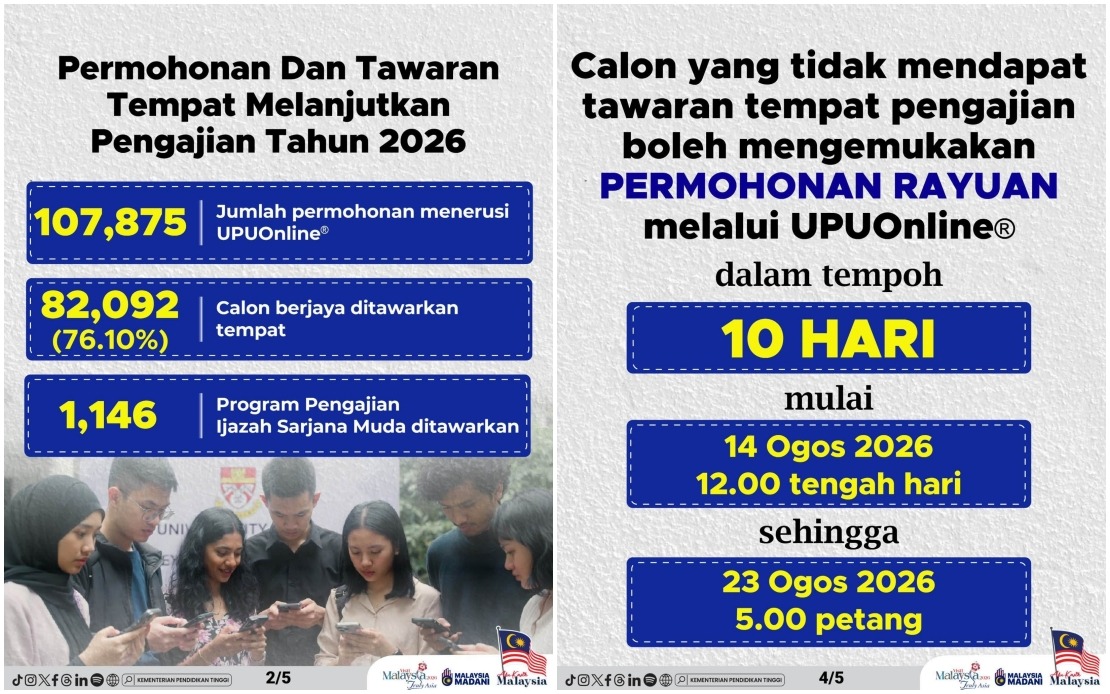
Malaysia's public university system has extended admission offers to 82,092 candidates seeking undergraduate education this academic year, according to an announcement from the Ministry of Higher Education (KPT). The successful applicants represent those who cleared the merit-based selection process administered through the centralized UPUOnline application platform, which processed more than 107,000 eligible applications across the country's 20 public tertiary institutions.
The intake figure, which constitutes 76.10 percent of all eligible applications received, reflects the capacity constraints inherent in Malaysia's public higher education system despite its wide network of universities. These admission decisions encompass a total of 1,146 distinct bachelor's degree programmes spanning diverse fields and disciplines, ranging from engineering and sciences to humanities and professional studies. The variety of offerings underscores the breadth of Malaysia's public university sector and its attempt to cater to varied student interests and market demands.
The KPT's approach to admissions remains grounded in meritocratic principles, with all eligible candidates ranked according to their individual merit scores and positioned in descending order of academic achievement. This systematic methodology ensures that admission decisions prioritize academic performance, though the final composition of enrolled cohorts also reflects the university placement algorithm designed to optimize student-institution matching across the entire system. The emphasis on merit-based selection aligns Malaysia's approach with international best practices, though questions about accessibility for students from disadvantaged backgrounds remain an ongoing policy consideration.
For the approximately 25,783 eligible candidates who did not receive offers in this initial allocation round, the ministry has established a structured appeal and reallocation mechanism. Beginning on 14 August and extending through 23 August 2026, these unsuccessful applicants may lodge appeals through the UPUOnline system during a ten-day window, effectively providing a second opportunity to secure placement. This appeal process recognizes that the initial merit-ranked allocation does not represent the final disposition of all available spaces, as institution-specific vacancies may emerge following acceptance decisions by successful candidates.
The annual undergraduate intake cycle represents a crucial juncture for hundreds of thousands of Malaysian school leavers and mature students navigating the transition to tertiary education. The concentration of admissions through a single centralized platform via UPUOnline has streamlined the application process compared to earlier systems involving multiple institutional applications, though it simultaneously creates winners and losers in a single-round competition. This year's statistics suggest that the gap between available places and eligible applicants continues to constrain opportunities, with more than one-quarter of qualified candidates unable to secure immediate admission to public universities.
The accessibility challenge reflected in these statistics has broader implications for Malaysia's knowledge economy and social mobility. Public universities remain the primary route to tertiary education for most Malaysian students, given tuition costs at private institutions and limited scholarship availability. The relatively fixed capacity of public universities, when contrasted against growing secondary school completion rates and societal expectations of university education, creates persistent bottlenecks that funnel unsuccessful candidates toward private institutions, distance learning options, or overseas education pathways. This stratification by access may reinforce existing socioeconomic disparities unless addressed through targeted policy intervention.
Regional comparisons provide useful context for understanding Malaysia's situation. Several Southeast Asian neighbours have expanded public university capacity more substantially in recent years, while others have invested heavily in quality improvements at existing institutions rather than numerical expansion. Malaysia's approach appears balanced between these alternatives, maintaining current capacity levels while presumably seeking qualitative enhancements, though specific details regarding programme development and infrastructure investment remain external to KPT's current announcements.
The ministry's extension of congratulations to successful candidates and encouragement for them to maximize their educational opportunities reflects standard institutional messaging but also underscores the competitive nature of university admissions in Malaysia. The language emphasizing "meritocracy" and individual achievement, while operationally sound, may obscure the role of socioeconomic advantage in determining academic performance and merit scores among secondary school graduates. Future policy discussions might productively examine whether supplementary considerations—such as school quality disparities or socioeconomic disadvantage indicators—should inform admissions alongside pure academic merit.
The ten-day appeal window represents a compressed timeframe for candidates to reassess their circumstances and determine whether appealing warrants their effort, particularly given the competitive pressures inherent in the reallocation process. Candidates who initially received offers at less preferred institutions may withdraw to pursue appeals for higher-ranked university placements, creating a complex cascade of movements that the UPUOnline system must accommodate during this appeal period. The opacity surrounding typical success rates in appeals or the likely scale of secondary placement opportunities would be valuable information for candidates making strategic decisions during this window.
Looking forward, the sustained gap between eligible applicants and available public university places will likely remain a policy pressure point for Malaysia's education sector. Demographic trends suggesting continued growth in school completion rates, combined with unchanged public university capacity, will perpetuate undersupply unless accompanied by either significant capital investment in institutional expansion or policy shifts toward alternative credentials and pathways. The rise of skills-based credentials, vocational qualifications, and micro-credentials reflects partly this constraint on traditional university access, positioning Malaysia within broader global trends toward educational diversification.

