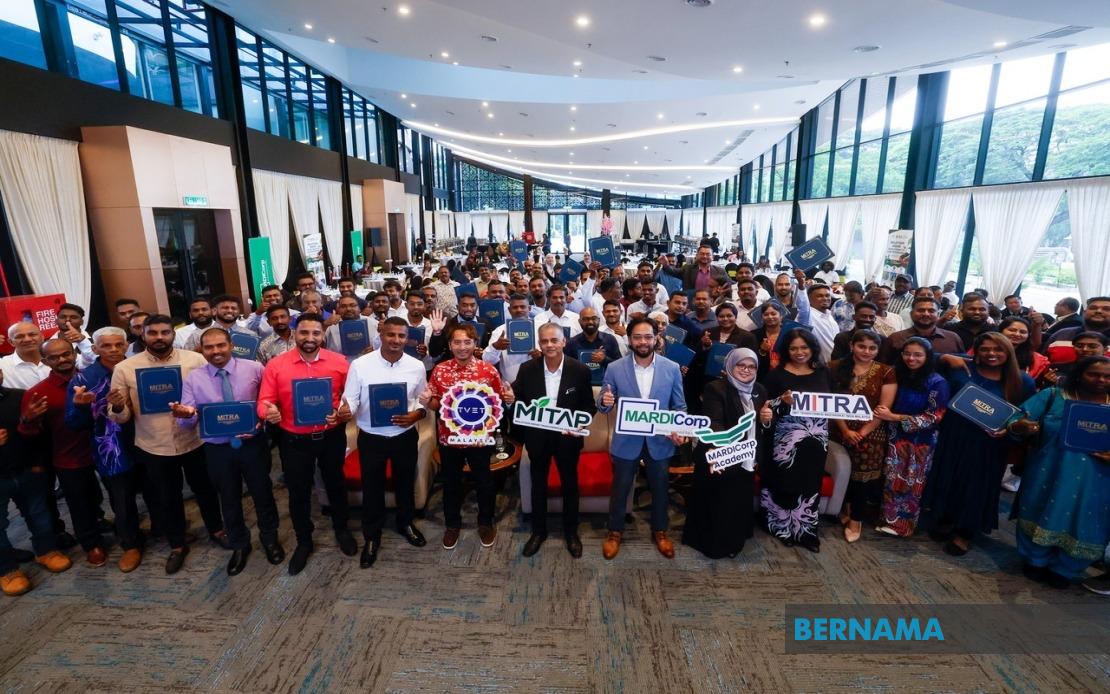
The Malaysian Indian Community Transformation Unit (MITRA) has distributed RM30,000 Agricultural Transformation Grants (GTP) to 68 young agropeneurs as part of efforts to strengthen agricultural participation within the Indian community. The initiative, known as the Malaysian Indian Transformative Agri Programme (MITAP), represents a coordinated push to equip youth with resources and knowledge needed to establish viable farming enterprises across diverse agricultural sectors.
MITAP operates as a two-pronged programme designed to address both immediate financing needs and longer-term skill development. The QuickWin MITRA component directly provides grant capital to selected young farmers, while the Young Agropreneur Programme (PUM) offers structured training spanning ten months. To date, eight participants have successfully completed the PUM training track, positioning them to progress toward independent commercial farming operations. MITRA director-general K. Raveendran Nair emphasized that recipients will continue accessing support systems beyond the initial grant disbursement, ensuring sustained guidance as they scale their operations.
The grant programme encompasses six primary agricultural focus areas selected for their commercial viability and labour absorption potential. Recipients are establishing ventures in food crop production, dairy cattle management, beekeeping, oyster mushroom cultivation, freshwater fish farming, and food processing technology. This sectoral diversity reflects deliberate portfolio design aimed at reducing market concentration risk while capitalizing on existing comparative advantages within Malaysia's agricultural landscape. The choice of mushroom cultivation and fish farming particularly suits smallholder models, while beekeeping offers relatively low land-requirement pathways into farming.
Implementation of MITAP involves partnership between MITRA and MARDICorp, the Malaysian Agricultural Research and Development Institute's commercial arm, under the broader Indian Community Socioeconomic Development Programme. This institutional collaboration ensures technical expertise flows directly to participants while government extension networks remain engaged. MARDICorp managing director Mohamad Zamir Ghazali outlined the corporation's ongoing commitment to guide MITAP beneficiaries through critical post-establishment phases, particularly in product marketing and downstream value addition. The corporation intends to facilitate technology adoption and help young farmers transition raw produce into processed products commanding higher margins.
One significant dimension of MITAP extends beyond capital provision to network development. Ghazali highlighted the programme's function as a platform enabling peer-to-peer learning and collective voice-building. Several recipients have already joined farmer associations, creating pathways toward bulk procurement arrangements and shared infrastructure access. By clustering young agropeneurs within formal organizational structures, MITRA positions them to attract government attention for subsequent support mechanisms and preferential market access schemes. This networking architecture appears designed to overcome the isolation that typically constrains smallholder farm viability in Southeast Asian contexts.
The initiative addresses a documented participation gap within Malaysia's agricultural sector, where Indian community involvement remains proportionally underrepresented relative to other ethnic groups. Agricultural enterprise typically requires substantial initial capital, limiting entry for communities facing historical economic barriers. By targeting youth specifically, MITAP recognizes that younger cohorts possess greater adaptability to new farming technologies and techniques while facing lower establishment costs than mature farmers transitioning to commercial operations. The RM30,000 grant threshold, while modest, represents meaningful working capital for commodity-based and small-scale specialty farming ventures.
Malaysian agricultural policy increasingly emphasizes inclusivity and community engagement as prerequisites for sectoral sustainability. MITAP reflects broader government recognition that food security depends partly on maintaining viable smallholder participation, particularly among underrepresented demographics. The programme's emphasis on capacity building rather than subsidy dependency suggests strategic intent to develop sustainable commercial capability rather than create aid dependency. This distinction matters considerably for long-term programme viability and beneficiary independence.
For young Indian Malaysians, agricultural entrepreneurship traditionally represented limited career pathways, with urban employment and established professions capturing most educational attention. MITAP's positioning of farming as legitimate entrepreneurial activity—supported by government capital and technical expertise—potentially shifts community perceptions. If demonstration effects prove compelling, successful MITAP beneficiaries may inspire peer cohorts to consider farming less as agricultural labour and more as knowledge-intensive commercial enterprise comparable to other business ownership opportunities.
The programme's regional significance extends to broader Southeast Asian patterns where government initiatives struggle balancing youth employment, rural development, and community economic inclusion. MITAP's structured approach combining capital grants, skills training, ongoing technical support, and network access offers a potentially transferable model. Other ASEAN nations facing similar youth-in-agriculture challenges may find relevant lessons in Malaysia's emphasis on cohort-building and institutional linkages rather than purely financial support.
Looking ahead, MITAP's success metrics will likely include not only immediate agricultural productivity but also retention rates, income sustainability, and whether recipients graduate toward larger-scale farming operations. Government extension systems remain critically important for monitoring outcomes and adjusting support mechanisms based on sector-specific challenges. The programme's integrated approach—combining MARDICorp's technical authority with MITRA's community connectivity—suggests recognition that successful agricultural entrepreneurship requires simultaneous attention to technical competence, market access, and social capital development.
The ceremony distribution of these grants represents tangible government commitment to widening agricultural ownership within Malaysia's Indian community. Whether this initiative catalyzes sustained entrepreneurial engagement or functions primarily as one-time assistance will depend substantially on post-grant support quality and broader agribusiness ecosystem development. MARDICorp's continued involvement and the emphasis on association membership suggest institutional awareness that grant recipients require ongoing scaffolding to translate initial capital into commercially viable, profitable enterprises capable of generating sustainable rural livelihoods.

