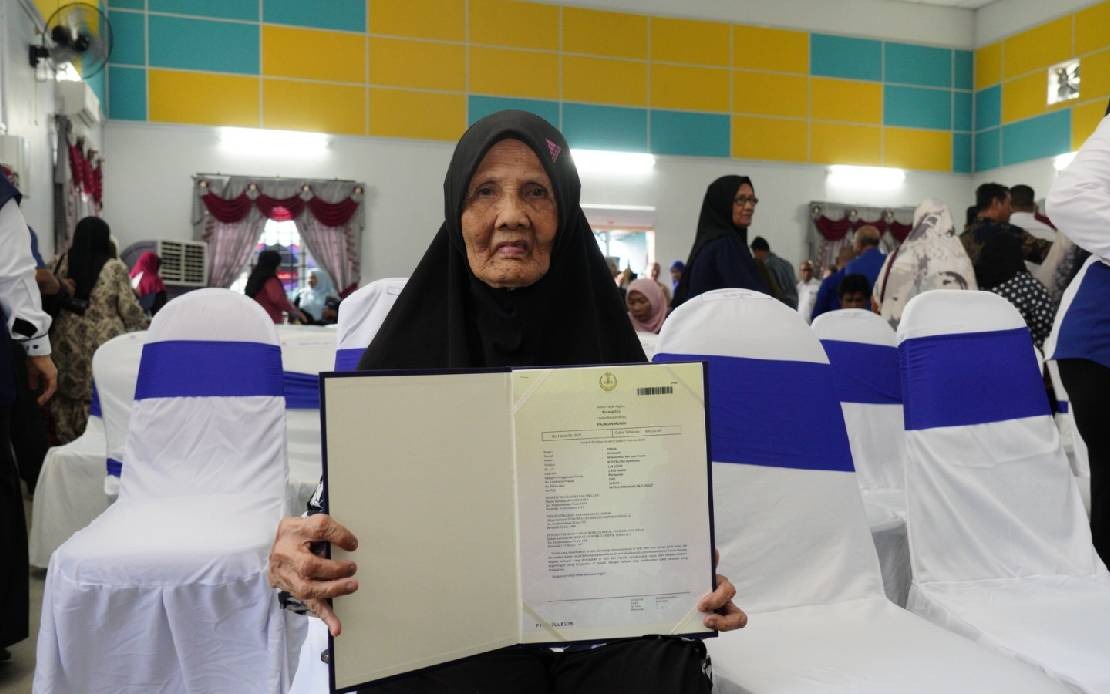
Forty-seven rural participants in Perak have received formal land ownership grants through the Federal Land Consolidation and Rehabilitation Authority (FELCRA), signalling the maturation of a significant agricultural development initiative in the state. The certificates, distributed at a ceremony in Ipoh on July 14, represent the culmination of years of planning and implementation under the FELCRA Consolidation and Rehabilitation Programme, which aims to convert marginal farming areas into productive estates that generate consistent income for smallholder participants.
Perak's Menteri Besar Datuk Seri Saarani Mohamad framed the land handover as more than routine administrative procedure, positioning it as a social contract that elevates rural dignity through legitimate asset ownership. In his remarks, he emphasised that granting participants formal title to their developed land provides economic security and establishes a tangible foundation for family prosperity in farming communities that have historically lacked such security. This philosophical framing reflects a broader Malaysian policy pivot toward treating rural development not merely as infrastructure spending but as a mechanism for wealth creation and social uplift.
The FELCRA consolidation model represents a departure from traditional smallholder farming arrangements. Rather than operating isolated plots, participating farmers work integrated land blocks that achieve economies of scale in cultivation, harvesting, and marketing. Saarani characterised the approach as systematic and economical, arguing that it transforms previously underutilised terrain into a renewable economic asset. The model has demonstrably expanded employment opportunities within rural areas, catalysing ancillary business development and restoring community confidence in agricultural enterprise as a viable path to prosperity.
Perak's emergence as the second-largest FELCRA operational region underscores the programme's footprint across peninsular Malaysia. According to Zainal Abidin Alias, FELCRA's director of participant affairs, the authority now manages approximately 32,000 hectares across nearly 20,000 participants nationally, with Perak accounting for a substantial proportion of this portfolio. Only Pahang exceeds Perak's scale, positioning both states as testing grounds for large-scale rural consolidation in Malaysia. The data suggests that FELCRA has become a significant institutional mechanism for restructuring agricultural land tenure and production patterns in the country.
The significance of the Seri Gala milestone extends beyond Perak's borders. Malaysia's rural sector has long grappled with fragmentation—parcels too small to achieve efficiency or sustainability without technological intervention and collective action. FELCRA's model addresses this structural challenge by aggregating holdings and introducing systematic management practices. For farmers accustomed to subsistence production, formal land ownership combined with professional estate management provides unprecedented leverage for credit access and market participation, potentially unlocking rural prosperity that family farming alone cannot achieve.
The ceremony itself brought together key stakeholders reflecting the programme's institutional complexity. Alongside Perak's political leadership were representatives from FELCRA Berhad's board and management, signalling alignment between state and federal rural development objectives. The inauguration of the Seri Gala PPSK Grand Hall suggests infrastructure investment complementing land consolidation—a physical community space designed to facilitate participant engagement and administrative functions. This integrated approach reflects contemporary understanding that development requires institutional scaffolding beyond land redistribution.
Zainal Abidin anchored the achievement within Deputy Prime Minister Datuk Seri Dr Ahmad Zahid Hamidi's recent articulation of rural development philosophy, presented during World Rural Development Day 2026 celebrations in Jengka, Pahang. Zahid's framing emphasises that modern rural policy must transcend physical infrastructure investment, encompassing human capital development, economic strengthening, entrepreneurship nurturing, and community agency. This ideological positioning suggests that FELCRA's land consolidation is positioned as a foundation for comprehensive rural transformation rather than a standalone agricultural scheme.
The Deputy Prime Minister's emphasis on rural communities determining their own futures carries particular resonance in Malaysia's contemporary policy environment. It reflects frustration with top-down development approaches that generated infrastructure without commensurate economic benefit to local populations. By conferring legitimate land ownership on FELCRA participants, the programme theoretically empowers farmers to make independent decisions regarding their assets, crop choices, and investment pathways—a democratic dimension absent from purely administrative land management arrangements.
For Malaysian policymakers observing similar challenges across Southeast Asia, the FELCRA model offers a potentially replicable framework. Land fragmentation affects rural productivity across the region, from Indonesia's scattered smallholdings to Thailand's northern farming communities. FELCRA's approach—combining formal consolidation, professional management, infrastructure support, and eventual participant ownership—addresses these structural constraints without requisitioning private property or imposing collectivist arrangements. The forty-seven Seri Gala participants receiving ownership grants represent tangible proof that this balance is achievable.
The Seri Gala ceremony also reflects Malaysia's evolving approach to measuring rural development success. Rather than relying exclusively on area developed or participants enrolled, the government increasingly emphasises wealth metrics—tangible asset transfers to rural households. Land ownership represents genuine wealth creation distinguishable from wage employment or subsidy dependency. This shift in measurement philosophy potentially reorients rural policy away from project completion metrics toward sustainable livelihood outcomes, a refinement with implications for how development agencies globally assess programme effectiveness.
Moving forward, attention will focus on how Seri Gala participants leverage their newly formalised land assets. Access to formal title traditionally enables agricultural financing, equipment investment, and market access improvements that smallholders cannot independently achieve. If FELCRA's consolidation generates demonstrable income gains for participants relative to traditional smallholding arrangements, replication across additional areas becomes politically feasible. Conversely, if administrative complexity or market conditions constrain participant earnings, political resistance to further consolidation may emerge, complicating rural development planning.
The land ownership grants ceremony ultimately symbolises a particular model of rural transformation—neither communist collectivisation nor pure market agriculture, but structured consolidation granting smallholders formal property rights within professionally managed estates. For Perak's rural communities, the forty-seven certificates represent economic security and family legacy assets. For Malaysian policymakers, they demonstrate that systematic land development can generate genuine wealth transfers to rural populations. Whether this model sustains and expands across Malaysia and the broader region will substantially shape agricultural development trajectories throughout Southeast Asia.

