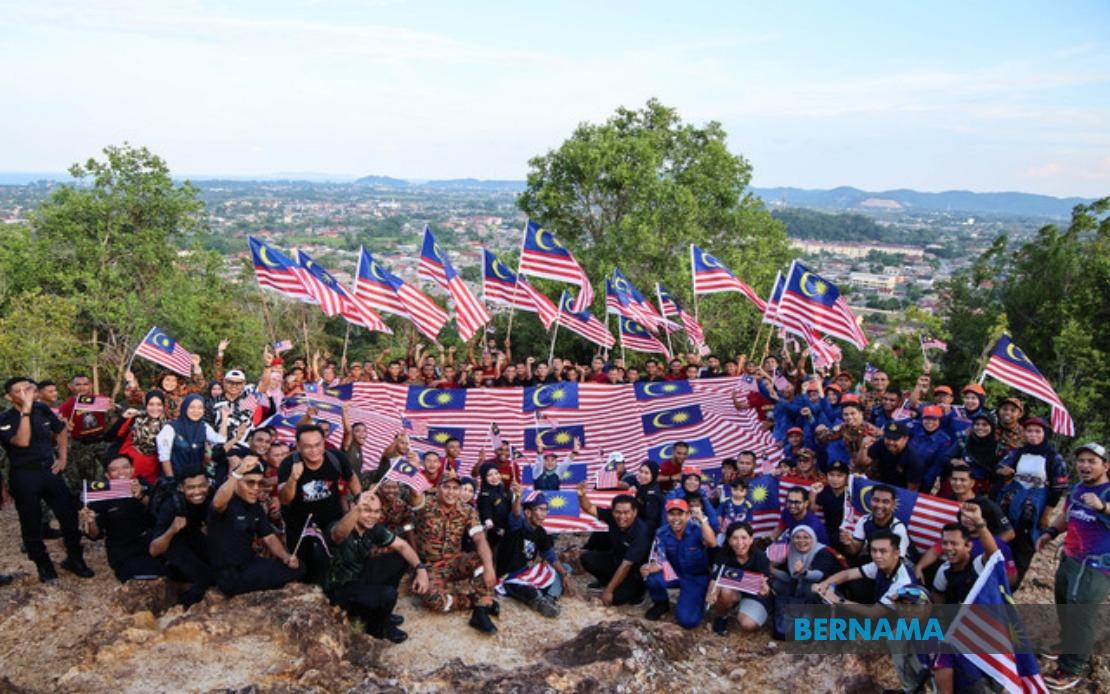
In a show of national pride timed to Terengganu's National Month festivities, approximately 300 participants representing Malaysia's security forces, government agencies and media fraternity converged on August 21 for an inaugural summit hike in Kuala Terengganu. The event drew personnel from diverse institutional backgrounds, including the Terengganu Fire and Rescue Department, Malaysian Armed Forces, Road Transport Department, Malaysian Anti-Corruption Commission, Terengganu Ministry of Domestic Trade and Cost of Living, Terengganu Royal Malaysian Customs Department and Malaysia Civil Defence Force, creating a rare cross-sectoral gathering united by patriotic purpose.
METRA president Mohd Zaid Mohd Noor framed the undertaking as more than a ceremonial climb. According to Mohd Zaid, the event encapsulated the media industry's broader mission to galvanise patriotic sentiment across the nation's communication landscape. By orchestrating a physical gathering of this scale, the media body sought to materialise abstract notions of national love into concrete, shared experience. The symbolic centerpiece—a giant flag unfurled at the summit—served as both visual anchor and rallying point for the assembled participants.
The initiative reflected mounting recognition among Malaysian institutions that fostering patriotism requires deliberate, multi-platform engagement strategies. Media practitioners and security agencies increasingly recognise that messaging alone cannot sustain civic bonds; tangible communal activities that unite disparate government functions prove more resonant. For Terengganu specifically, the timing capitalised on heightened national sentiment during August's commemorative period, when public consciousness pivots toward themes of sovereignty and collective identity.
Mohd Zaid articulated the event's dual mandate: enliven state-level National Month programming whilst simultaneously leveraging the physical exertion of summit climbing as vehicle for promoting healthy lifestyle choices. This convergence—patriotic messaging married to wellness objectives—reflects contemporary public health discourse gaining traction across Southeast Asia. By framing the hike as both patriotic duty and personal wellness opportunity, organisers attempted to dissolve traditional boundaries separating civic obligation from individual health interests.
Equally significant was the event's function as institutional bridge-building mechanism. Malaysia's security and civil defence apparatus often operates within compartmentalised frameworks, with individual agencies pursuing narrowly defined mandates. The summit hike created structured opportunity for inter-departmental personnel to interact beyond formal hierarchies, potentially fostering informal networks that facilitate smoother inter-agency coordination on substantive matters. Such relationship-building proves particularly valuable in emergency response scenarios, where quick institutional cooperation can prove decisive.
The participation of the Malaysian Anti-Corruption Commission alongside defence and customs agencies carried particular symbolic resonance. By positioning anti-corruption efforts within a patriotic frame—treating integrity promotion as expression of national love—event organisers implicitly suggested that institutional reform and patriotic sentiment constitute complementary rather than competing endeavours. This messaging strategy attempts to reposition governance integrity from technical compliance concern into emotional, identity-based commitment.
From a media practitioner's perspective, the gathering represented strategic assertion of journalism's role in national consciousness-building. By positioning media personnel as co-participants rather than mere chroniclers, METRA signalled that newsrooms function as active stakeholders in patriotic discourse rather than neutral observers. This approach carries implications for how Malaysian media subsequently frames government initiatives and institutional narratives—participation creates subtle but meaningful shifts in editorial perspective and institutional alignment.
The event occurred within broader Southeast Asian context where governments increasingly employ experiential, participatory mechanisms to reinforce national identity. Singapore, Thailand and Indonesia have implemented comparable cross-institutional patriotic events, suggesting regional recognition that traditional top-down civics education requires supplementation through embodied, collective experiences. Terengganu's summit hike aligns with this regional trajectory whilst adapting the model to local geography and institutional structures.
For Malaysian readers, particularly those in East Coast states, the gathering carries implications extending beyond ceremonial significance. Multi-agency coordination mechanisms forged during such events potentially influence emergency response capacity, inter-departmental resource-sharing and institutional transparency. When security and civil defence personnel develop collegial relationships through patriotic activities, subsequent official interactions proceed through channels lubricated by prior personal connection and mutual understanding. This soft-infrastructure dimension of patriotic events often escapes public notice but fundamentally shapes governance effectiveness.
The scale of participation—300 personnel—suggests Terengganu authorities successfully mobilised substantial institutional resources toward this initiative. Such mobilisation indicates either genuine enthusiasm for the undertaking or institutional pressure channelling personnel toward state-sanctioned patriotic activities. The distinction carries implications for understanding whether such events represent genuine grassroots institutional commitment or top-down mandate compliance. Either trajectory reflects genuine insights into contemporary Malaysian governance dynamics.
Looking forward, the event's success may encourage replication across other states and institutional contexts. Should summit hikes and analogous participatory patriotic activities proliferate, Malaysian civil society will witness gradual shift in how national identity gets constructed and performed. Rather than through passive consumption of patriotic messaging, citizens increasingly experience nationalism through active participation in state-organised collective endeavours. This experiential turn in patriotism-building represents meaningful evolution in Malaysia's nation-building strategies, with implications for civic engagement patterns extending well beyond ceremonial occasions.

