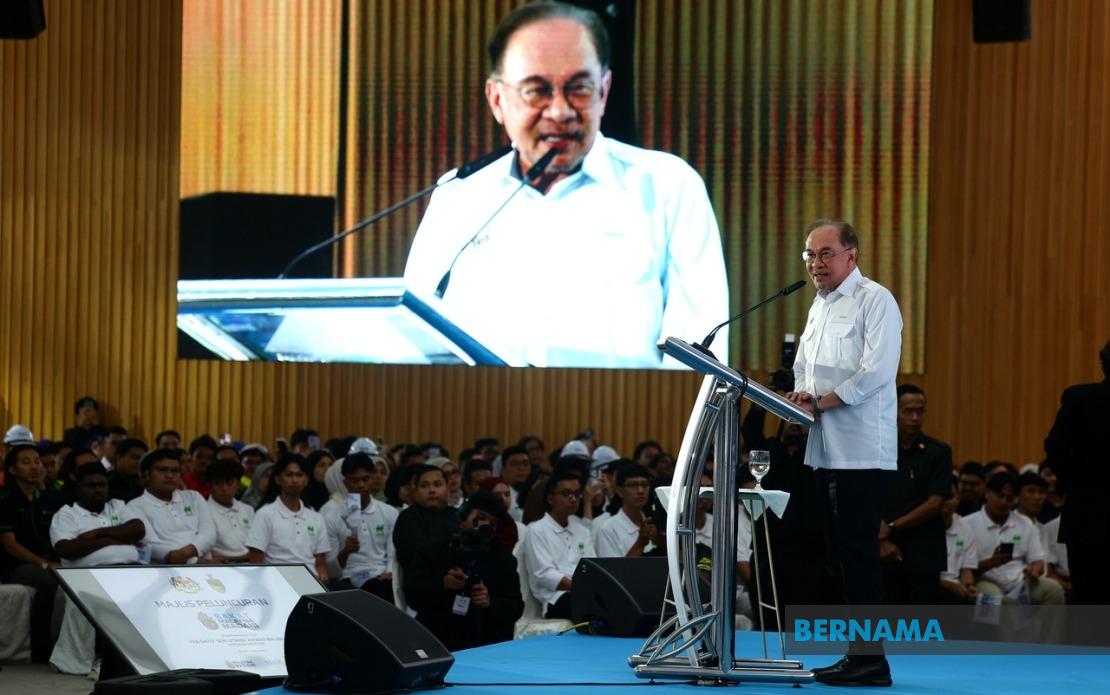
Prime Minister Datuk Seri Anwar Ibrahim has launched the Bakat MADANI initiative in Seremban, a comprehensive national talent development programme designed to equip 25,000 Malaysians with market-ready skills and secure employment pathways. Speaking at the official ceremony, attended by Negeri Sembilan Menteri Besar Datuk Seri Aminuddin Harun and senior government officials, Anwar emphasised that the scheme represents a collaborative endeavour between government-linked investment companies, government-linked companies, and Petronas to strengthen Malaysia's human capital and economic competitiveness.
The initiative directly addresses a persistent challenge facing the nation: the disconnect between skills development and actual job creation. By pooling resources and expertise across major institutional players, Bakat MADANI seeks to create a seamless pathway from training to meaningful employment in strategically important sectors. The involvement of corporate entities means sustained financing and real-world job prospects, distinguishing this programme from earlier efforts that often lacked coordinated private-sector participation. Anwar was candid about the arrangement, noting that young beneficiaries should acknowledge the corporate bodies funding the initiative and maintaining its operational viability.
Finance Minister II Datuk Seri Amir Hamzah Azizan elaborated on three strategic pillars underpinning the programme. The first focuses on embedding employment and career progression within the existing ecosystem of government-linked entities and Petronas, leveraging internal promotion and structured career development. The second expands job placement opportunities across sectors identified as vital to Malaysia's economic future—semiconductors, renewable energy, the digital economy, and advanced manufacturing—recognising that growth in these domains will drive rising living standards. The third pillar strengthens Technical and Vocational Education and Training institutions, ensuring they align curricula and graduate profiles with industry demands rather than operating in isolation from employers.
Malaysia's demographic challenge of youth unemployment and underemployment gives urgency to Bakat MADANI. The programme operates on the principle that economic growth and improved living standards reinforce each other, provided that opportunity reaches those capable of grasping it. By concentrating effort on high-value sectors with expansion potential, the initiative sidesteps the trap of channelling talent into sectors facing structural decline. This strategic focus is particularly relevant for Malaysia as it competes regionally to retain skilled workers and attract foreign investment in knowledge-intensive industries.
A notable component of the framework involves reimagining and upgrading existing talent schemes. Petronas, in partnership with the Malaysian Petroleum Resources Corporation and the Malaysian Oil, Gas & Energy Services Council, is transforming VISTA into Vista i-Plus, creating an integrated vocational model that bridges separate TVET pathways. This consolidation draws on resources from MARA Skills Institutes, National Youth Skills Institutes, Advanced Technology Training Centres, and the Malaysian Construction Academy, creating economies of scale and reducing duplication. Such integration has long been advocated by education experts and industry bodies, making its realisation under Bakat MADANI a material improvement in how public training infrastructure operates.
Within the government-linked company and government-linked investment company ecosystem, Khazanah Nasional Berhad is orchestrating collaboration with 23 higher education institutions, including Universiti Teknologi MARA, Universiti Teknikal Malaysia Melaka, and Universiti Malaysia Sabah. This partnership model emphasises industrial training, technical certification, and immersion in real workplace environments, moving beyond classroom learning. Universities gain clarity about employer expectations while students and graduates obtain practical credentials and professional networks before formally entering the workforce. For institutions in less-developed regions, such collaboration can provide access to training resources and industry mentorship otherwise unavailable locally.
The government has introduced special tax incentives for firms operating training programmes under Bakat MADANI, a mechanism designed to deepen private-sector involvement in skills development. These incentives represent an evolution of earlier employability measures, now extended to vocational graduates with enhanced allowance structures ensuring trainees receive fair compensation. The incentive design acknowledges a market reality: companies often resist formal training investment if public subsidies are absent or minimal, and trainees struggle financially while learning. By offsetting employer costs and guaranteeing trainee income, Bakat MADANI removes friction from the skills-to-employment transition.
For Malaysian workers and job seekers, the programme offers tangible pathways into sectors offering wage growth and career stability. Semiconductor manufacturing, renewable energy infrastructure, and digital services represent frontiers where Malaysia seeks regional and global competitiveness, and workers trained in these domains will command premiums. The emphasis on quality jobs rather than mere employment numbers reflects a departure from quantity-focused policies; a 25,000-strong cohort entering sustainable, well-remunerated roles represents genuine social mobility rather than padding unemployment statistics.
Regionally, the initiative signals Malaysia's commitment to human capital development as a competitive advantage. Neighbouring economies pursuing similar strategies make talent retention and attraction critical. Bakat MADANI, by ensuring local opportunity exists in emerging sectors, can stem brain drain and position Malaysia as a regional hub for skilled talent. The programme also demonstrates institutional coordination between government and corporate sectors that many Southeast Asian nations struggle to achieve, offering a potential model for peer economies grappling with youth unemployment and skills misalignment.
The success of Bakat MADANI will hinge on execution at implementation level. Coordination across dozens of institutions, alignment of curriculum with employer feedback loops, and consistent job placement outcomes require sustained management and accountability mechanisms. Early indicators will emerge within months as the first cohorts complete training and transition to employment. The involvement of Finance Ministry oversight and centralized coordination through Khazanah Nasional and Petronas suggests serious institutional backing, yet past programmes in the Malaysian context have encountered bottlenecks in execution despite strong initial intent. Monitoring graduation rates, job placement success, wage outcomes, and retention metrics will reveal whether Bakat MADANI achieves its transformative ambition or remains a well-intentioned but incomplete intervention.
The initiative arrives at a pivotal moment for Malaysia's economic trajectory. Post-pandemic labour market disruptions, intensifying regional competition, and technological displacement of routine jobs create urgency around skills development. Bakat MADANI represents a recognition that Malaysia cannot compete globally through low-cost manufacturing alone; prosperity requires a workforce capable of commanding value through specialisation and expertise. Whether the programme generates sustainable returns on investment and genuinely transforms 25,000 lives will determine its legacy and influence policy design for years ahead.

