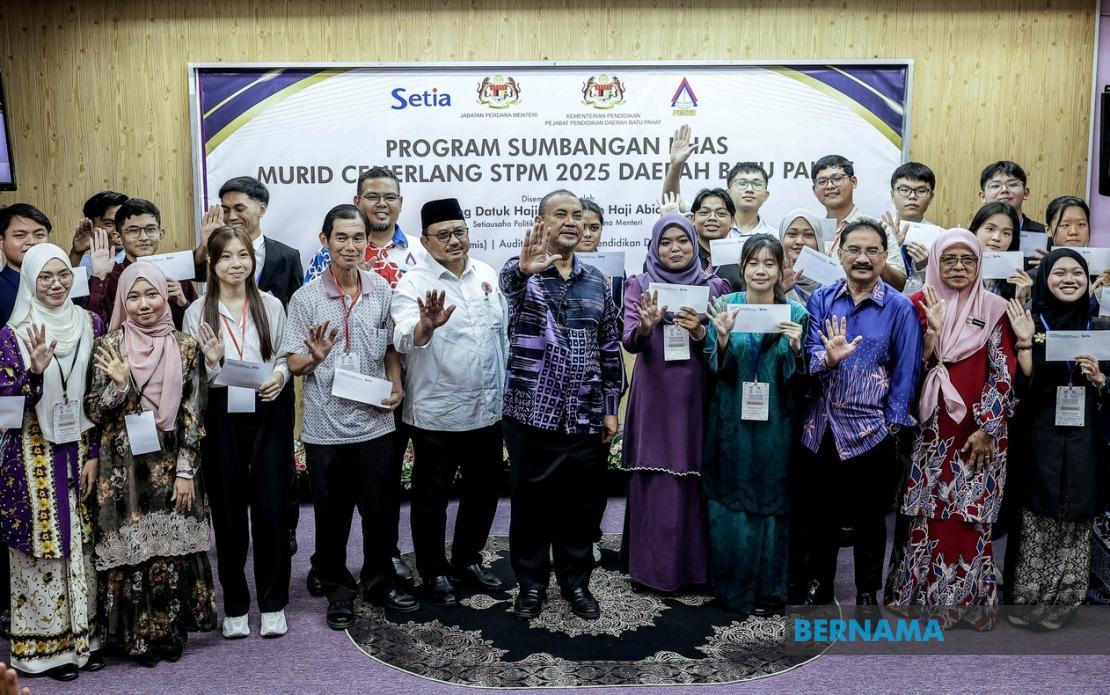
Two hundred and fourteen students who achieved distinction in their 2025 Sijil Tinggi Persekolahan Malaysia examinations were honoured at an awards ceremony in Batu Pahat on Tuesday, receiving special financial contributions from the Prime Minister's Office. The recognition programme brought together top performers from 16 secondary schools across the district, marking a concerted government effort to acknowledge and celebrate educational excellence at the pre-university level. The initiative reflects a broader strategy to nurture high-achieving students and inspire their peers to pursue academic ambitions with greater determination.
Datuk Azman Abidin, Political Secretary to the Prime Minister, delivered remarks at the 2025 STPM Top Achievers Award Ceremony held at the Batu Pahat District Education Office auditorium. He emphasised that the financial awards serve a dual purpose: recognising the substantial effort invested by students in their studies while simultaneously motivating them to maintain their momentum as they transition toward higher education. By providing tangible support at this critical juncture, the government signals that academic achievement carries real value and deserves institutional backing.
The scope of the recognition programme extends beyond immediate financial assistance. Azman articulated the government's vision of using such initiatives as tools for systemic educational improvement, noting that the scheme aims to foster a culture of excellence among the broader student population. The ceremony itself functions as a public affirmation of achievement, elevating these students as role models whose success others might emulate. This peer-influence dimension recognises that educational motivation operates not merely through individual incentive but through social proof and community recognition.
Looking forward, Azman indicated that the programme's continuation depends on budgetary availability, suggesting that while current year funding has been secured, future iterations require sustained government financial commitment. The statement reveals the tension between policy ambition and resource constraints that frequently characterises government initiatives in Malaysia. Nevertheless, he expressed intent to expand the scheme geographically, potentially bringing similar recognition to top-performing students in other districts and states. Such expansion would require careful coordination between federal and state education authorities, as well as consultation with schools to identify qualifying candidates.
The awards exemplify what Azman described as governmental care and commitment toward educational empowerment. In the Malaysian context, where tertiary education remains financially demanding for many families, such schemes help bridge gaps between academic achievement and economic capacity. Students from less affluent backgrounds who excel academically often face barriers in accessing higher education despite their qualifications; targeted support addressing this disparity strengthens social mobility and ensures talent is not lost due to financial constraint.
Among the recipients was Afida Auni Airulnizam, a 20-year-old from Sekolah Menengah Kebangsaan Tun Sardon in Rengit, who articulated how the contribution functioned both as validation and practical support. Her aspiration to pursue sports science at the tertiary level represents the kind of specialised higher education pathway that requires careful financial planning. Having an older brother already navigating university life provided her with familial insight into those pathways, yet the government contribution nonetheless offers meaningful relief to household finances. Her gratitude underscores how students themselves perceive such support—not merely as monetary transfer, but as institutional affirmation that their efforts matter.
Similarly, Muhd Ammar Firdaus Mohd Fadzil, also aged 20 and formerly from Sekolah Menengah Kebangsaan Tun Ismail, highlighted the practical dimension of the award scheme. The financial burden associated with tertiary preparation—from application fees to entrance examination costs, prerequisite courses, and living allowances—accumulates substantially. For students from middle-income families particularly, this financial pressure can constrain choices, forcing compromises between preferred institutions and financial feasibility. Recognition awards that directly address these preparation costs therefore expand the universe of realistic options available to high-achieving students.
The STPM qualification itself occupies a particular position within Malaysia's educational landscape. As a pre-university pathway pursued after secondary education, it offers an alternative to the International Baccalaureate and other programmes, remaining popular particularly among government school students. The government's strategic focus on recognising STPM top achievers reflects an institutional commitment to maintaining the credibility and prestige of this national qualification. Such targeted recognition ensures that excellence within the STPM track receives comparable public acknowledgment to achievement through other pathways.
Batu Pahat district, where this ceremony occurred, encompasses communities ranging from urban centres to rural areas, each with varying levels of educational infrastructure and resources. The decision to conduct a formal recognition ceremony at the district education office level demonstrates how such programmes can be adapted to regional contexts. By bringing together students from multiple schools, the event creates space for networking among achievers and between students and educators, potentially catalysing mentorship relationships and peer learning communities that extend beyond the formal award presentation.
The sustainability question implicit in Azman's remarks about funding availability deserves scrutiny. Government programmes addressing education often struggle with year-to-year consistency, as competing budgetary demands shift priorities. Yet for students themselves, the announcement of such schemes generates expectations; establishing the award, then subsequently discontinuing it due to budgetary constraints, carries reputational costs. This tension suggests the government must either commit to reliable funding streams or clearly communicate temporal boundaries of such initiatives from their inception.
The broader significance of the Batu Pahat awards lies in their reinforcement of meritocratic principles within Malaysian education policy. By explicitly rewarding academic excellence and financial supporting recipients through their transition to tertiary studies, the government positions itself as invested in maximising the return on its educational investment. Students who excel at secondary and pre-university levels represent a valuable resource; ensuring they reach tertiary education and beyond strengthens the nation's human capital development and competitive positioning in an increasingly knowledge-dependent global economy.

