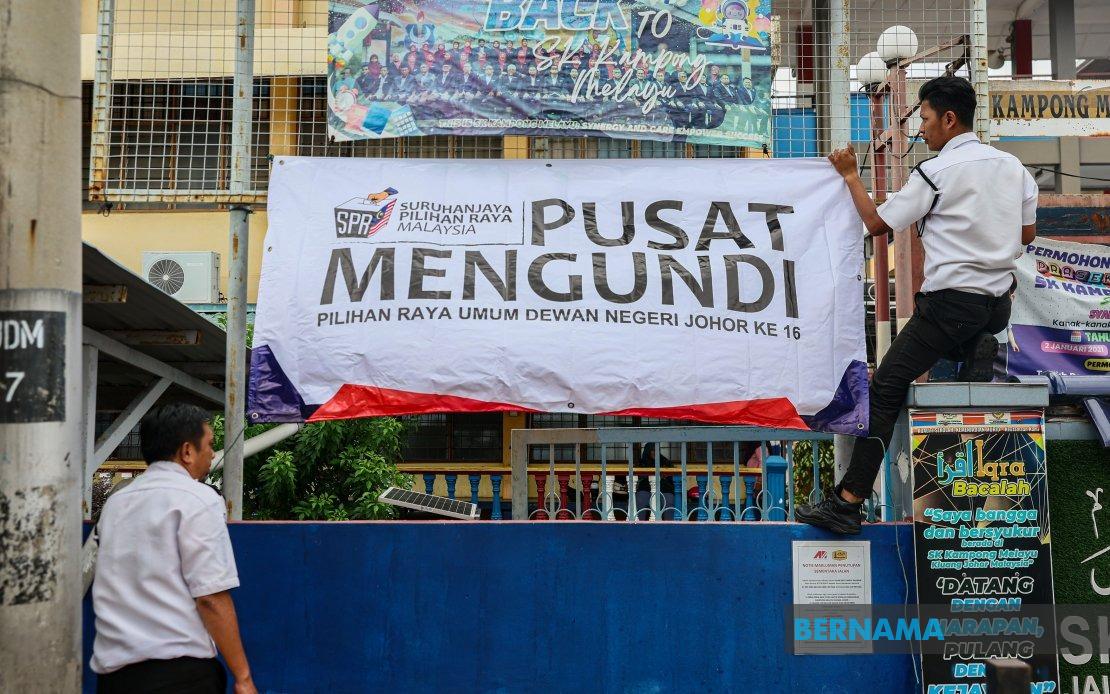
Johor takes centre stage today in a significant electoral exercise as more than 2.7 million registered voters cast ballots in the 16th state assembly election. The contest will determine representation across all 56 state seats, marking a pivotal moment for Malaysia's second-largest state by population and economic output. Polling centres across the state will simultaneously open their doors at 8 am, with the machinery of democratic participation spanning 1,076 venues and 4,889 individual voting streams to accommodate the expected volume of voters.
The logistical undertaking of running a state election of this scale reflects careful planning by the Election Commission, which has mobilised 43,036 election workers to oversee the voting process and ensure procedures are followed. The commission has set its sights on achieving a voter turnout of approximately 70 per cent, a target that would represent a significant improvement over the 54.92 per cent participation recorded during the 2022 Johor state election. Such an increase would signal growing public engagement with state-level politics, particularly important given that state governments directly manage crucial policy areas including education, healthcare, agriculture, and local development.
The campaign period that concluded at midnight yesterday provided three weeks of intense political activity across the state's constituencies. Candidates and parties traversed neighbourhoods from the northern reaches near Kluang and Segamat to the southern districts of Johor Bahru and Pontian, presenting their visions and seeking voter support. This final push represents the culmination of weeks of door-to-door canvassing, ceramah gatherings, and media engagement as contenders made their case to increasingly discerning voters.
The 172 candidates competing for the 56 seats represent a diverse political landscape, with the two major coalitions dominating the contest. Pakatan Harapan and Barisan Nasional each field 56 candidates, essentially offering voters a choice between the incumbent federal government's preferred coalition partner and the traditional establishment. Perikatan Nasional, which advocates a different political direction, contests 33 seats, while smaller parties including Parti Bersama Malaysia with 15 candidates and MUDA with four candidates round out the slate. Six independent candidates also seek office, alongside candidates from Parti Orang Asli Malaysia and Parti Sosialis Malaysia. This configuration represents Malaysia's contemporary political fragmentation, with no single coalition having overwhelming dominance outside the 56-seat parliament.
The transition from the previous administration to this election provides context for understanding the stakes. Before the State Legislative Assembly's dissolution on June 1, Barisan Nasional controlled a commanding 40 seats, giving it comfortable authority over state affairs. Pakatan Harapan held 12 seats, while Perikatan Nasional and MUDA each held three and one seats respectively. Today's election will fundamentally reshape this balance, potentially allowing voters to express preferences significantly different from the configuration that preceded the dissolution.
Administrative arrangements have been structured to facilitate maximum participation while maintaining electoral integrity. Polling locations will close in staggered fashion between 11 am and 6 pm depending on their geography, with island constituencies such as Pulau Besar, Pulau Aur, and Pulau Pemanggil closing earlier to accommodate the practical realities of island voting. A total of 24,677 postal ballots issued for voters unable to attend polling stations in person must be returned by 6 pm to count toward the final tally. Early voting took place on Tuesday, when 20,607 members of the police and armed forces, along with their spouses, participated in the electoral process, helping to build momentum toward today's main event.
The counting of votes is expected to proceed efficiently once polls close, with the Election Commission targeting the completion of full results by 10 pm. This relatively swift timeline, compared to some previous elections marred by delays and counting irregularities, suggests improved administrative capability and coordination. As results emerge across the evening, Malaysians will gain clarity about the political direction that Johor voters have chosen and implications for the broader national political landscape.
Weather conditions throughout the state will fluctuate today, according to forecasts issued by the Malaysian Meteorological Department. Morning rain is anticipated in Johor Bahru, Batu Pahat, Kulai, Muar, Pontian, and Tangkak, potentially influencing voter turnout during early morning hours. Conditions are expected to improve during the afternoon and evening in these areas. Kluang, Kota Tinggi, and Segamat face the prospect of afternoon thunderstorms, while Mersing may experience similar weather from the afternoon into evening hours. Such weather variations are unlikely to deter determined voters but may influence the timing and pace of voting participation throughout the day.
Employers statewide have been reminded of their obligation to allow employees reasonable time away from work to fulfil their voting responsibilities. This guidance, issued by relevant authorities, reflects the recognition that voting is a civic duty requiring practical accommodation by business and institutional sectors. The combination of a weekday election, staggered poll closings, and employer cooperation should theoretically maximise the proportion of registered voters able to participate, underpinning the commission's 70 per cent turnout target.
The outcome of this election carries significance extending beyond Johor's borders. As one of Malaysia's most economically important states and a region where different political coalitions maintain competing bases of support, Johor's electoral direction frequently signals trends relevant to national politics. The state's diverse demographic composition, including substantial numbers of urban professionals, rural voters, and migrant workers, makes it a microcosm of broader Malaysian political preferences. Whether voters prioritise continuity with Barisan Nasional's long stewardship, opt for change through Pakatan Harapan's alternative vision, or select other options will be closely analysed by political observers across the country as they assess the current state of public sentiment and the trajectory of Malaysian politics heading toward potential federal elections.

