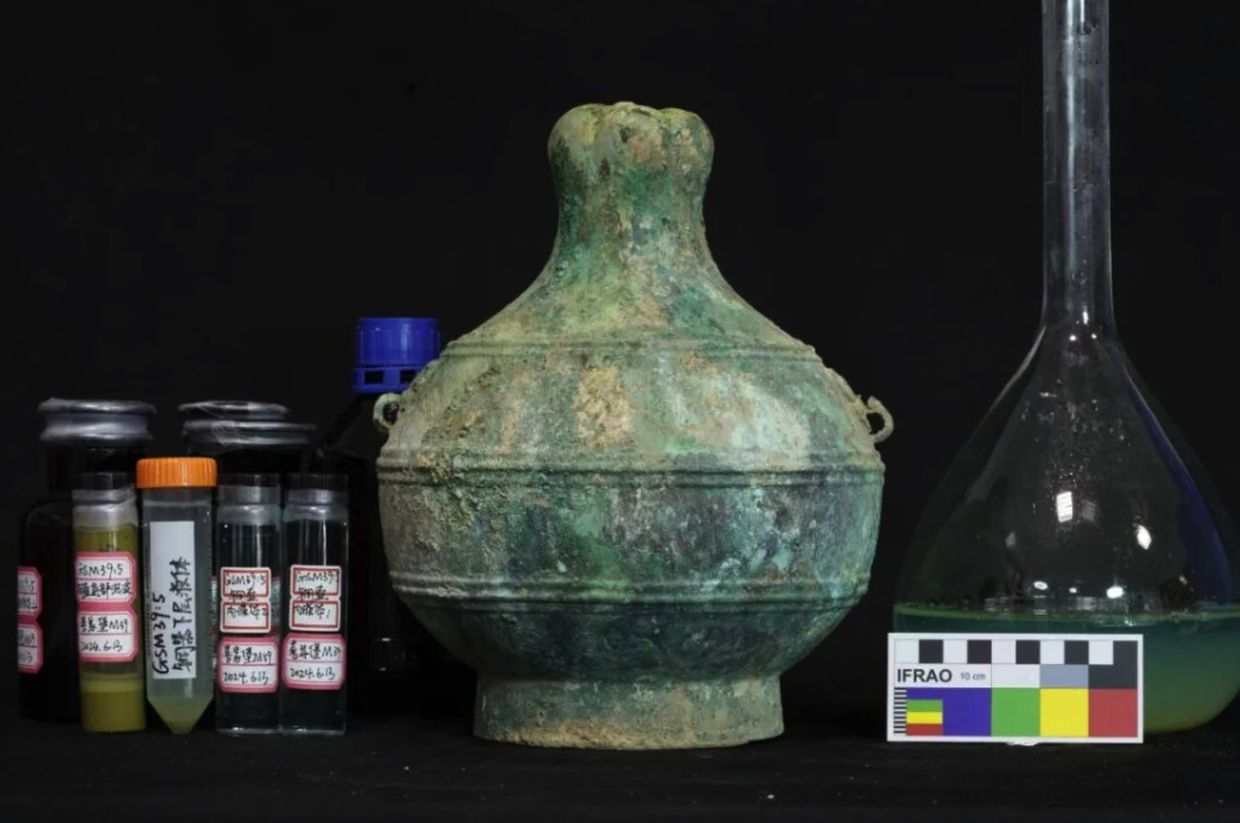
Archaeologists working along a 170-kilometre stretch of the ancient Qin Great Wall have made a remarkable discovery that illuminates the daily lives and culinary practices of China's earliest imperial forces. Excavation of the Shanjiabao cemetery, situated just two kilometres from the Warring States defensive fortifications, has yielded a bronze wine vessel so pristinely preserved that it retains its original gleam and seal—a relic of extraordinary scientific and historical value that researchers now believe represents the most intact and information-rich Qin-era wine discovery ever made public in China.
The remarkable find emerged from Tomb No 39, where archaeologists carefully extracted 3,740 millilitres of ancient liquid residue from a bronze pot shaped distinctively like a garlic bulb, a cultural hallmark of the Qin period. Subsequent analysis confirmed the liquid to be genuine wine, but what makes this discovery exceptional is not merely its age or volume, but the sophisticated preservation technique employed by its makers. The pot employed a double-layer sealing mechanism combining a textile inner lining with an outer coating of organic clay—a technology that successfully maintained the wine's integrity across more than two millennia, permitting modern scientists to conduct comprehensive chemical analysis and trace the origins of ancient brewing knowledge.
The archaeological context enriches the narrative considerably. The 170-kilometre fortified wall was studded with multiple defensive structures of varying sizes, and the Shanjiabao cemetery itself likely functioned as a public burial ground for soldiers and their families stationed at these military installations. Of 183 tombs excavated from the Warring States period, 179 belonged to individuals of Qin cultural background, suggesting that this location served garrison communities who maintained constant vigilance along the empire's northern frontier. The discovery of such a precious wine vessel in a soldier's tomb points to the significance of alcohol in military life and suggests that families honoured their deceased with cherished possessions to accompany them in the afterlife.
Wang Xiaoyang, who heads the Shanjiabao cemetery project at the Ningxia Institute of Cultural Relics and Archaeology, emphasized in July that this vessel represents an unparalleled window into Qin dynasty viticulture. To decipher the ancient recipe and manufacturing processes with scientific precision, researchers partnered with Northwest University to conduct detailed compositional analysis of the liquid. The laboratory identified twenty-four distinct chemical compounds within the sample, including organic acids and their derivatives, amino acids and their derivatives, and various carbohydrates—a chemical fingerprint that tells the story of fermentation and ingredient sourcing.
The analytical breakthrough centres on understanding geographical variations in ancient Chinese brewing methodology. China ranks among the world's earliest adopters of alcoholic beverage production, with archaeological evidence accumulating steadily over recent decades to reveal the evolution of fermentation techniques across different regions and dynasties. However, significant distinctions emerge between the drinking cultures of northern and southern China. Southern regions, blessed with abundant rice cultivation, traditionally brewed rice-based alcoholic beverages, whereas northern communities relied upon grains such as millet and foxtail millet as their primary fermentation substrates. This vessel provides crucial confirmation of northern brewing practices during the Qin period.
The starch residue analysis proved definitively diagnostic of the wine's origins. Researchers confirmed that over ninety-two percent of the starch content originated from broomcorn millet, conclusively establishing that the garrison soldiers of the Great Wall frontier consumed grain-based alcoholic beverages rather than fruit wines such as grape varieties. The distribution pattern of organic acids within the sample precisely matched that of artificially aged yellow wine, a traditional Chinese alcoholic beverage category, further confirming the wine's classification and suggesting sophisticated understanding of fermentation chemistry among ancient brewers.
This discovery addresses a significant gap in archaeological knowledge. Ningxia region's winemaking history during the Warring States period and the Qin dynasty remains poorly documented compared to other aspects of military and civilian life. The vessel and its contents now provide the first comprehensive, scientifically verifiable evidence of brewing practices in this strategic frontier zone, revealing that soldiers assigned to these remote and challenging posts enjoyed access to quality fermented beverages—a testament to either their rank, their family's resources, or the military's provision systems.
The human dimension underlying this archaeological find deserves recognition. Somewhere along this windswept, defensive frontier more than twenty-three centuries ago, a soldier or officer developed a taste for fine wine. When death came to this individual, his family or comrades demonstrated their affection and respect by filling his most treasured bronze vessel with premium wine, placing it in his tomb as provision for the spiritual journey ahead. This act of remembrance, preserved through millennia of soil and silence, speaks to universal human impulses—the love of quality refreshment, family devotion, and the rituals through which societies honour their dead.
For Southeast Asian readers and scholars, this discovery carries broader implications for understanding early imperial consolidation and frontier administration across the entire Asian region. The evidence of sophisticated logistics networks supplying goods to distant military garrisons, the cultural homogeneity across hundreds of kilometres of defensive positions, and the integration of local populations into state structures all reflect patterns that would repeat throughout subsequent dynasties and influence neighbouring civilizations. The meticulous fermentation chemistry and preservation techniques also demonstrate sophisticated knowledge transfer systems within ancient societies, indicating complex economies and specialized craftspeople whose expertise shaped daily life in ways archaeology is only beginning to fully appreciate.
The research published in the June issue of the Journal of Archaeological Science represents the culmination of interdisciplinary collaboration between field archaeologists, laboratory specialists, and historical researchers. This methodological approach—combining careful excavation with rigorous scientific analysis—has become increasingly essential for extracting maximum knowledge from archaeological discoveries. Future excavations in this region and along other sections of ancient defensive walls may yield similarly preserved vessels and residues, gradually building a comprehensive picture of consumption patterns, agricultural production, trade networks, and daily life along China's ancient imperial frontiers. Each discovery contributes threads to the vast tapestry of human civilization, revealing how ordinary people negotiated extraordinary circumstances in service to empire.

