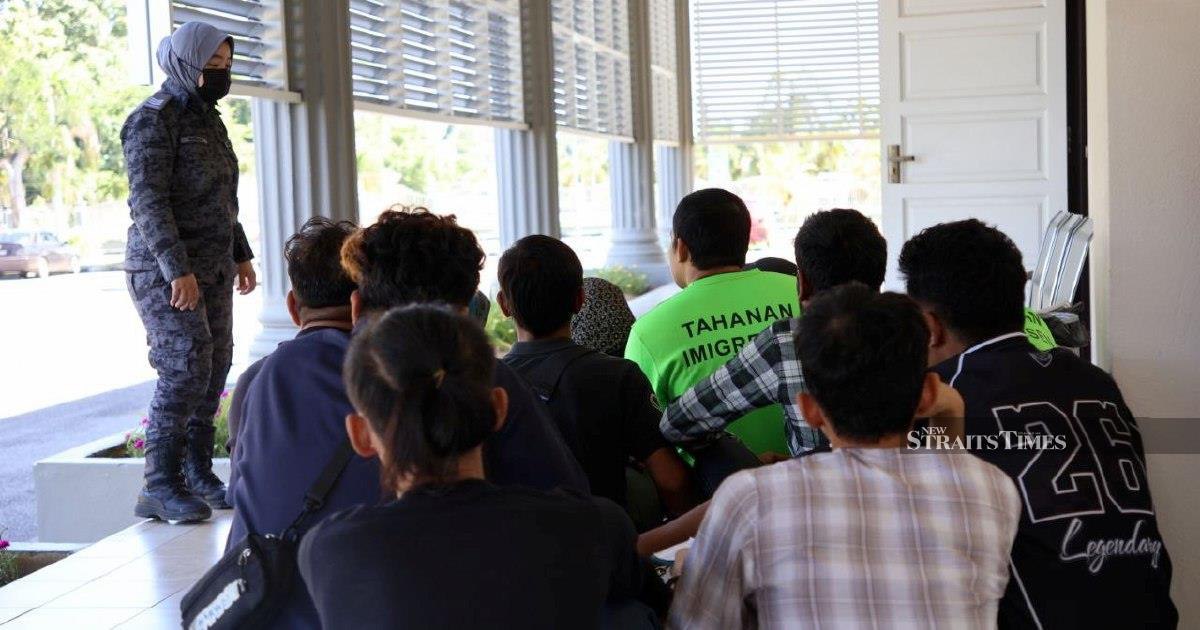
Immigration enforcement authorities in Kelantan have brought charges against ten foreign nationals at the Pasir Mas Sessions Court, addressing what remains a persistent challenge across Malaysia's borders. The group, which included three women among the accused, faced multiple counts relating to their illegal presence in the country. The proceedings underscored the ongoing efforts by immigration authorities to manage irregular migration through the judicial system, a process that has become increasingly significant as Malaysia grapples with managing its migrant population across peninsular and East Malaysia.
The charges filed against the migrants encompassed three distinct categories of immigration violations. These included entering Malaysia without proper authorisation, remaining in the country beyond the validity of their social visit passes, and deliberately misusing the visit pass mechanism—a temporary immigration status typically issued for tourism or short-term business purposes. Such charges reflect the multilayered nature of irregular migration in Malaysia, where individuals may arrive through clandestine means, overstay after legitimate entry, or exploit the visa system through fraudulent means.
The location of these proceedings in Pasir Mas, a town in Kelantan's southern region near the Thai border, highlights the geographic vulnerability of Malaysia's northern frontier. The Kelantan-Thailand border has long been identified as a pressure point for irregular migration, human trafficking, and smuggling operations. Individuals crossing through less-monitored border regions often utilise established migration routes, and Pasir Mas serves as a nodal point where authorities frequently intercept those moving between Thailand and Malaysia's interior.
Social visit passes represent a significant vulnerability in Malaysia's immigration framework. Designed to facilitate legitimate short-term movement across the region—allowing tourists, business visitors, and temporary workers to enter Malaysia for limited periods—these passes can be misused by individuals who overstay their authorised duration or use fraudulent documentation. The inclusion of misuse charges suggests that some of the accused may have either obtained passes through deception or violated their conditions deliberately, representing different operational patterns within irregular migration networks.
The Sessions Court setting indicates that these charges carry potential custodial sentences. Immigration offences in Malaysia can result in fines ranging from several hundred to several thousand ringgit, imprisonment up to several years, or both. The severity of penalties depends on whether violations are treated as first-time or repeat offences, as well as the specific circumstances of each case. Deportation typically follows any custodial sentence, though enforcement remains inconsistent, particularly when transit nations or source countries are unwilling to facilitate rapid repatriation.
The presence of three women among the accused reflects broader patterns in irregular migration that often receive less media attention than male-dominated migration flows. Women migrants face distinct vulnerabilities, including heightened exploitation risks, potential trafficking situations, and gender-specific discrimination in both their source countries and destination locations. Immigration enforcement processes must therefore account for these vulnerabilities, distinguishing between those genuinely fleeing hardship and those coerced into irregular movement by trafficking networks.
Kelantan's role as an enforcement hotspot reflects resource allocation decisions by the Immigration Department and internal security agencies. The state's porous borders and established migrant networks mean that checkpoint operations, raids on suspected migrant hideouts, and port-of-entry inspections receive proportionally greater attention. However, sustained enforcement remains hampered by funding limitations and the sheer volume of cross-border movement, particularly in less-developed or remote areas where oversight capability remains thin.
These charges also carry implications for regional cooperation frameworks. Malaysia's immigration challenges cannot be resolved unilaterally; effective management requires coordination with source and transit countries. Thailand, the primary country of origin for many undocumented migrants in northern Malaysia, and Myanmar, which generates significant migrant flows via Thailand, represent crucial partners. Bilateral agreements on deportation, information sharing, and border security have improved incrementally, yet structural challenges persist, particularly where financial incentives for smuggling remain robust and employment opportunities in Malaysia exceed those available domestically.
The economic dimension of irregular migration remains central to understanding enforcement activities. Many undocumented migrants are drawn to Malaysia by wage differentials, particularly in sectors like agriculture, manufacturing, and domestic work where labour shortages provide employment opportunities. Even after overstaying, many migrants remain economically productive, contributing to sectors where documented workers prove scarce. This creates a paradoxical situation where enforcement authorities pursue legal consequences while employers continue benefiting from the migrant labour supply, suggesting that comprehensive immigration policy must address demand-side factors alongside supply-side enforcement.
Beyond immediate legal consequences, these cases illustrate Malaysia's broader integration challenges. The country hosts one of Asia's largest migrant populations, with estimates suggesting between 1.5 and 2.5 million documented and undocumented foreign workers. Managing this population through criminalisation alone—the current dominant approach—creates recurring waves of enforcement, deportation, and re-entry, perpetuating cyclical patterns that fail to address root causes. Longer-term solutions might involve regularisation programmes, sectoral migration frameworks, or technological improvements in documentation and verification systems.
For Malaysian readers, these prosecutions represent the enforcement end of a much broader immigration ecosystem. The migrants facing charges in Pasir Mas are among thousands processed annually through Malaysia's immigration courts, yet their cases generate comparatively little public discussion beyond enforcement statistics. The outcomes of these trials will contribute to evolving jurisprudence around immigration violations and may influence how similar cases are subsequently handled. Additionally, the effectiveness of these enforcement operations in deterring future irregular entry remains uncertain, with research from other Southeast Asian contexts suggesting that legal consequences alone produce limited deterrent effects on prospective migrants.

